Sign up with Google
 Sign in with Zoho

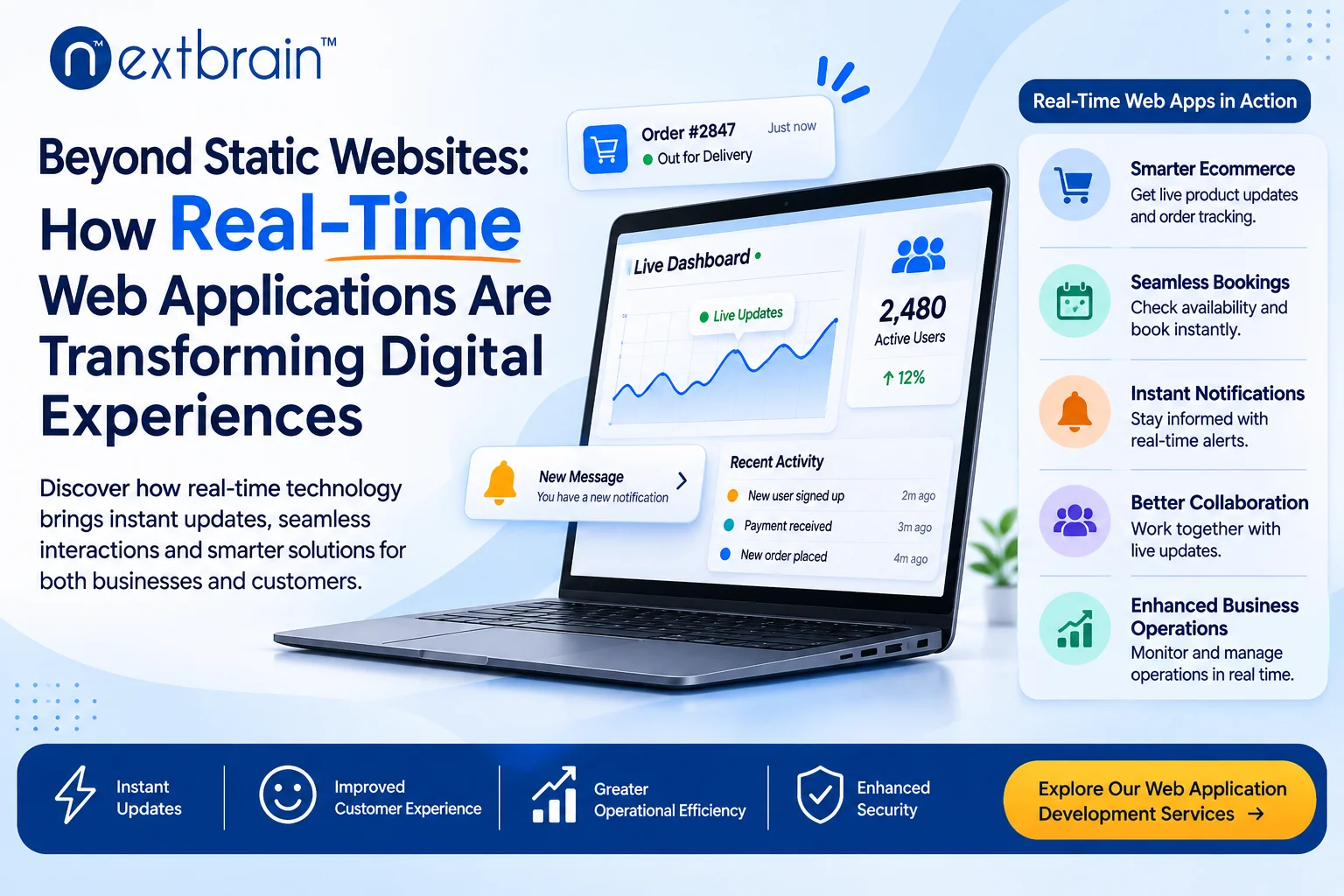
The way people interact with websites has changed significantly. Users no longer want to refresh a page repeatedly to check an order status, wait for a booking confirmation, or see whether new information is available. They expect digital platforms to respond quickly, display updated information and make everyday interactions feel effortless.
This shift has encouraged businesses to move beyond traditional websites and adopt more interactive digital platforms. Modern web application development services help organisations create experiences where users can access information, complete tasks and receive updates without unnecessary delays.
Real-time functionality is not limited to messaging applications or social media platforms. It is becoming valuable across ecommerce, healthcare, logistics, education, financial services and enterprise operations. From tracking a delivery to monitoring business activity, these applications are changing what users expect from digital services.
What Makes a Web Application Real-Time?
A traditional website generally displays information that changes when a user loads or refreshes a page. A real-time web application, on the other hand, can receive and display new information as events occur, often without requiring manual refreshes.
For example, consider an online shopping platform. A customer places an order and expects to see its status change as it moves from confirmation to processing, dispatch and delivery. A real-time application can communicate these updates as they become available.
The same principle applies to collaborative tools, appointment platforms, inventory systems and customer dashboards.
Technologies such as WebSockets, Server-Sent Events (SSE), APIs and event-driven systems help applications exchange information between servers and browsers. The appropriate approach depends on how frequently data changes, how quickly updates must appear and how many users need access.
How Real-Time Applications Improve Everyday Customer Experiences
The biggest advantage of real-time functionality is that it reduces the gap between an event happening and a user knowing about it.
Here are some practical examples of how this improves digital experiences.
1. Faster and More Transparent Ecommerce Experiences
Online shoppers want more than product listings and payment options. They also expect accurate stock information, smooth checkout processes and timely order updates.
Real-time functionality can help ecommerce platforms:
- Display updated product availability.
- Reflect changes in shopping cart quantities.
- Provide payment and order confirmation updates.
- Show delivery progress when tracking information is available.
- Notify customers about important changes to their orders.
For instance, if a product becomes unavailable while a customer is shopping, an updated inventory system can help prevent the customer from proceeding with an order that cannot be fulfilled.
These improvements reduce uncertainty and make online shopping more convenient.
2. Better Communication Through Instant Notifications
Customers often become frustrated when they have to repeatedly check a website for important information.
Real-time notifications can communicate relevant updates about appointments, payments, bookings, account activity and service requests.
Consider an online appointment platform. When a booking is confirmed, the application can update the customer's account and send a notification. If the appointment time changes, the platform can communicate that update without requiring the customer to contact support.
Notifications should remain relevant and useful. Sending too many alerts can create the opposite experience and encourage users to disable them.
3. More Convenient Online Booking and Scheduling
Booking platforms depend on accurate availability. This is particularly important for hotels, healthcare providers, transportation services, event organisers and other businesses that manage time-sensitive reservations.
When availability is updated across the application, customers can see which slots or services are currently available.
For example, if two customers attempt to reserve the same appointment slot, the system should validate availability before confirming either booking. This requires more than simply updating the screen. The application must also handle concurrent requests correctly on the server.
A well-designed booking application can make reservations more reliable while reducing unnecessary communication between customers and service teams.
Why Businesses Are Adopting Real-Time Web Applications
Real-time functionality also has a significant role behind the scenes. Businesses increasingly rely on connected systems to coordinate employees, customers, suppliers and operational information.
4. Improved Visibility Across Business Operations
Many organisations use separate systems for customer management, inventory, finance, logistics and internal communication. When these systems do not exchange information efficiently, employees may work with outdated records or spend time manually checking updates.
Integrated web applications can bring relevant information into a central interface.
For example, a logistics dashboard could display vehicle locations, delivery progress and operational alerts. A manufacturing application could help supervisors monitor inventory movement, workforce activities and service requests.
When information is updated consistently, managers can identify issues earlier and make decisions using more current operational data.
5. More Effective Team Collaboration
Teams working across different locations need reliable access to shared information. Traditional processes involving spreadsheets, email attachments and repeated status checks can make collaboration difficult.
Real-time web applications can support:
- Shared project dashboards.
- Live task status updates.
- Collaborative document editing.
- Team activity notifications.
- Centralised communication and reporting.
When one team member updates a task, other authorised users can see the change without waiting for a new document or email.
This is particularly useful for distributed teams, service organisations and businesses managing multiple projects simultaneously.
6. More Responsive Customer Support
Customer support teams need access to accurate information to resolve requests efficiently.
A connected customer portal can display ticket progress, service updates, account information and communication history. Support agents can also work with updated records rather than relying on information gathered through separate channels.
For example, when a customer submits a service request, the application can generate a reference number and display its progress. As the support team changes the ticket status, the customer can see the latest available information.
This creates a clearer communication process for both customers and employees.
The Technology Behind Real-Time Web Applications
A smooth user experience depends on several technical components working together. The technology selected should reflect the application's requirements rather than simply following the latest development trend.
APIs and System Integrations
Application Programming Interfaces (APIs) allow different software systems to exchange information. A web application may use APIs to connect with payment gateways, CRM platforms, ERP systems, inventory tools and external services.
For example, an ecommerce application can connect its order management system with a payment provider and inventory platform. This allows information to move between different parts of the business without requiring employees to update every system manually.
WebSockets and Server-Sent Events
WebSockets provide two-way communication between a browser and a server through a persistent connection. This makes them useful for chat platforms, collaborative tools and applications that require frequent interactive updates.
Server-Sent Events allow a server to send updates to a browser over an HTTP connection. They can be suitable for dashboards, notifications and monitoring interfaces where information mainly flows from the server to the user.
Not every application requires a persistent connection. Standard API requests, periodic polling or background updates may be sufficient when immediate responses are not essential.
Cloud Infrastructure and Scalable Architecture
As an application attracts more users, its infrastructure must support increasing requests and data processing requirements.
Cloud infrastructure can provide resources that businesses scale according to application demand. A well-planned architecture also considers database performance, caching, monitoring, security and failure recovery.
Scalability should be considered during the initial planning stage, especially when the application is expected to support multiple locations, customer groups or business operations.
Challenges Businesses Should Consider
Although real-time functionality offers several advantages, implementing it without proper planning can introduce technical and operational challenges.
Data consistency: Multiple users or systems may update the same information simultaneously. Applications need reliable validation and conflict-handling mechanisms.
Security and access control: Real-time updates should only reach authorised users. Authentication, permissions, encryption and secure API communication are important safeguards.
Performance: Frequent updates can increase server and network workloads. Developers need to identify which information genuinely requires immediate updates.
Reliability: Network interruptions and server failures can affect live features. Applications should account for reconnection, error handling and recovery.
User experience: Continuous updates should make an application easier to use, not overwhelm people with notifications, animations or changing information.
Addressing these considerations early helps businesses avoid unnecessary complexity and build applications that remain reliable as requirements evolve.
How to Decide Whether Your Business Needs Real-Time Functionality
Not every web application needs live updates. A company website, informational portal or simple content management platform may work perfectly well without them.
Real-time features become more valuable when:
- Customers frequently check changing information.
- Employees depend on shared operational data.
- Multiple users need to collaborate simultaneously.
- Delays in updates affect bookings, transactions or service delivery.
- Different business systems need to exchange information regularly.
Businesses should begin by identifying the user problems they want to solve. From there, they can decide which information needs immediate updates and which can be refreshed periodically.
This approach helps keep development focused on practical outcomes rather than adding features simply because the technology is available.
The Future of Digital Experiences
The evolution of web applications is not just about making websites faster or adding more interactive elements. It is about creating connected digital environments where information moves between people, platforms and business processes more effectively.
As customers become accustomed to convenient online services, expectations around transparency, responsiveness and accessibility will continue to grow. Businesses that understand these expectations can use real-time functionality to improve customer journeys while making internal operations more connected.
The most successful applications will not necessarily be the ones with the greatest number of features. They will be the ones that use the right technology to solve genuine problems, protect user information and deliver dependable experiences.
Ultimately, moving beyond static websites means thinking about digital experiences as ongoing interactions rather than one-way presentations of information.
Frequently Asked Questions
1. What is a real-time web application?
A real-time web application is a platform that can receive and display information as events occur, often without requiring users to refresh the page. Examples include live tracking dashboards, online chat platforms, booking systems and collaborative applications.
2. How do real-time web applications improve customer experience?
They provide timely updates about transactions, bookings, product availability and service requests. This reduces uncertainty, improves transparency and helps customers complete tasks more conveniently.
3. Which technologies are used to build real-time web applications?
Common technologies include WebSockets, Server-Sent Events, APIs, event-driven architecture and cloud infrastructure. The right combination depends on the application's functionality, performance requirements and expected user activity.
4. Are real-time web applications suitable for small businesses?
Yes. Small businesses can use real-time functionality for appointment scheduling, order tracking, customer notifications and inventory updates. The features should be selected according to actual business needs and budget.
5. Are real-time web applications secure?
They can be designed securely using authentication, role-based access control, encrypted communication, input validation and regular security testing. Security must be considered throughout development, not added only after deployment.