Sign up with Google
 Sign in with Zoho
.webp)
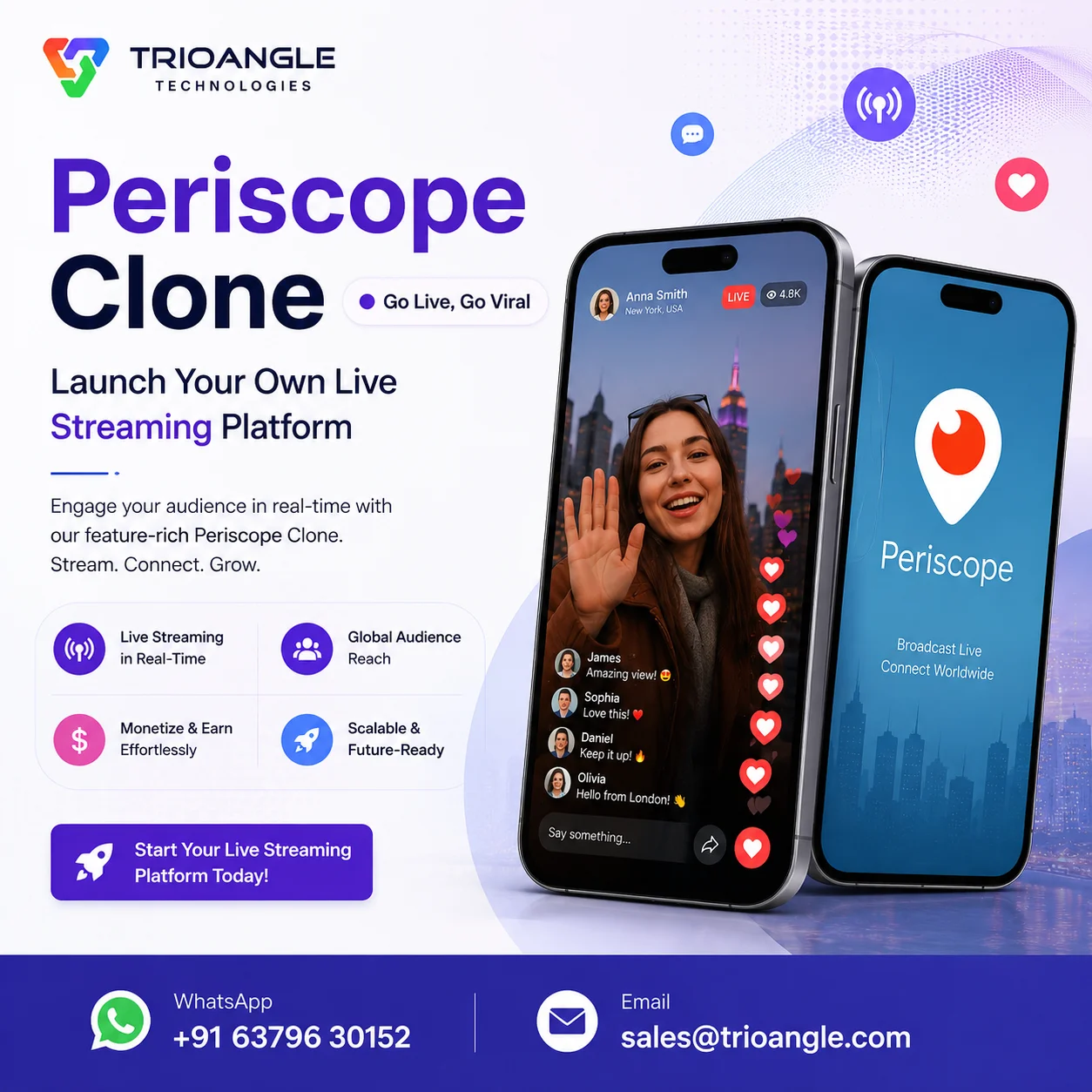
Periscope was discontinued in 2021. This led people to search for other options for watching and posting live streams, and companies began creating a replacement for it. As a new business owner, you might think about building a Periscope clone to take advantage of this increasing demand.
So, the question worth asking in 2026 isn’t whether the market exists, it’s whether building a Periscope clone now is the better option for startups.
Why Periscope Didn't Survive the Live Streaming Explosion
Periscope built something that worked. What it couldn't build was an existing relationship with users. Facebook, Instagram, and YouTube had years of daily habits behind them before live streaming was even part of the conversation.
Nobody wants another social network unless their friends move there too.
With major players introducing live streaming services to their apps, users no longer felt compelled to download a separate app only to view live broadcasts. This, together with difficulties with platform upkeep, monetization, and growing competition, ultimately led to its shutdown.
What Does Building a Periscope Clone Really Mean Today?
Consumer live streaming is a crowded market. Building a Periscope clone doesn't mean you're trying to launch Periscope 2.0. It usually means you're taking a proven live streaming model and applying it to a different audience or problem.
What you need as a startup founder is reliable infrastructure that supports live streaming features like:
- User registration
- Live broadcasting
- Comments
- Notifications
- Moderation
- Replay
- Reporting
- Analytics
A Periscope clone script gives entrepreneurs a functioning live streaming platform from the start. Instead of redesigning existing systems, they can focus on building the platform around a specific audience or business strategy.
That shift might seem small at first. But it changes the entire approach.
You no longer have to worry about building the platform itself. The entry barriers are much lower. Your focus shifts to finding the right audience and creating a product they'll actually want to use.
Why Building a Niche Live Streaming App Is Better in 2026
There’s no need for the internet to have yet another platform designed to entertain everyone. What it needs are better platforms that solve specific problems.
This is where many startups are getting space to expand.
Consider live shopping for independent brands. Customers don't just want to see a product page. They are looking for demonstrations, immediate answers to their questions, and confidence before purchasing.
The same applies to education. Recorded lessons are good for some topics, but live lessons give students the opportunity to ask questions, interact with the teacher, and stay engaged.
The healthcare sector has discovered the same benefits. Live sessions are now being used in clinics for patient education. Webinars with financial advisors. Live bidding is the basis of auction platforms. Real estate firms host virtual real estate tours for buyers that are unable to visit the actual property.
These businesses aren't trying to become social networks.
It's a live video that enhances the experience they already provide.
That's a much better base than relying on millions of people downloading another general-purpose streaming app.
Why Now Is a Better Time to Build a Periscope Clone Than a Few Years Ago
Consumer behavior has already changed, where people no longer hesitate to join live sessions.
They attend virtual events, shop during livestreams, and watch product launches.
They ask questions in real time instead of sending emails.
It’s not just a prediction. It’s backed by real data. According to Grand View Research, the global live commerce market, valued at $172.86 billion in 2025, is projected to reach $2.54 trillion by 2033. And that growth isn’t random. The key drivers are rising demand for interactive shopping experiences, the continued rise of social media, and widespread mobile adoption.
In other words, startups no longer need to convince people that live interaction is valuable.
That work has already been done.
The opportunity today isn't creating demand.
It's building better experiences around demand that already exists.
That's a much easier starting point than trying to invent entirely new behavior.
What Startups Should Look for Before Choosing a Periscope Clone
It's easy to compare feature lists. The harder part is understanding how the platform will hold up as your business grows. Before making a decision, ask a few practical questions.
- Can it support thousands of viewers if your audience grows?
- Does it include moderation tools for live conversations?
- Can broadcasts be saved and replayed later?
- Does it support private as well as public streaming?
- Will it integrate with payment systems if you decide to monetize?
- Can the interface be customized enough that users recognize your brand instead of someone else's template?
These questions become much more important after launch than they do during development. Choosing the cheapest option often feels like saving money until the platform needs to evolve.
Then those shortcuts become expensive.
Conclusion: Is Building a Periscope Clone Worth It?
Building a Periscope clone is still worth it. Just not for the reasons it was ten years ago.
The opportunity isn't another social platform competing for everyone's attention. It's creating focused products where live interaction genuinely improves the experience.
A Periscope clone script doesn't guarantee success.
It gives you a faster way to build the infrastructure so you can spend more time solving the business problem that actually matters.
Because that's what startups are really building.
Not live streaming apps.
Products that become better because people can connect in real time.
Frequently Asked Questions About Periscope Clone
Q1. What exactly is a Periscope clone?
A Periscope clone is a white label live streaming platform that's already built. You get broadcasting, real-time chat, notifications, and monetization features without starting from scratch or waiting six months for a development team to finish.
Q2. Is there still a market for live streaming apps in 2026?
Yes. The global live streaming market is growing strongly in 2026 and is projected to be $345.13 billion by 2030. The majority of the increase is coming from industries such as education, telemedicine, and live commerce.
Q3. What features should a Periscope clone include?
Low-latency broadcasting, viewer engagement tools like polls and virtual gifting, real-time chat, trending stream pages, in-app wallets, and advanced admin dashboards are some of the key features of a Periscope clone.
Q4. What are the biggest mistakes startups make when launching a live streaming platform?
Going broad instead of finding a niche, skipping live chat and engagement tools, as if it were a television broadcast, and delaying monetization until the platform feels “ready.” These three decisions are often what cause Periscope clone startups to fail.
Q5. How much does it realistically cost to launch a Periscope clone?
The cost of custom development is usually $100,000 to $250,000, not including maintenance. By comparison, the Periscope clone script costs start at $1,000 and $10,000 for a base package and $20,000 to $40,000 for a launch-ready version.
WhatsApp - +91 63796 30152
Email ID - [email protected]