Sign up with Google
 Sign in with Zoho

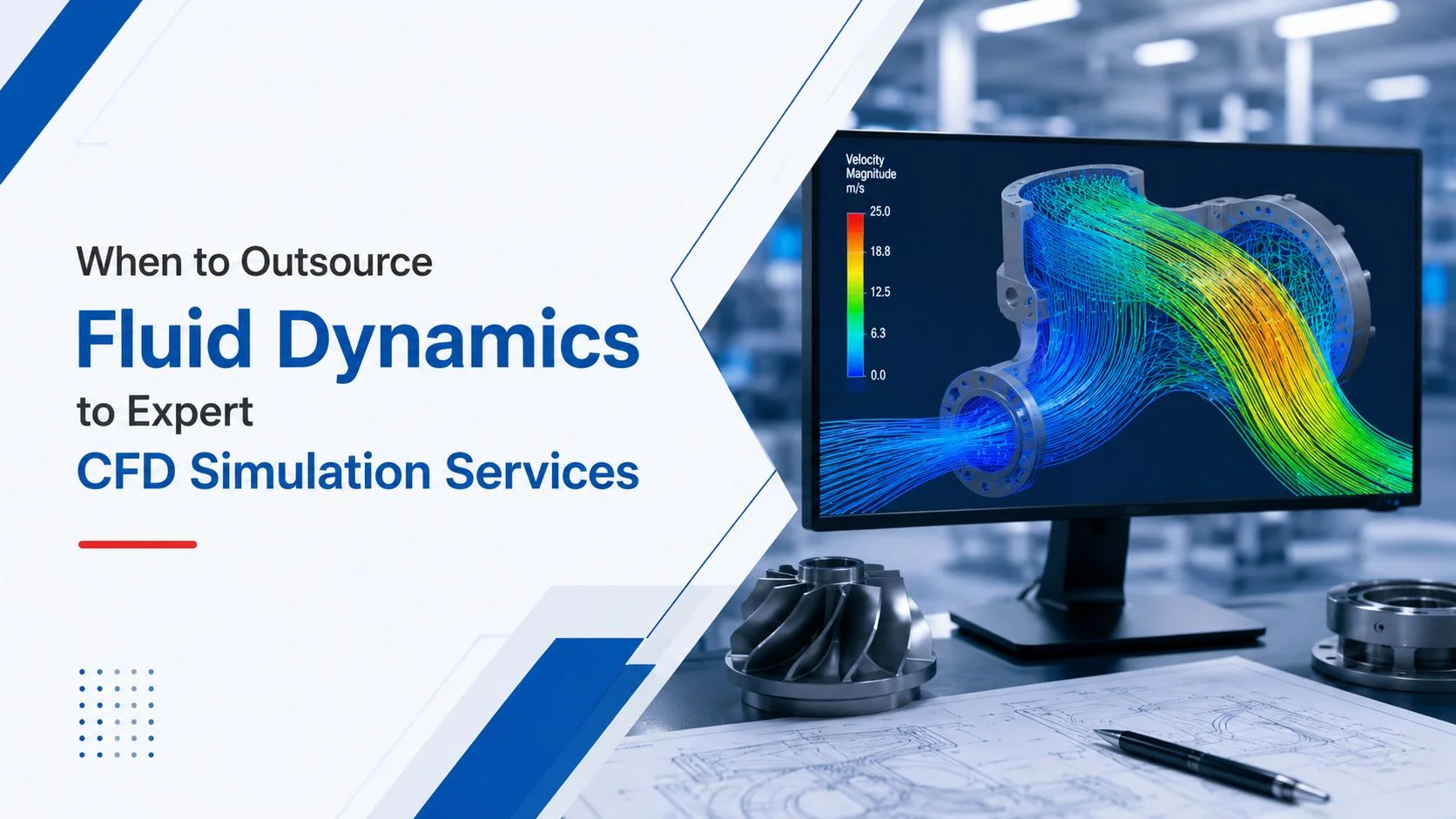
In modern engineering, product performance is often determined long before a physical prototype is built. Whether designing an aircraft cooling duct, optimizing an electric vehicle battery enclosure, improving a medical device's fluid pathway, or reducing pressure losses in an industrial pump, understanding fluid behavior early in development can significantly reduce risk, cost, and time-to-market.
Computational Fluid Dynamics (CFD) has become an essential engineering discipline for organizations seeking to validate designs before manufacturing. However, building an in-house CFD capability requires specialized expertise, advanced software, high-performance computing resources, and rigorous validation practices. For many organizations, partnering with providers of CFD simulation services offers a more efficient and strategically flexible approach.
Rather than replacing internal engineering teams, external simulation specialists complement existing expertise by solving complex fluid dynamics challenges that demand advanced modeling techniques and industry-specific experience.
Why CFD Simulation Services Matter in Modern Product Development
Short answer: They enable engineers to predict fluid behavior digitally, reducing design uncertainty before physical testing.
Today's products operate in increasingly demanding environments where airflow, heat transfer, pressure distribution, turbulence, and multiphase flow directly influence reliability and performance.
Professional CFD simulation services help engineering teams:
- Optimize product performance
- Reduce physical prototype iterations
- Improve thermal management
- Validate design concepts
- Support regulatory testing
- Shorten development cycles
- Lower manufacturing costs
Instead of relying solely on trial-and-error testing, organizations can evaluate multiple design alternatives through simulation before committing to production.
When Should Companies Outsource CFD Simulation Services?
Short answer: Outsourcing is most valuable when projects require specialized expertise, advanced computational resources, or accelerated development timelines.
Several scenarios make external simulation support particularly beneficial.
Complex Physics Beyond Internal Expertise
Many engineering teams routinely perform basic simulations but encounter projects involving:
- Turbulent flow
- Multiphase fluids
- Combustion
- Conjugate heat transfer
- Compressible flow
- Fluid-structure interaction
These analyses require advanced numerical methods, mesh optimization, and validation techniques that may not exist internally.
Specialized CFD simulation services provide experienced analysts who regularly solve these high-complexity engineering problems.
Product Development Deadlines
Engineering schedules rarely slow down because simulation resources are unavailable.
During peak development periods, outsourcing allows organizations to maintain project momentum without expanding permanent engineering teams.
This flexibility is particularly valuable for manufacturers managing multiple concurrent product programs.
How CFD Supports Product Development Solutions
Short answer: Simulation improves design quality while reducing engineering risk.
Modern product development solutions increasingly integrate simulation into every stage of engineering rather than treating it as a final validation step.
Typical applications include:
- Aerodynamic optimization
- Thermal management
- Cooling system design
- HVAC performance
- Pump and valve optimization
- Battery cooling
- Medical device flow analysis
- Process equipment design
By identifying performance issues early, simulation minimizes expensive redesigns later in development.
For example, an aerospace manufacturer may evaluate multiple cooling duct geometries digitally before machining a single prototype, significantly reducing both development cost and engineering lead time.
Why CFD and FEA Often Work Together
Short answer: Many engineering challenges involve both fluid flow and structural behavior.
Although fluid dynamics and structural analysis are separate disciplines, many products require integrated evaluation.
This is where FEA simulation services complement CFD analysis.
Combined simulation helps engineers understand how:
- Fluid pressure affects structural deformation
- Temperature changes influence material behavior
- Vibration impacts flow characteristics
- Thermal expansion alters component performance
Applications include:
- Aircraft components
- Pressure vessels
- Heat exchangers
- Automotive battery systems
- Medical equipment
- Industrial processing machinery
Using CFD and FEA together provides a more comprehensive understanding of real-world operating conditions.
Practical Considerations Before Outsourcing
Successful simulation projects begin with clearly defined engineering objectives.
Organizations should establish:
Performance Goals
Examples include:
- Reduce pressure drop
- Improve airflow uniformity
- Lower operating temperatures
- Increase cooling efficiency
- Minimize energy consumption
Well-defined objectives produce more actionable simulation results.
Available Engineering Data
Simulation accuracy depends heavily on input quality.
Useful project information includes:
- CAD models
- Material properties
- Operating conditions
- Boundary conditions
- Experimental measurements
- Performance requirements
Complete engineering data reduces modeling assumptions and improves confidence in simulation outcomes.
Validation Strategy
Numerical simulation should complement not replace engineering validation.
Experienced providers compare simulation predictions with:
- Laboratory testing
- Wind tunnel measurements
- Field performance
- Historical engineering data
Validation ensures simulation results accurately represent real operating conditions.
Common Mistakes When Using CFD
Even experienced organizations encounter recurring challenges.
Treating CFD as a Design Verification Tool Only
Simulation creates the greatest value when introduced early during concept development rather than after design decisions have already been finalized.
Oversimplifying Boundary Conditions
Highly accurate models still produce misleading results if operating conditions do not reflect actual product behavior.
Careful definition of boundary conditions is essential.
Focusing Solely on Software
Successful CFD projects depend more on engineering expertise than software capabilities.
Model setup, mesh quality, solver selection, convergence assessment, and result interpretation all require experienced analysts.
Ignoring Cross-Disciplinary Collaboration
Simulation delivers greater value when CFD specialists collaborate with design engineers, manufacturing teams, testing groups, and systems engineers throughout product development.
Industry Perspective: Simulation as a Strategic Engineering Capability
Across aerospace, automotive, medical devices, and industrial manufacturing, simulation is evolving from a specialized engineering activity into a core component of digital product development. Organizations increasingly integrate CFD, structural analysis, systems engineering, and lifecycle management to make design decisions earlier and with greater confidence.
Engineering service providers such as 3HTi reflect this broader industry trend by offering simulation expertise across computational fluid dynamics, structural analysis, and engineering consulting. Its Simulation Services illustrate how external engineering specialists can support organizations requiring advanced simulation capabilities without expanding permanent internal resources.
Conclusion
As products become more sophisticated and development schedules continue to tighten, simulation has become an essential competitive advantage rather than an optional engineering activity.
Professional CFD simulation services enable manufacturers to solve complex fluid dynamics challenges, improve product performance, reduce development risk, and accelerate innovation without the overhead of building specialized internal teams. When integrated with broader product development solutions and complementary FEA simulation services, CFD provides engineering organizations with deeper insights into product behavior before physical prototypes are built.
The organizations that achieve the greatest value from simulation are those that treat it as an integral part of product development using digital engineering to guide smarter design decisions from concept through production.
FAQs
1. What are CFD simulation services?
CFD simulation services use computational methods to analyze fluid flow, heat transfer, pressure distribution, and related physical phenomena, helping engineers optimize product performance before manufacturing or physical testing.
2. When should companies outsource CFD simulation services?
Organizations should consider outsourcing when projects involve complex fluid dynamics, specialized expertise, limited internal resources, tight development schedules, or advanced computational requirements beyond existing engineering capabilities.
3. How do CFD simulation services improve product development?
By predicting product performance early, CFD helps reduce prototype iterations, optimize designs, identify potential issues, improve thermal efficiency, and shorten overall development timelines while lowering engineering costs.
4. What industries benefit most from CFD simulations?
Aerospace, automotive, medical devices, life sciences, energy, industrial manufacturing, electronics, HVAC, and process industries commonly use CFD to solve complex fluid flow and thermal management challenges.
5. How are CFD and FEA simulation services different?
CFD focuses on fluid flow and heat transfer, while FEA simulation services analyze structural behavior, stress, deformation, and vibration. Many engineering projects benefit from combining both methods for comprehensive product evaluation.
6. What information is needed before starting a CFD project?
Typical inputs include CAD geometry, material properties, operating conditions, boundary conditions, performance objectives, and any available experimental or field data to improve simulation accuracy and validation.
7. Can CFD simulations replace physical testing?
No. CFD complements physical testing by identifying design improvements early and reducing the number of prototypes required. Final validation typically combines simulation results with laboratory or field testing for greater confidence.