Sign up with Google
 Sign in with Zoho

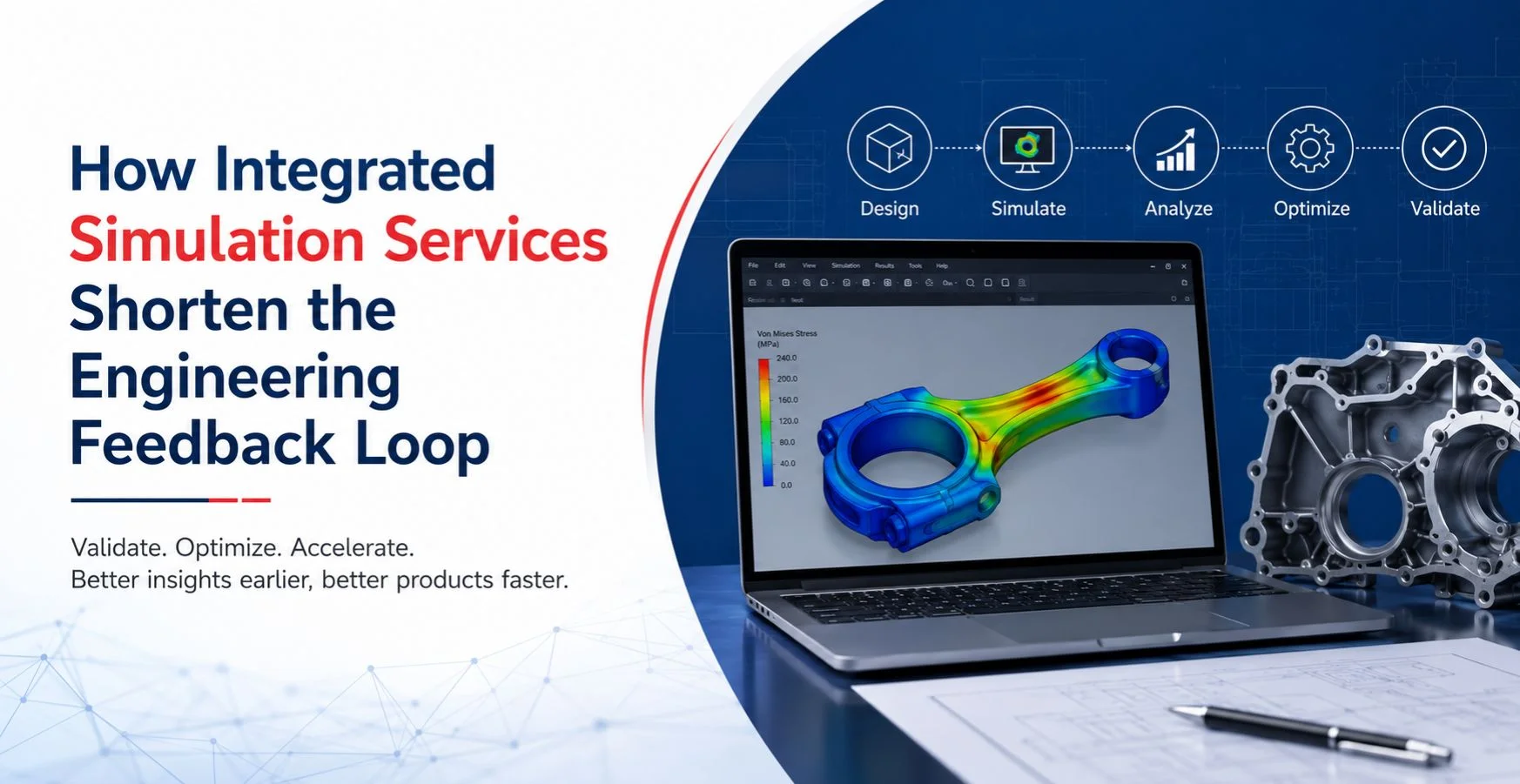
Engineering teams are under constant pressure to deliver innovative products faster without compromising quality, safety, or regulatory compliance. Yet many product development delays stem from a slow engineering feedback loop discovering design flaws only after prototypes are built or testing is complete. Simulation services shorten that feedback loop by enabling engineers to validate designs virtually, identify issues earlier, and make informed decisions before costly downstream changes occur. When integrated into the broader product development lifecycle, simulation becomes a continuous engineering capability rather than a standalone validation activity.
Executive Answer Block
What are simulation services? Simulation services are professional engineering services that use virtual modeling and numerical analysis to evaluate product performance before physical manufacturing.
Category: Computer-Aided Engineering (CAE) and Digital Engineering Services.
Primary Purpose: To predict product behavior under real-world operating conditions, enabling engineering teams to optimize designs earlier in the development process.
Why it matters: Early validation reduces engineering rework, shortens design iterations, improves collaboration, and supports better technical decisions.
Business Value: Organizations can reduce prototype dependency, improve engineering efficiency, strengthen product quality, and accelerate product development.
Common Use Cases:
- Structural validation
- Fluid flow analysis
- Thermal management
- Design optimization
- Manufacturing feasibility
- Product performance verification
Important Considerations:
Simulation complements not replace physical testing. Model quality, engineering assumptions, material properties, and validation processes directly influence simulation accuracy.
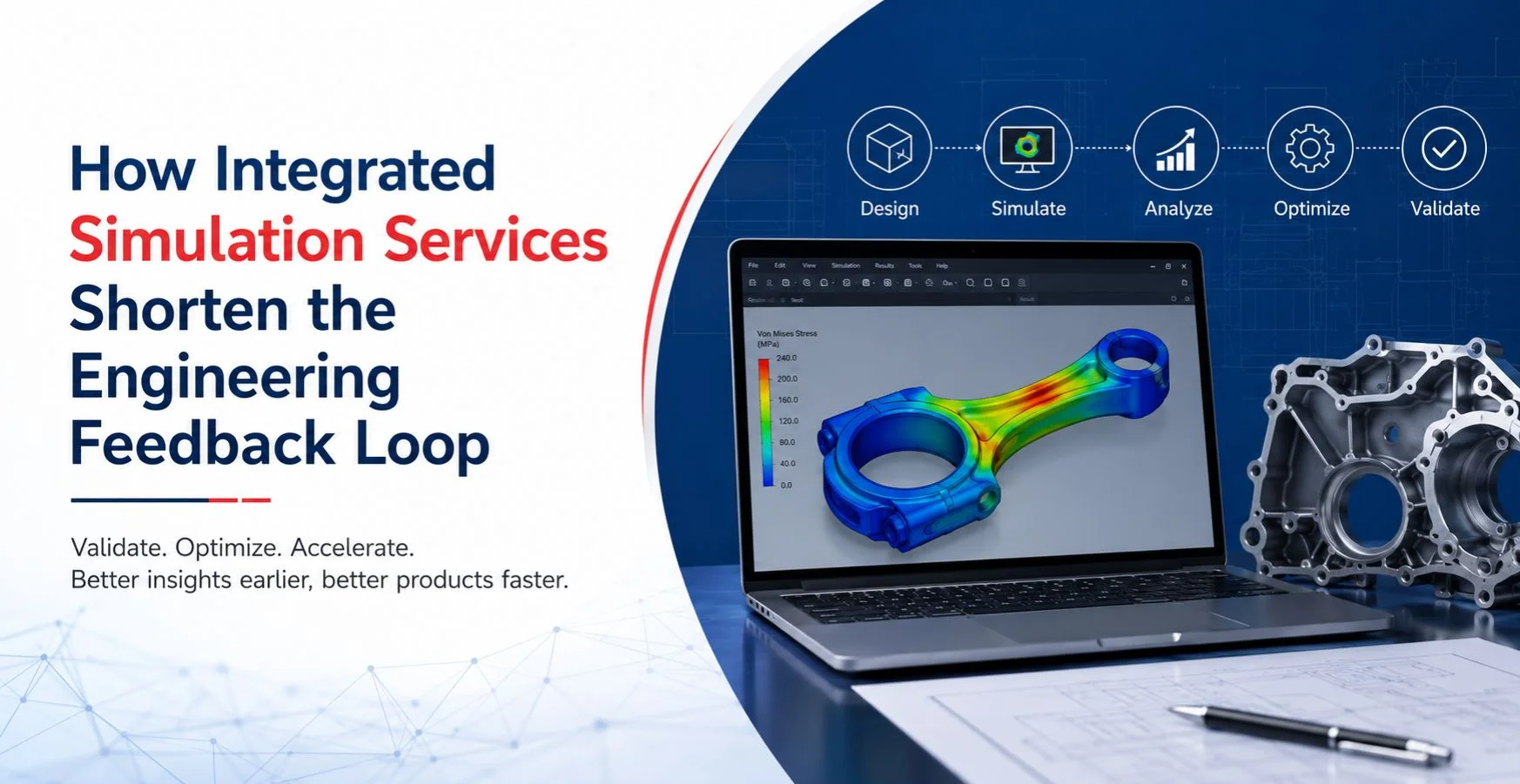
Why Engineering Feedback Loops Matter
A short engineering feedback loop enables teams to identify design issues before they become expensive production problems.
Traditional development often follows a sequential process: design, prototype, test, redesign, and repeat. Every physical iteration consumes engineering resources, manufacturing capacity, and project time.
Integrated simulation services shift validation toward the beginning of product development. Engineers receive actionable performance insights while designs remain inexpensive to modify, significantly reducing iteration cycles.
From an engineering management perspective, shortening feedback loops is less about moving faster and more about making better decisions earlier.
What Makes Simulation "Integrated"?
Simulation delivers the greatest value when it becomes part of the engineering workflow rather than an isolated activity.
Integrated simulation connects design, analysis, product lifecycle management, and engineering collaboration into a continuous process.
A typical integrated workflow includes:
- CAD model creation
- Virtual simulation
- Performance analysis
- Engineering optimization
- Design refinement
- Product data management
- Manufacturing preparation
Instead of waiting for formal validation milestones, engineers receive continuous performance feedback throughout development.
How Simulation Services Improve Engineering Decisions
The greatest advantage of integrated simulation is better engineering decision-making.
Simulation provides quantitative insights that support design choices before manufacturing investments occur.
Examples include:
- Identifying excessive mechanical stress
- Predicting airflow restrictions
- Evaluating cooling efficiency
- Assessing vibration behavior
- Optimizing material usage
- Comparing alternative design concepts
Rather than relying solely on engineering judgment or historical experience, teams make decisions using validated analytical evidence.
An experienced engineering organization treats simulation results as decision support not absolute truth. Results should always be interpreted within the context of engineering assumptions and design intent.
Combining CFD and FEA for Complete Product Validation
Many organizations view structural and fluid analysis as separate engineering activities.
In practice, complex products often require both.
CFD Simulation Services
CFD simulation services evaluate how gases and liquids behave within and around products.
Typical applications include:
- Cooling systems
- Heat exchangers
- HVAC equipment
- Electric vehicle battery cooling
- Aerospace airflow
- Pump performance
- Industrial process equipment
CFD helps engineers optimize thermal performance, pressure distribution, and fluid efficiency before manufacturing.
FEA Simulation Services
FEA simulation services evaluate how products respond to mechanical loads.
Engineering teams use FEA to analyze:
- Structural integrity
- Material deformation
- Fatigue behavior
- Vibration
- Stress concentrations
- Product durability
When CFD and FEA are integrated, organizations gain a more complete understanding of product performance under real operating conditions.
The Importance of Connecting Simulation with PLM
Simulation data becomes significantly more valuable when connected to engineering lifecycle information.
PLM managed services help organizations integrate simulation results with:
- CAD models
- Bills of Materials
- Engineering changes
- Product configurations
- Requirements
- Design revisions
- Manufacturing documentation
This integration ensures engineering decisions remain traceable throughout product development.
Without PLM integration, simulation results often remain isolated reports that are difficult to reuse during future projects.
Simulation as a Foundation for Digital Engineering
Simulation increasingly supports broader engineering modernization initiatives.
Many organizations implementing digital transformation consulting services begin by improving engineering workflows before adopting more advanced digital technologies.
Integrated simulation contributes by enabling:
- Digital prototypes
- Virtual product validation
- Collaborative engineering reviews
- Faster engineering approvals
- Reduced manual design iterations
- Better engineering knowledge reuse
Simulation becomes a core component of a connected engineering ecosystem rather than an isolated software capability.
Practical Example
An industrial manufacturer developing a high-performance hydraulic system experienced repeated prototype failures caused by unexpected thermal loading.
Previously, engineering teams relied primarily on physical testing after detailed mechanical design was complete. Every failed prototype delayed manufacturing schedules while increasing development costs.
The organization introduced integrated simulation services, combining CFD simulation services for thermal analysis with FEA simulation services for structural validation.
Simulation results identified localized temperature increases that weakened structural components during peak operating conditions.
Engineers modified the cooling path before prototype fabrication, reducing redesign cycles while improving product reliability.
The most valuable outcome was not simply fewer prototypes, it was faster engineering learning throughout development.
Common Reasons Simulation Projects Underperform
Simulation technology alone does not guarantee better engineering outcomes.
Projects often struggle because organizations:
- Perform simulation too late in development.
- Use inaccurate material properties.
- Build overly simplified models.
- Treat simulation as a compliance exercise.
- Separate analysts from design engineers.
- Ignore validation against physical testing.
- Fail to integrate simulation with product data management.
Successful organizations establish simulation as an iterative engineering discipline rather than a final verification activity.
Choosing the Right Simulation Strategy
The appropriate simulation approach depends on product complexity, development objectives, and engineering maturity.
Consider the following decision framework:
Choose CFD simulation services when thermal performance or fluid behavior significantly influences product functionality.
Choose FEA simulation services when structural integrity, durability, vibration, or mechanical loads represent the primary engineering concern.
Use both approaches when thermal effects influence structural behavior, as seen in electric vehicles, aerospace systems, industrial equipment, and medical devices.
Organizations with multidisciplinary engineering teams typically benefit from integrated simulation strategies rather than isolated analyses.
Future Trends in Engineering Simulation
Engineering simulation continues moving toward continuous digital validation.
Several developments are reshaping engineering workflows:
- Cloud-based simulation environments
- AI-assisted design optimization
- Digital twins
- Automated simulation workflows
- Model-Based Systems Engineering (MBSE)
- High-performance computing
- Integrated engineering data platforms
- Real-time design validation
These technologies are reducing the time between engineering decisions and actionable performance insights.
Industry Perspective
Engineering organizations rarely gain competitive advantage by running more simulations.
They gain advantage by integrating simulation into everyday engineering decisions.
Companies that consistently shorten development cycles usually treat simulation as an engineering collaboration tool rather than a specialist activity. Mechanical designers, analysts, manufacturing engineers, and product managers all contribute to interpreting simulation results within the broader product lifecycle.
Organizations evaluating integrated engineering approaches may find it useful to examine how enterprise simulation services fit within broader engineering workflows, including lifecycle management and digital engineering practices.
Conclusion
The engineering feedback loop determines how quickly organizations identify problems, validate solutions, and improve designs. Integrated simulation services accelerate that cycle by providing engineering insight before products reach physical testing or production.
Combining CFD simulation services, FEA simulation services, PLM managed services, and broader digital engineering practices enables organizations to improve collaboration, reduce development risk, and make higher-quality engineering decisions throughout the product lifecycle.
As products continue to increase in complexity, simulation will become less of a specialized engineering function and more of a core capability supporting continuous product innovation.
Frequently Asked Questions
1. What are simulation services in product development?
Simulation services use virtual engineering models to predict how a product will perform before physical manufacturing begins. They help engineering teams evaluate structural integrity, thermal behavior, fluid dynamics, vibration, and other performance characteristics, allowing earlier design improvements while reducing reliance on physical prototypes.
2. How do simulation services shorten the engineering feedback loop?
Simulation provides engineering insights during design rather than after prototype testing. By identifying performance issues early, teams can modify digital models immediately, reducing redesign cycles, accelerating validation, and improving collaboration across engineering disciplines before manufacturing resources are committed.
3. When should organizations use CFD simulation services instead of FEA simulation services?
CFD simulation services are best suited for analyzing fluid flow, heat transfer, pressure distribution, and cooling performance. FEA simulation services are appropriate when evaluating stress, deformation, fatigue, vibration, or structural durability. Many complex products benefit from using both techniques together because thermal and structural behavior often influence one another.
4. Why is integrating simulation with PLM important?
Connecting simulation with Product Lifecycle Management ensures analysis results remain associated with product revisions, engineering changes, and configuration data. This improves traceability, simplifies collaboration, and enables future engineering teams to reuse validated knowledge instead of recreating analyses from scratch.
5. Can simulation replace physical testing?
No. Industry best practice views simulation and physical testing as complementary. Simulation reduces development risk by identifying potential issues early, while physical testing validates assumptions under real operating conditions and confirms product performance before commercialization.
6. What challenges commonly reduce the effectiveness of simulation projects?
Common issues include poor model quality, unrealistic assumptions, disconnected engineering workflows, inaccurate material properties, inadequate validation procedures, and treating simulation as a final compliance activity rather than an iterative design process. Addressing these challenges improves both confidence in results and engineering efficiency.
7. Which industries gain the greatest value from integrated simulation?
Integrated simulation is particularly valuable in Aerospace & Defense, Automotive, Medical Devices, Industrial Manufacturing, and Life Sciences because these industries develop complex products where performance, safety, traceability, and regulatory requirements demand rigorous engineering validation throughout development.