Sign up with Google
 Sign in with Zoho

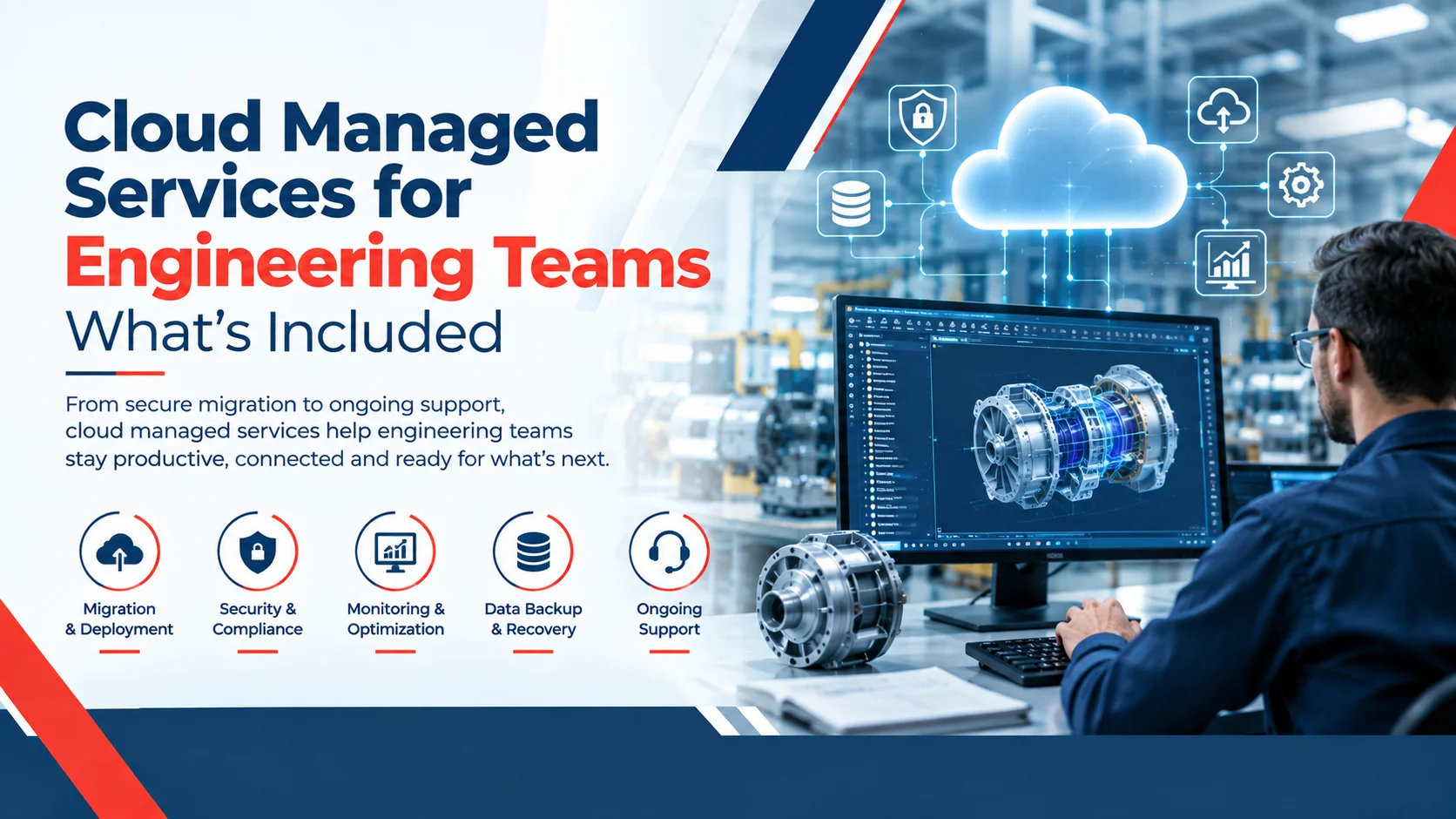
Cloud managed services for engineering teams go beyond hosting servers or responding to support tickets. A properly scoped service can cover cloud monitoring, data migration, security and governance, backup and recovery, performance management, environment maintenance, and ongoing operational support. For engineering organizations running CAD, PDM, PLM, simulation, or collaboration workloads, the scope must also account for application dependencies, intellectual property, engineering workflows, and system availability.
NIST defines cloud computing as on-demand access to a shared pool of configurable computing resources, including networks, servers, storage, applications, and services.
The practical question for an engineering leader is therefore not simply “Should we move to the cloud?” but “What operational responsibilities should a cloud partner take on, and what should remain with our engineering and IT teams?”
Key Takeaways
- Cloud managed services can include monitoring, migration support, security, backup, governance, performance management, and operational assistance.
- Engineering workloads require more than generic infrastructure management because CAD, PDM, PLM, simulation, and engineering data have application-specific dependencies.
- Cloud migration should begin with workload discovery, dependency mapping, security requirements, and operating-model decisions—not simply moving virtual machines.
- Cloud management services should define ownership, escalation procedures, maintenance responsibilities, and reporting before production operations begin.
- Windchill software and other PLM platforms require attention to application configuration, databases, file storage, integrations, and recovery processes.
- The right service model complements internal engineering and IT teams rather than automatically replacing them.
What Are Cloud Managed Services for Engineering Teams?
Cloud managed services are ongoing services used to operate, maintain, monitor, secure, and optimize cloud environments after—or alongside—the initial implementation.
For engineering teams, the environment may include cloud infrastructure, engineering applications, databases, file repositories, identity services, integrations, development environments, and collaboration systems.
A useful way to understand the scope is:
Cloud platform + engineering applications + data + security + operations + governance = managed engineering cloud environment.
This distinction matters because an engineering organization may have a technically functional cloud environment that still suffers from uncontrolled access, poor backup practices, configuration drift, excessive resource consumption, or unclear ownership.
1. Cloud Assessment and Environment Baseline
A managed engagement should begin by establishing what actually exists.
The assessment can document:
- Cloud accounts, subscriptions, regions, and resources
- Engineering applications and dependencies
- Databases and file repositories
- Network and identity architecture
- Backup and recovery arrangements
- Monitoring and alerting
- Security controls and access permissions
- Existing operating procedures
- Workload performance and capacity requirements
This creates a baseline against which future changes can be evaluated.
Microsoft's current Cloud Adoption Framework similarly separates planning, readiness, adoption, governance, security, and ongoing management rather than treating cloud adoption as a one-time migration event.
2. Cloud Migration and Data Transition
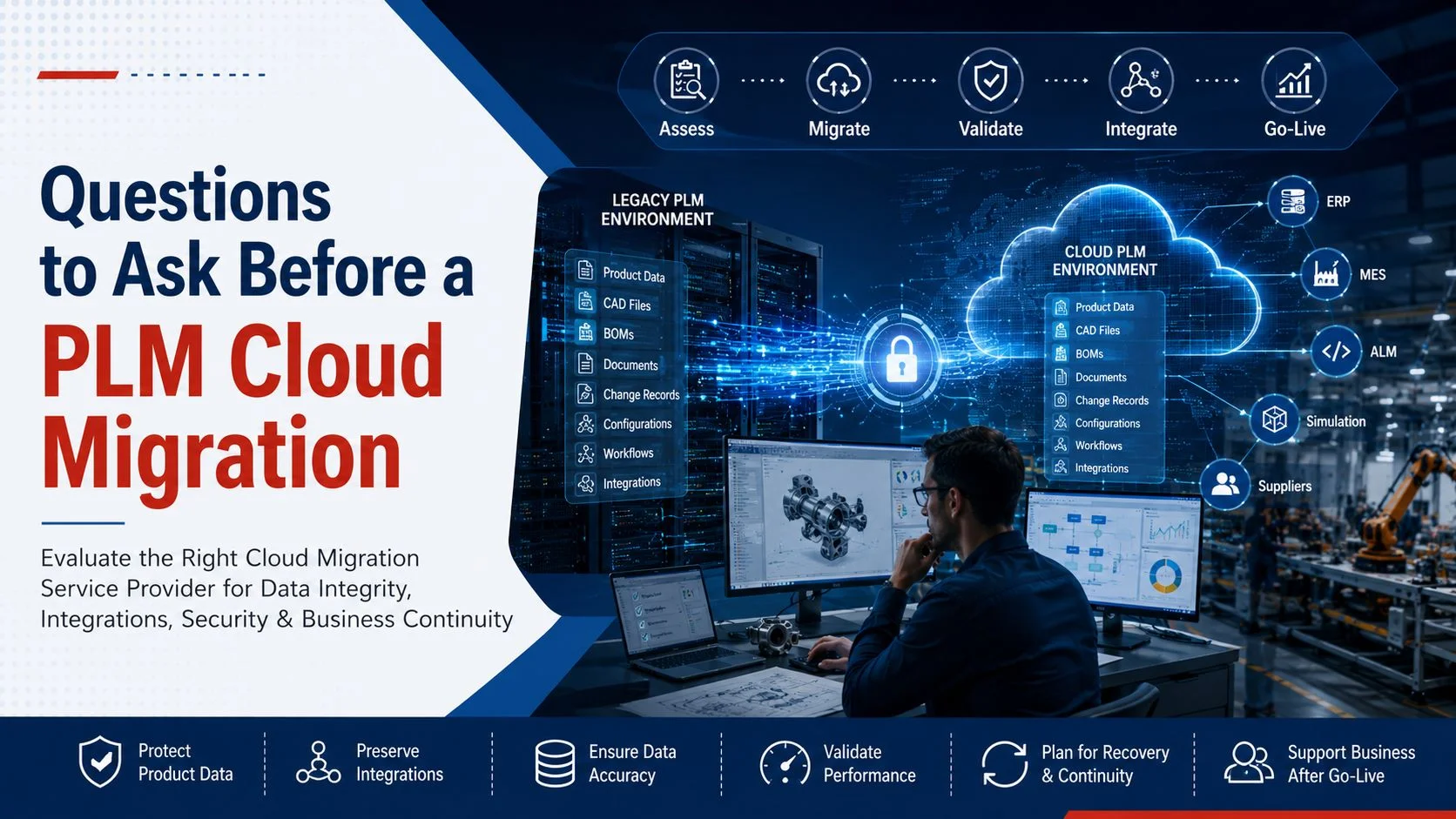
Cloud migration service providers may support discovery, migration planning, workload preparation, data movement, validation, and post-migration stabilization.
For engineering organizations, migration planning should consider more than compute resources. A PLM environment, for example, can involve application servers, databases, CAD workers, file storage, integrations, authentication, and development or test environments.
Microsoft's migration guidance emphasizes assessing architecture, dependencies, performance, security, code, and databases before moving workloads.
The important information-gain point is that migration and managed operations are different activities. A provider can move an environment successfully without necessarily establishing an effective long-term operating model.
3. Monitoring, Performance, and Incident Management
Continuous monitoring is one of the most recognizable components of cloud management services, but engineering teams should look beyond simple uptime dashboards.
Monitoring may cover:
- Infrastructure health
- Application availability
- Storage capacity
- Database performance
- Network connectivity
- Resource utilization
- Backup status
- Security events
- Service dependencies
Incident management should also define severity levels, escalation paths, response responsibilities, maintenance windows, and communication procedures.
For engineering applications, performance problems can have downstream consequences. A slow database, overloaded storage system, or unavailable application service can interrupt design reviews, product-data access, or engineering change workflows.
4. Security, Identity, and Governance
Cloud security is not a one-time configuration task. Microsoft describes security posture as an ongoing process requiring governance, monitoring, identity controls, and continuous improvement.
A managed environment may therefore include:
- Identity and access management
- Least-privilege access
- Authentication controls
- Security monitoring
- Patch coordination
- Configuration baselines
- Vulnerability management
- Audit logging
- Governance policies
- Periodic security reviews
For engineering organizations, governance also needs to consider intellectual property. CAD models, product structures, engineering specifications, simulation results, and product lifecycle records can represent highly sensitive business information.
5. Backup, Recovery, and Business Continuity
A backup policy is not the same as a recovery capability.
Engineering teams should ask:
What is backed up? How frequently? Where is it stored? Who can restore it? How quickly can critical systems be recovered? Has restoration actually been tested?
Recovery planning should account for databases, application configurations, engineering files, integrations, and dependencies rather than treating each component independently.
This is particularly important for systems supporting product development, where losing access to authoritative engineering data can affect multiple teams and downstream processes.
6. Engineering Application and PLM Support
Generic cloud administration may not be enough for organizations running engineering software.
Consider Windchill software. A managed cloud environment supporting Windchill may need to account for the application, database, CAD workers, file servers, configurations, integrations, backup and recovery, and performance tuning.
3HTi's published cloud services include cloud data migration support, dashboard monitoring, cloud audits and evaluations, and business-process coaching for cloud and hybrid environments. Its PLM services also describe Windchill installation, cloud deployment, migration, backup/recovery assistance, and performance tuning.
This illustrates an important selection criterion: the provider should understand both the cloud platform and the engineering application stack running on it.
7. Cost and Capacity Management
Cloud does not automatically mean lower cost. Consumption-based infrastructure can create waste when resources are oversized, idle, duplicated, or poorly governed.
A managed service can establish recurring reviews of:
- Resource utilization
- Storage growth
- Compute capacity
- Development and test environments
- Licensing considerations
- Resource lifecycle
- Scaling requirements
For engineering workloads, optimization must balance cost against performance. Reducing resources too aggressively can create unacceptable delays for CAD, simulation, data processing, or PLM operations.
A Practical Checklist for Choosing Cloud Management Services
Before signing an agreement, engineering leaders should ask:
- What exactly is managed? Infrastructure, applications, databases, security, backups, or all of these?
- Who owns each responsibility? Define the boundary between the provider, IT, engineering, and application owners.
- What happens during an incident? Check escalation, response targets, communication, and root-cause processes.
- How is migration handled? Confirm discovery, dependency mapping, validation, rollback planning, and post-migration support.
- How is engineering data protected? Review identity, access, backup, recovery, and governance controls.
- How is performance measured? Define meaningful technical and business metrics rather than relying only on infrastructure uptime.
- Can the provider support the engineering application stack? This matters when workloads include PLM, CAD, simulation, or other specialized systems.
The strongest managed-service agreements make these responsibilities explicit rather than leaving them implicit in a general support package.
Conclusion
Cloud managed services for engineering teams should provide more than infrastructure monitoring. A complete approach connects cloud operations with migration, security, data protection, application performance, governance, and the specialized requirements of engineering software.
For organizations running CAD, PLM, or Windchill software, the provider's understanding of the application environment can be as important as its cloud infrastructure expertise. 3HTi's cloud services for engineering environments include migration support, monitoring, cloud evaluation, and cloud/hybrid process coaching.
The practical objective is not to outsource every technology responsibility. It is to establish a clear operating model in which cloud specialists handle agreed responsibilities while internal engineering and IT teams retain appropriate ownership of applications, data, architecture, and business decisions.
FAQs
What do cloud managed services typically include?
They can include cloud monitoring, incident management, security and access controls, backup and recovery, performance optimization, migration support, governance, cost management, and ongoing operational assistance. The exact scope should be documented in the service agreement.
Are cloud managed services the same as cloud migration?
No. Cloud migration moves workloads from one environment to another, while managed services provide ongoing operation and maintenance. A provider may offer both, but they represent different phases and responsibilities.
Do engineering teams still need internal IT or DevOps staff?
Usually, managed services complement rather than automatically replace internal teams. Internal personnel typically retain responsibility for business priorities, application ownership, architecture decisions, data governance, and approval of significant changes.
Why does PLM require specialized cloud support?
PLM environments can involve application servers, databases, file storage, CAD integrations, authentication, workflows, and other dependencies. Managing the infrastructure without understanding these relationships can create operational or performance problems.
What should be checked before moving engineering data to the cloud?
Organizations should assess application dependencies, data classification, access requirements, network architecture, performance, backup and recovery, security controls, migration sequencing, validation procedures, and rollback options.