Sign up with Google
 Sign in with Zoho

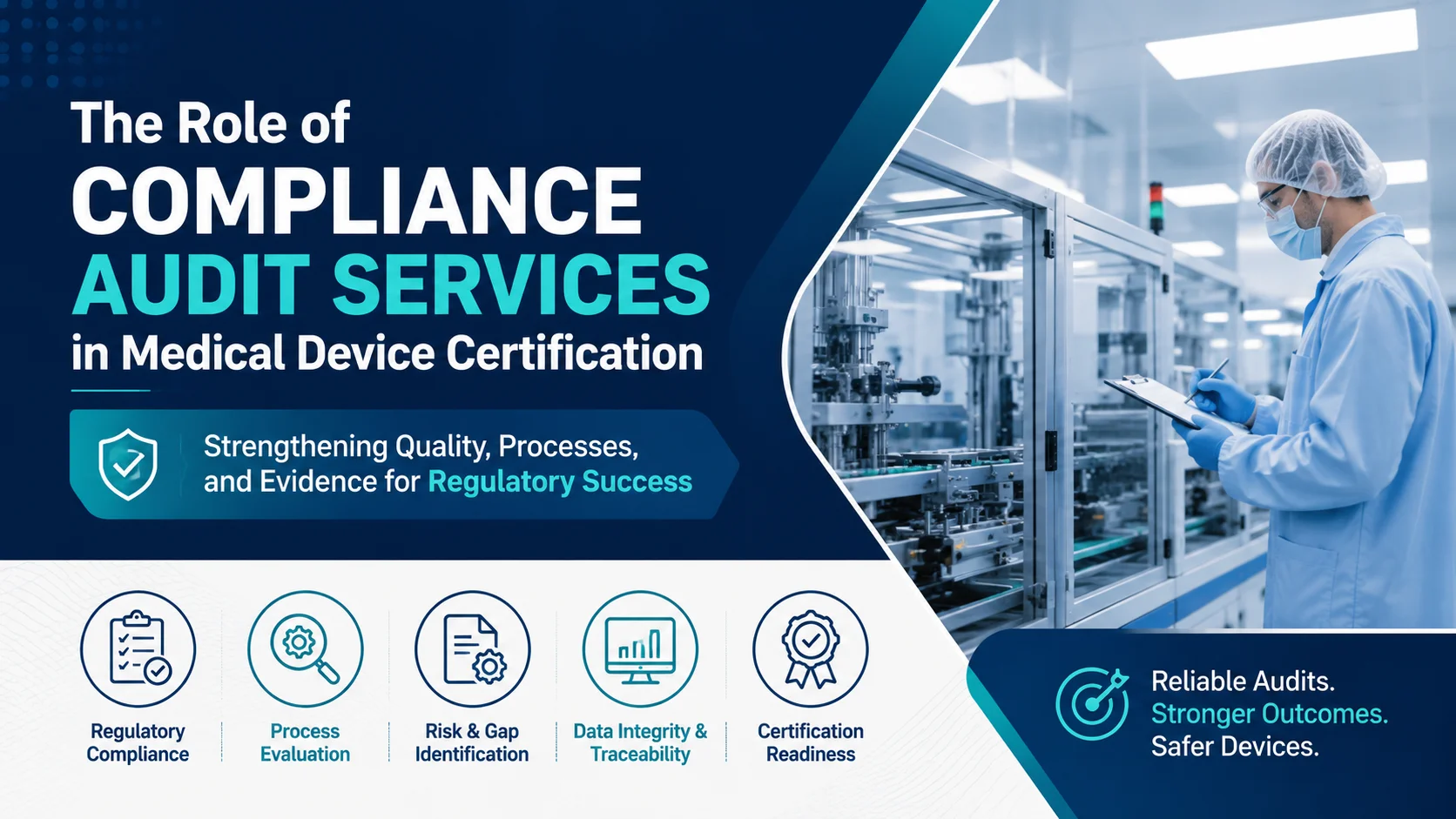
Medical device certification depends on more than a technically sound product. Manufacturers must demonstrate that their quality management system (QMS), design controls, production processes, records, risk controls, and post-market activities operate consistently and meet applicable regulatory requirements. This is where compliance audit services become valuable: they provide a structured way to identify gaps before they become findings during regulatory or certification assessments.
For manufacturers in the U.S. and Canada, the timing is especially important. The FDA's Quality Management System Regulation (QMSR) became effective on February 2, 2026, incorporating ISO 13485:2016 into the FDA's device quality-system framework.
Key Takeaways
- Compliance audits assess whether documented processes and actual practices align with applicable requirements.
- FDA's QMSR became effective February 2, 2026, incorporating ISO 13485:2016 into 21 CFR Part 820.
- Canadian manufacturers of applicable Class II, III, and IV devices rely on ISO 13485 QMS certification and MDSAP auditing requirements.
- A strong audit examines evidence, not merely whether procedures exist on paper.
- PLM and ALM integration can improve traceability between product data, requirements, changes, testing, and quality records.
What Are Compliance Audit Services for Medical Devices?
Compliance audit services systematically evaluate an organization's processes, records, controls, and practices against defined regulatory or quality requirements. In medical-device manufacturing, the scope may include design and development, supplier controls, production, document control, complaint handling, corrective and preventive actions, risk management, change control, and other QMS processes.
An audit is different from a certification itself. An internal or independent readiness audit can identify deficiencies and provide corrective-action priorities, while an authorized certification or regulatory assessment determines compliance for its specific purpose.
This distinction matters because passing an internal audit does not itself grant FDA authorization, ISO certification, or a Canadian medical-device licence.
Why the 2026 FDA QMSR Change Matters
The U.S. regulatory environment changed materially in 2026. The FDA's QMSR became effective on February 2, 2026, replacing the previous QS Regulation framework and incorporating ISO 13485:2016 by reference. The FDA also moved away from QSIT and began using the inspection process described in Compliance Program 7382.850.
For manufacturers, this makes regulatory readiness less about maintaining two disconnected frameworks and more about demonstrating an effective quality system that aligns with the QMSR's requirements.
The FDA states that investigators may review QMS records created before the QMSR effective date as part of determining compliance. Manufacturers can therefore benefit from comparing existing procedures and records against the current requirements rather than assuming older documentation is automatically sufficient.
What Should a Medical Device Compliance Audit Examine?
A useful audit follows the product lifecycle rather than checking documents in isolation.
1. Design and Development Controls
Design controls establish a structured process for translating user needs and requirements into verified and validated design outputs. The FDA identifies design controls as fundamental controls for applicable device development and requires manufacturers to establish and maintain procedures governing design activities and responsibilities.
Auditors should therefore examine whether teams can demonstrate relationships between:
- User and regulatory requirements
- Design inputs and outputs
- Design reviews
- Verification and validation
- Risk-management activities
- Design changes
- Approved product configurations
A process that appears compliant on paper but cannot produce objective evidence of these relationships represents a significant audit concern.
2. Document and Change Control
Medical-device development generates drawings, specifications, software requirements, test results, manufacturing instructions, labeling, and other controlled information.
The audit should determine whether employees can reliably identify the current approved version and whether changes are reviewed, authorized, implemented, and traceable.
This is particularly important where engineering teams use multiple systems. PLM implementation services can help establish controlled product-data structures and lifecycle workflows so that engineering changes are not disconnected from downstream quality processes.
3. Production and Supplier Controls
Compliance extends beyond internal engineering. Manufacturers need appropriate controls over purchased products, suppliers, outsourced processes, and production activities.
A practical audit should test whether supplier qualification, incoming inspection, production controls, acceptance activities, and supplier changes are documented and consistently executed. Health Canada likewise identifies supplier controls as part of the quality-system framework applicable to medical-device manufacturers.
4. Risk, Complaints, CAPA, and Post-Market Feedback
A mature QMS should create a feedback loop between field experience and product/process improvement.
Auditors should examine whether complaints are appropriately evaluated, quality issues are investigated, corrective actions address underlying causes, and effectiveness is subsequently assessed.
The important question is not simply, "Do we have a CAPA procedure?" It is, "Can the organization demonstrate that the procedure consistently produces appropriate decisions and evidence?"
How Business Process Audits Improve Certification Readiness
A business process audit examines how work actually flows across departments, systems, and responsibilities. That makes it particularly useful when compliance problems originate at organizational boundaries.
Consider a design change to a medical device. Engineering may update CAD data, quality may need to assess its regulatory impact, software teams may need to modify embedded functionality, manufacturing may require revised instructions, and testing may need to repeat verification.
A fragmented process can leave one of these activities disconnected.
An effective operational audit process therefore follows the transaction from initiation to completion and asks:
- Who initiates the change?
- Which requirements are affected?
- Which product records change?
- Who approves the change?
- Which verification or validation activities are triggered?
- How are manufacturing and quality teams notified?
- What evidence demonstrates completion?
This approach identifies process failures that a document-only review can miss.
Why PLM and ALM Integration Matters
Modern medical devices increasingly combine mechanical components, electronics, embedded software, and supporting applications. Consequently, compliance evidence can span product lifecycle management and application lifecycle management systems.
ALM integration can connect software requirements, development tasks, defects, tests, and releases with broader product and quality processes. PLM can provide control over product structures, engineering configurations, revisions, and associated documentation.
When appropriately integrated, these systems can strengthen traceability across the product lifecycle.
The objective is not to integrate systems simply because integration is technically possible. Each interface should have defined ownership, data rules, validation requirements, and change-control responsibilities.
U.S. and Canadian Certification Considerations
For U.S. manufacturers, QMSR compliance is now central to the FDA's device quality-system framework. The FDA explicitly states that manufacturers should be prepared to provide records demonstrating compliance during inspections conducted under the new framework.
In Canada, the requirements differ by device class and regulatory pathway. Health Canada requires applicable manufacturers of Class II, III, and IV devices to provide appropriate ISO 13485 quality-system certification, with MDSAP auditing organizations playing a central role in the applicable certification process.
MDSAP is designed to allow a single audit to address quality-management requirements derived from participating regulatory jurisdictions, including Canada and the United States, while retaining jurisdiction-specific regulatory requirements.
Therefore, manufacturers selling across both countries should build their audit program around the applicable requirements for each market rather than assuming one certification automatically satisfies every regulatory obligation.
A Practical Compliance Audit Readiness Framework
Before an external assessment, medical-device organizations can use a five-part readiness review:
Map: Identify applicable regulatory, quality, and product requirements.
Trace: Connect requirements to design outputs, testing, risk controls, and approved configurations.
Test: Verify that documented procedures match actual employee practices.
Evidence: Confirm that objective records demonstrate execution and approval.
Correct: Prioritize gaps according to regulatory significance, product risk, and recurrence potential.
This framework helps management move beyond checklist-based compliance toward a measurable quality-system assessment.
For organizations that need structured process evaluation, 3HTi Business Process Audit Services can be incorporated into a broader engineering and digital-process improvement program. The value is greatest when audit findings are translated into specific process, system, ownership, and data improvements.
Conclusion
Medical-device certification readiness is fundamentally an evidence and process problem. Compliance audit services help manufacturers determine whether their documented QMS actually works in practice and whether critical evidence can be produced when required.
With the FDA's QMSR now effective and Canada's MDSAP-based requirements continuing to shape QMS certification, manufacturers should treat audit readiness as an ongoing operational capability rather than a project completed immediately before an assessment. Connecting business processes with PLM, ALM, quality, and engineering systems can make that capability more consistent, traceable, and sustainable.
FAQs
Are compliance audits required before medical-device certification?
Not necessarily as a separate universal requirement. However, internal or independent readiness audits can identify gaps before formal certification or regulatory assessments. The specific certification and regulatory requirements depend on the device, market, classification, and applicable conformity-assessment pathway.
What changed for U.S. medical-device manufacturers in 2026?
The FDA's QMSR became effective February 2, 2026. It incorporates ISO 13485:2016 into 21 CFR Part 820 and introduced a revised FDA inspection approach. Manufacturers should evaluate existing QMS documentation and records against the current requirements.
How does a business process audit differ from a compliance audit?
A compliance audit primarily evaluates conformity with specified requirements. A business process audit examines how work actually flows across people, systems, and departments. Combining both perspectives can reveal compliance risks caused by inefficient or disconnected processes.
Can PLM systems support medical-device compliance?
Yes. Properly configured PLM can help control product structures, revisions, engineering changes, documents, and configurations. However, PLM does not automatically make an organization compliant; processes, controls, records, validation, and appropriate governance remain essential.
Why is ALM integration useful for medical devices?
ALM integration can connect software requirements, development, testing, defects, and releases with broader product-development and quality processes. This becomes particularly valuable for devices containing embedded or software-based functionality where traceability spans multiple engineering disciplines.
Does ISO 13485 certification guarantee FDA compliance?
No. The FDA's QMSR incorporates ISO 13485:2016 but also contains U.S.-specific regulatory provisions and applicable statutory requirements. FDA compliance must be evaluated against the complete applicable framework rather than treating ISO 13485 certification as a blanket substitute.












.webp)