Sign up with Google
 Sign in with Zoho

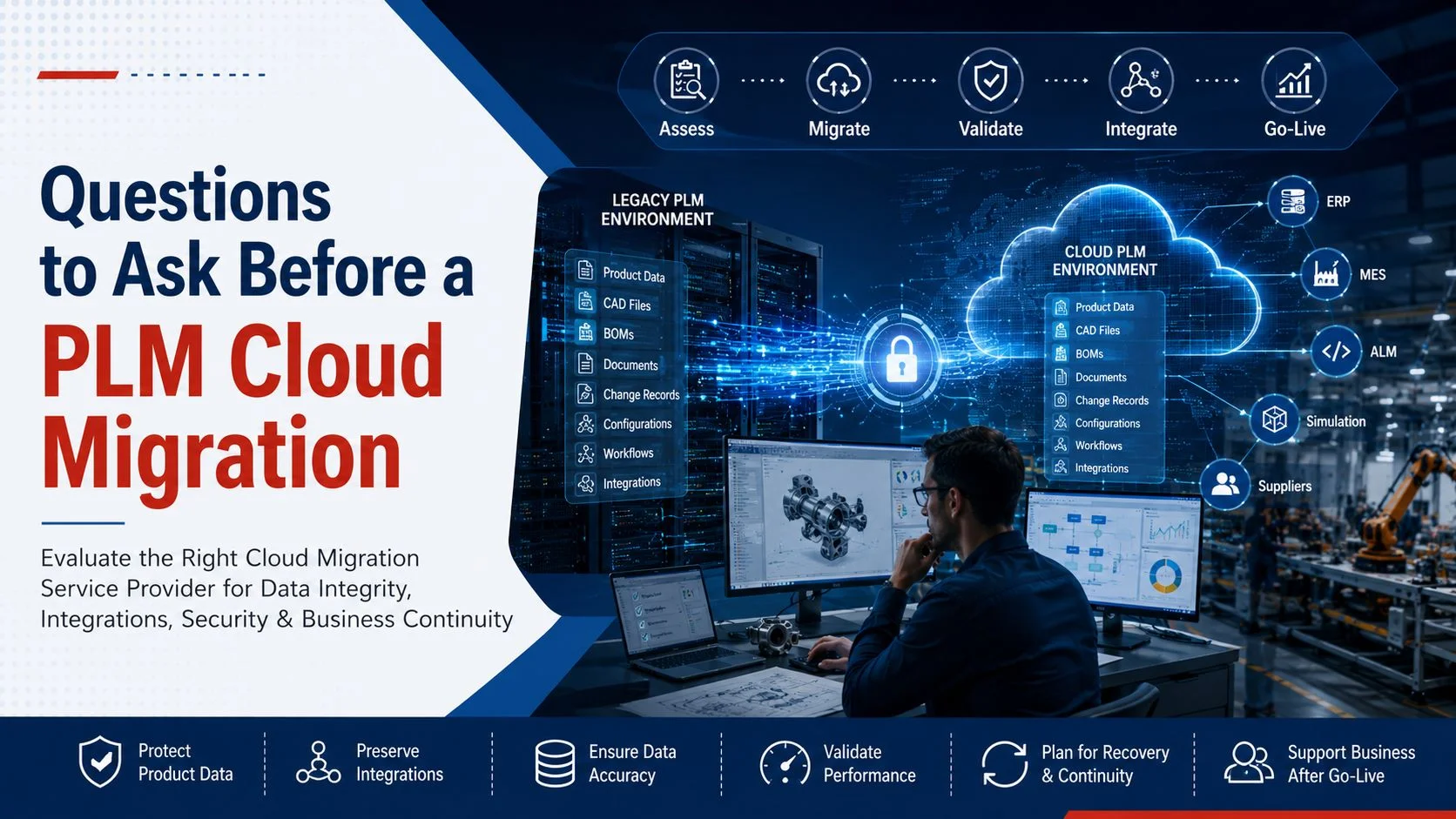
Moving a Product Lifecycle Management (PLM) environment to the cloud is not simply an infrastructure exercise. For manufacturers, the PLM platform may contain CAD relationships, product structures, bills of materials, engineering changes, documents, configurations, supplier information, and integrations with ERP, MES, ALM, and simulation environments. A poorly planned migration can therefore disrupt engineering operations even when the underlying cloud infrastructure performs as expected.
Before selecting cloud migration service providers, manufacturing leaders should ask questions that reveal how a provider will protect product data, preserve integrations, handle customizations, validate the migrated environment, and support the business after go-live.
1. What Exactly Are You Migrating?
The first question should be surprisingly basic: What constitutes the PLM environment?
A provider should evaluate more than the PLM application and database. A typical enterprise environment can include:
- Product and part data
- CAD files and relationships
- Bills of materials
- Documents and specifications
- Engineering-change records
- Configurations and variants
- Workflows and lifecycle states
- User roles and permissions
- Custom code
- APIs and integrations
- Reporting
- Authentication services
- External storage
- Development and test environments
Windchill, for example, can be deployed across different architectures and integrated with heterogeneous IT environments, including enterprise systems. PTC describes deployment options ranging from on-premises to cloud and highly scalable clustered environments.
A provider that only evaluates the production application without mapping these dependencies may underestimate migration risk.
2. How Will You Assess Our Existing PLM Environment?
Ask for a formal discovery and assessment phase before committing to a migration design.
The assessment should document:
- Current architecture
- Data volumes and types
- Integrations
- Customizations
- User population
- Performance requirements
- Security controls
- Business-critical workflows
- Data-quality issues
- Recovery requirements
This is especially important for organizations with years of accumulated PLM customization.
PTC's own Windchill+ migration methodology begins with an Assess phase that examines the existing environment, including hardware and customizations, before conversion.
If a provider wants to skip discovery and immediately propose a migration architecture, that deserves scrutiny.
3. What Happens to Our Customizations?
Customization is one of the most important questions in a PLM cloud migration.
Legacy environments often contain custom workflows, reports, interfaces, scripts, extensions, and business logic that accumulated over years.
The correct question is not simply "Can you migrate our customizations?"
Instead, ask:
Which customizations should be retained, redesigned, replaced by standard functionality, or retired?
A strong migration methodology evaluates the business purpose behind each customization. PTC's Windchill+ migration approach specifically includes technical standardization of customizations so their intended functionality can work within the SaaS environment.
This can be an opportunity to reduce technical debt rather than reproduce it in the cloud.
4. How Will You Protect Product Data During Migration?
Manufacturing organizations may consider PLM information highly sensitive intellectual property.
Ask the provider how it will protect:
- CAD and engineering files
- Product configurations
- Supplier information
- Personally identifiable information
- Authentication credentials
- Engineering-change history
- Backups
- Migration staging environments
Security should be evaluated across the entire migration lifecycle, not just after production deployment.
NIST's manufacturing cybersecurity guidance emphasizes protecting the integrity and availability of manufacturing information and systems, particularly as IT and operational environments become increasingly interconnected.
A useful provider should be able to explain access controls, encryption, backup strategy, logging, incident response, and recovery procedures in terms relevant to your environment.
5. How Will You Handle PLM Data Migration and Validation?
Data migration is often the highest-risk technical component of a PLM transition.
Ask:
- How will data be extracted?
- How will obsolete records be handled?
- How will relationships be preserved?
- How will revisions be validated?
- How will CAD associations be tested?
- How will BOM structures be reconciled?
- How will permissions be transferred?
- How will migration errors be identified?
- How many test migrations will occur?
A useful approach is to perform repeated migration rehearsals using representative production data.
The objective is not simply to confirm that records exist in the target environment. Teams should verify that the relationships and business meaning of those records remain intact.
NIST notes that trustworthy manufacturing data requires careful management across distributed systems and emphasizes the challenges associated with synchronization and data integrity.
6. How Will You Test Our Integrations?
PLM rarely operates alone.
Your provider should map dependencies involving:
- ERP
- MES
- CAD
- ALM
- CRM
- Supplier systems
- Identity platforms
- Manufacturing applications
- Simulation environments
- Reporting platforms
Windchill's architecture can include connections to enterprise directories, ERP, CRM, SCM, and other PDM systems.
This is why ALM services, ERP integration, and other engineering-system dependencies should be considered during the initial architecture assessment rather than after the PLM migration has already begun.
For example, if an engineering change triggers downstream manufacturing or software-development processes, the migration must preserve the relevant integration behavior, not merely move the PLM records.
7. What Is the Cutover and Rollback Strategy?
Ask the provider to explain exactly what happens during production cutover.
A mature plan should define:
- Data-freeze procedures
- Final migration
- Validation
- User-access transition
- Integration activation
- Business acceptance testing
- Go-live decision criteria
- Rollback conditions
- Recovery procedures
- Post-launch monitoring
The provider should also explain how long the organization can tolerate disruption.
For globally distributed engineering teams, a migration window that appears reasonable to IT may be unacceptable to engineering or manufacturing operations.
8. How Will You Test Performance at Scale?
Cloud migration can change application behavior even when functionality remains identical.
Ask how the provider will test:
- Concurrent users
- Large BOM structures
- CAD data access
- Search performance
- File transfers
- Engineering-change workflows
- Integration throughput
- Global access latency
- Peak workloads
Windchill supports architectures ranging from smaller deployments to highly scalable clustered environments, so the target architecture should reflect actual workload and user requirements.
Performance testing should use realistic workloads rather than generic infrastructure benchmarks.
9. How Will Cloud Migration Affect Simulation and Engineering Workflows?
PLM does not exist in isolation from engineering analysis.
Organizations using FEA simulation services, CFD, or other engineering-analysis workflows should determine how simulation data, models, results, and references interact with the new PLM environment.
Questions should include:
- Where will simulation data reside?
- How will models reference product revisions?
- Will engineering teams experience additional data-transfer latency?
- How will simulation environments authenticate?
- Which files need lifecycle control?
- How will results remain associated with the correct configuration?
These questions become increasingly important as manufacturers pursue model-based engineering and connected product-development workflows.
10. Can You Assess Our Business Processes Before Migration?
Cloud migration is an opportunity to identify inefficient processes before reproducing them.
A business process audit can examine:
- Engineering-change workflows
- Approval structures
- Data ownership
- Lifecycle states
- Manual handoffs
- Duplicate activities
- Access controls
- Reporting requirements
- Integration dependencies
This matters because migrating a poorly designed process does not make it better. It simply moves the same inefficiency to a different technical environment.
A strong provider should therefore be willing to distinguish between technical migration requirements and process-transformation opportunities.
11. What Happens After Go-Live?
Migration is not finished when users log into the new environment.
Ask what ongoing support includes:
- Application monitoring
- Performance optimization
- Incident response
- Security management
- Integration monitoring
- User administration
- Upgrade planning
- Backup and recovery
- Capacity management
- Continuous improvement
This is particularly relevant when organizations transition from managing infrastructure internally to using cloud or SaaS services.
NIST's recent manufacturing cybersecurity guidance emphasizes operational resilience and the ability to respond to and recover from cyber incidents affecting interconnected industrial environments.
A Better Way to Evaluate Cloud Migration Service Providers
Instead of comparing providers primarily on hourly rates or migration promises, score them across six dimensions:
The strongest provider is not necessarily the one promising the fastest migration. It is the one that can demonstrate how the organization will maintain data integrity, engineering continuity, security, and operational resilience throughout the transition.
For manufacturers evaluating cloud-based PLM modernization, cloud services and migration support for engineering environments can provide a useful reference point for understanding the broader infrastructure, application, and transformation considerations involved in moving engineering workloads to the cloud.
Conclusion
A PLM cloud migration should be evaluated as an enterprise engineering transformation, not a simple hosting decision.
Before selecting cloud migration service providers, manufacturing leaders should demand clear answers about data migration, customization, integration, security, performance, process governance, cutover, recovery, and long-term operations.
The most valuable question may ultimately be this:
"How will you prove that our engineering processes and product information work correctly after migration?"
A provider that can answer that with measurable validation criteria, realistic testing, and a documented recovery strategy is much better positioned to manage a complex PLM transition than one focused only on moving infrastructure.