Sign up with Google
 Sign in with Zoho

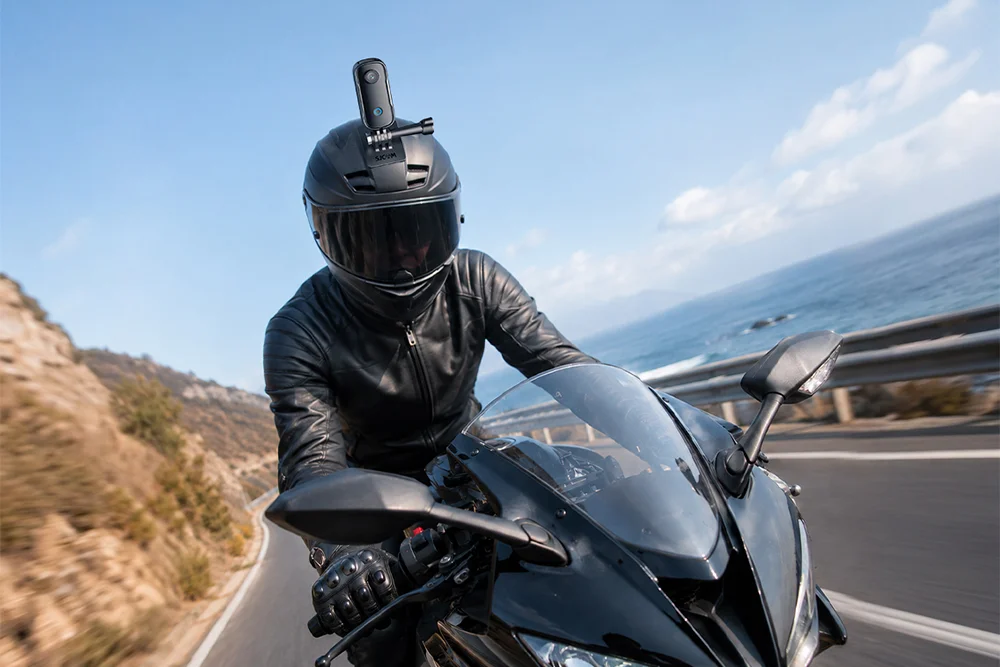
You’ve got the bike, the gear, and the route. Now, you need the memory card. But with three heavyweights dominating the market—GoPro, Insta360, and DJI—choosing the right motorcycle action camera can feel more overwhelming than navigating rush hour traffic on a busy freeway.
Each brand brings a distinct philosophy to the table. GoPro is the veteran, known for rugged reliability and killer stabilization. Insta360 is the innovator, offering 360-degree capture that lets you “shoot first, frame later.” DJI is the tech disruptor, bringing drone-grade software and magnetic mounting systems to the table.
For riders, the choice isn’t just about resolution or megapixels. It’s about wind noise, battery life for long tours, mounting stability, and how the camera handles high-speed vibration. A camera that looks great in a YouTube review can completely fail when mounted to a helmet at 70 mph.
In this head-to-head breakdown, we will pit these three giants against each other to determine which one deserves a permanent spot on your helmet or handlebars.
Round 1: Stabilization and the “Wobble” Factor
For motorcyclists, stabilization is the holy grail. A motorcycle action camera that produces shaky footage is useless. Let’s see how these three handle the vibrations of a twin-cylinder engine and wind buffeting.
GoPro (Hero 12 Black): The HyperSmooth King
GoPro’s HyperSmooth 6.0 stabilization is the benchmark in the industry. It combines software and hardware to deliver buttery-smooth footage even in the most aggressive off-road conditions. For riders, the “AutoBoost” feature is a game-changer. It automatically crops the frame only when needed, which means you get a wide field of view when riding on a smooth highway and extra stabilization when you hit a pothole. It handles the “jello” effect better than most, though it can struggle slightly with high-frequency vibrations (like those from a single-cylinder thumper) if your mount isn’t solid.
Insta360 (X3 or Ace Pro): The Gimbal-like Smoothness
Insta360 uses FlowState stabilization, which is equally impressive. However, the real magic lies in the 360-degree models. Because the camera sees everything, the software has an infinite canvas to crop from. It digitally pans and tilts to keep your horizon perfectly level, even if you are leaning heavily into a corner. This is particularly useful for track days where you want a perfectly level horizon. The Insta360 Ace Pro (their flagship action cam) also uses AI-based stabilization that is nearly indistinguishable from GoPro’s, but the 360 models offer a unique edge for riders who want to show both their face and the road simultaneously.
DJI (Osmo Action 4): The Rocksteady Challenger
DJI’s RockSteady 3.0 stabilization is incredibly impressive, often matching GoPro’s output. In blind tests, many riders struggle to tell the difference between DJI and GoPro at 4K/60fps. The key difference is DJI’s horizon balancing. The Osmo Action 4 features a 360-degree horizon lock, which means even if you tilt the camera completely sideways, the footage stays level. This is perfect for adventure riders who are constantly shifting weight and leaning the bike. It also handles high-frequency vibration slightly better than GoPro, thanks to its larger sensor which captures more light and data to work with.
Winner: Tie between GoPro and DJI for standard action cams. Insta360 wins if you want a 360-degree view.
Round 2: Audio Quality (Wind Noise is the Enemy)
As a rider, your exhaust note is part of the story. But the wind roaring past your helmet is not. Audio quality is a major differentiator here.
GoPro: The Mediocre Default
GoPro’s built-in microphones are notoriously bad at handling wind. Without a foam cover (a “dead cat”), the audio is almost unusable at speed. However, GoPro offers a proprietary Media Mod (an accessory that adds a directional mic port and shotgun microphone). This is the best solution for motovloggers, but it adds bulk and cost to the setup. If you are using the bare camera, expect to edit out the wind noise in post-production.
Insta360: The 360 Audio Advantage
Insta360’s 360 cameras have a unique trick: they record spatial audio. While this is cool, it doesn’t automatically block wind. The Insta360 Ace Pro, however, uses a partnership with DJI’s rival (and AI technology) to suppress wind noise in-camera. It actually uses an AI algorithm to identify and remove wind noise while keeping the mid-range frequencies (like your engine and voice) intact. It is noticeably better than GoPro out of the box, but still not perfect without an external mic.
DJI: The Vlogger’s Choice
DJI’s Osmo Action 4 is the clear winner for built-in audio. Its wind reduction algorithm is aggressive and effective. It filters out the low-frequency rumbling of wind without cutting out the high-frequency “crackle” of the exhaust. DJI also has an excellent wireless microphone ecosystem (the DJI Mic 2) that pairs directly with the camera via Bluetooth, allowing you to clip a lapel mic to your jacket collar for clear voice audio without wires.
Winner: DJI takes the crown for out-of-the-box audio and wireless mic compatibility.
Round 3: Mounting, Durability, and Ergonomics
How a camera attaches to your helmet or bike is critical. A heavy camera is a neck strain; a poorly designed mount is a safety hazard.
GoPro: The Universal Standard
GoPro’s “fingers” mounting system is the industry standard. You can find mounts for GoPro everywhere—from gas stations to Amazon. The downside is that the plastic mount is prone to stress fractures over time if you use the “J-hook” with a heavy camera. You will need to use threadlocker on the screws to prevent them from vibrating loose. It is built like a tank, however, and can survive serious crashes.
Insta360: The Flexible Options
Insta360 offers standard GoPro-compatible mounts on their Ace Pro, which is convenient. However, their 360 cameras (like the X3) require a specific mount due to the dual-lens design. You can’t just slap a GoPro mount on an X3 without an adapter. On the plus side, the X3 is extremely lightweight, which reduces the strain on your helmet and minimizes the “wobble” effect at high speeds.
DJI: The Magnetic Marvel
DJI has introduced a brilliant magnetic quick-release mount system for the Osmo Action 4. This is a massive win for riders. You can attach the camera to a magnetic base on your helmet, and it locks in with a satisfying click. In an emergency, the camera pops off cleanly instead of ripping your head backward. It’s also incredibly stable—there is zero play in the magnetic connection, which eliminates micro-wobbles. However, this proprietary mount means you can’t easily use universal GoPro mounts without an adapter.
Winner: DJI for ease of use and mount stability. GoPro for universal compatibility.
Round 4: Battery Life and Heat Management
Long rides mean long recording times. A dead camera halfway through a canyon run is a tragedy.
GoPro: The Thirsty Performer
The GoPro Hero 12 is better than its predecessors, but it still runs hot when recording 5.3K/30fps. In direct sunlight, mounted to a black helmet, thermal throttling is a real issue. You’ll get about 70–80 minutes of continuous 4K recording. The removable battery is a plus, so carrying spares is easy.
Insta360: The Efficiency Expert
The Insta360 Ace Pro uses a larger 1/1.3" sensor, which is more power-efficient. It can record for about 90–100 minutes of continuous 4K. The 360 X3, however, is a power hog. It records dual lenses, which doubles the processing load. Expect about 60–70 minutes per charge on the X3.
DJI: The Marathon Runner
The DJI Osmo Action 4 is the efficiency king. It runs cooler and lasts longer. You can easily squeeze out 2+ hours of continuous 4K recording on a single charge. It also charges incredibly fast via USB-C (up to 80% in about 40 minutes). This is perfect for riders who do multi-day trips without wanting to manage a backpack full of spare batteries.
Winner: DJI dominates in battery life and heat management.
The Verdict: Which One Should You Buy?
The “best” motorcycle action camera depends entirely on your riding style.
Choose GoPro if:
- You want the widest ecosystem of mounts and accessories.
- You are a serious motovlogger who will buy the Media Mod for external audio.
- You want the most proven, crash-tested durability on the market.
- You prefer a standard, reliable form factor with no frills.
Best for: Track riders and content creators who want maximum compatibility with existing gear.
Choose Insta360 if:
- You want to capture both the road ahead and your face in a single shot.
- You love the idea of “reframing” your shot after the ride—pointing the camera anywhere and choosing the angle in editing.
- You ride with friends and want to capture them from your perspective without holding a camera.
Best for: Adventure riders who want dynamic, “wow-factor” content and creative editing options.
Choose DJI if:
- You want the absolute best stabilization and horizon lock for minimal effort.
- You hate dealing with complex mounts and want the magnetic quick-release system.
- You need the best battery life and don’t want to carry spare batteries.
- You want to use wireless microphones without wires getting in the way.
Best for: Commuters and long-distance tourers who want a “set and forget” camera that just works.
Final Thought
Whichever brand you choose, remember that your motorcycle action camera is only as good as the rider behind it. Spend time securing your mount, use high-quality memory cards, and adjust your settings for the lighting conditions.
For riders who want the perfect blend of battery life, stabilization, and audio quality, the DJI Osmo Action 4 is the most well-rounded choice on the market today. But if you value creative flexibility and unique angles, the Insta360 X3 will unlock a world of content possibilities that neither GoPro nor DJI can match.