Sign up with Google
 Sign in with Zoho

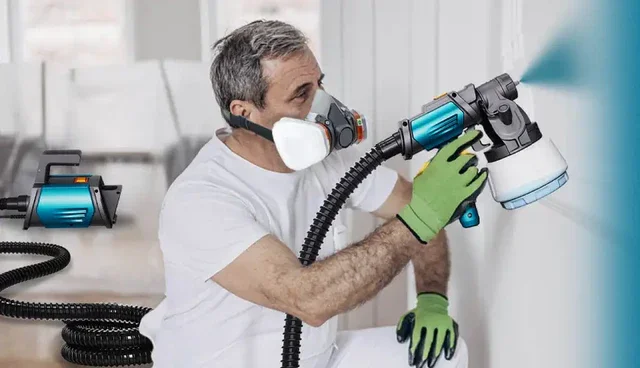
You bought the biggest, baddest airless paint sprayer on the market. You watched the YouTube tutorials. You covered your floor in plastic. You thinned the paint. You pulled the trigger.
And then… disaster.
Paint is pooling in corners, dripping off edges like a waterfall, and the “smooth finish” you dreamed of now looks like the surface of a golf ball. You spent three hours cleaning the massive sprayer and its 50-foot hoses, only to sand down your project and start over with a paintbrush.
Sound familiar?
You are not a bad painter. The problem is that you were using the wrong tool for the job. The truth is, an airless paint sprayer is a bulldozer—it moves massive amounts of material, but it has zero finesse. For the detail, precision, and flawless finish required by most DIY furniture and cabinetry projects, you need a different approach. You need an HVLP electric spray paint gun.
If you are tired of ruining projects with orange peel and runs, this article is your intervention. Let’s diagnose why your airless sprayer is failing you—and how the switch to an HVLP will revolutionize your work flow.
The #1 Culprit of Airless Failures: The “Fire Hose” Effect
To understand why your airless sprayer ruins small projects, you need to understand its physics. An airless pump uses a giant piston to shove paint through a tiny, hardened steel rod nozzle at an astronomical pressure (often over 3,000 PSI).
This extreme pressure creates a massive, high-velocity fan pattern. It’s designed to coat an entire wall or a 500-square-foot exterior in minutes. But when you point this fire hose at a chair rail, a cabinet door, or a small tabletop, the results are predictable:
- Runs and Sags: The sheer volume of paint being dumped onto a small surface exceeds the liquid’s surface tension. The paint begins to slide down, creating ugly drips and curtains of material.
- Massive Overspray: The high pressure creates an atomized cloud of paint that bounces off the surface and floats around the room. You lose up to 50% of the paint to the air, and you’ll be breathing it in for hours.
The HVLP Solution: An HVLP electric spray paint gun uses “high volume, low pressure." It is a heavy proportion of air—so you get a refined pattern. The paint is not blasted at super high speeds; it’s safely settled as a soft, gentle air mixture. The spray is gentle enough to lay down a flat film on wood and trim without launching thousands of small airborne paint droplets back into the air.
Problem #2: TOO MUCH Paint for Detail Work
Let’s look at a classic DIY project: repainting your kitchen cabinets. You have a bunch of frames, delicate moulding patterns, and inset panel doors.
With an airless, you start “painting” the sides of a shaker cabinet door. The spray fan extends wider than the door itself. To feel the entire surface, you line up the edge with the panel and paint it. But because the volume is so massive, when you make the second pass to get the outside area, you are laying over the paint of the first pass before it’s set. This means:**
- Kaizen on Shoe Wood: You induce a triple layer of heavy, thick paint that can’t level out. It stays as thick wrinkles.
- Blown-out Corners: Those crisp 90-degree angles on a door frame get flooded with paint, destroying the sharp edge where the wood meets.
The HVLP Advantage:The spray pattern of an electric HVLP is adjustable to be very narrow or very wide. More importantly, the fluid flow control (the needle valve) allows you to dial down the actual paint output to a driplets. This allows you to:
- Slow down and take your time on the detailed sections.
- Lay a thin, precisely controlled layer onto the shaker panel, then move.
- Achieve a crisp, defined line between the cabinet shading and the face frame build.
Problem #3: The Clogging Nightmare and Viscosity Dilemma
In our previous article on HVLP vs Airless Paint Sprayer settings, we established that airless models are designed to handle thick, unthitled paint. But that is the trap for a DIYer.
To run layers or a project big coat, you might think the airless will just power right through any thick paint. However, the smaller airless machines (the $200-$300 homeowner models) can’t handle unthitled paint. You will still get clogs, or worse—the machine will splash a wet, thick chunk of paint that looks like toothpaste.
This frustrating situation causes you to over-thin, making it watery, and then the runs start again. It’s a vicious cycle.
The HVLP Solution:The HVLP Electric Spray Paint Gun is designed for the precise viscosity of paints and primers that those DIY projects require. The modern electric HVLP systems (like the Tilswall) come with breaker nozzle sizes (e.g., 1.8mm to 2.5mm). This can be tailored to the consistency of the paint you’re using.
Instead of worrying about a hydraulic pump crack, you simply:
- Pick the correct nozzle for the paint material (thicker? go bigger).
- Stir your paint to a smooth “honey” consistency.
- Spray.
You work with the paint’s natural properties rather than trying to smother it with an enormous pump.
Problem #4: The Cleaning Nightmare That Kills Momentum
One of the most overlooked—and worst—aspects of an airless sprayer for DIYers is the cleanup ritual.
Your system has a fluid inlet hose, a 25-foot high pressure hose, a spray gun, a pump, and waste lines. After use, all of this must be drained, flushed with solvent, and wrapped in rags. It takes 30-45 minutes just to clean up, and any missed paint dot can permanently seal the foot piston. Most frustratingly, you have to do this every single time you want to spray 40 minutes. Most DIYers dread it so much they mix it, The spirit delay ends up doing a poor job where they can’t stain.
The HVLP Solution:An HVLP Electric Spray Paint Gun is a self-contained unit for impact. It has a paint cup and a longer air hose going to the turbine, but there is no high-pressure fluid line. Cleaning time literally decreases by 80%.
- Empty the cup.
- Fill it with water (or solvent).
- Pump it through the gun.
- Rinse the nozzle and cup.
That’s it, less than 5 minutes. It’s so fast for you might not learn that a habit and not postpone the job until the next day.
Why the Tilswall HVLP Electric Spray Paint Gun is the Fix
If you are ready to stop fighting the fire hydrant of an air and finally answer the tension of a controlled artist’s brush, you need to start with a reliable platform. Your solution is the Tilswall HVLP Electric Spray Paint Gun.
Why Tilswall? Because it’s not just a gun—it’s a complete replacement for your bad airless experiences.
- Multi-Nozzle Versatility: The Tilswall comes with 1.8mm, 2.0mm, and 2.5mm nozzles. The 1.8mm is a flea for wood finish, dyes, and thinned words polyurethane floorboards. The 2.5mm gets you into the capacity of thicker latex paint for when you work on furniture.
- Pressure Adjustability: It has an dial built on top of the turbine to match the fluid flow to the air output. This allows you to adjust the pattern to avoid the exact orange peel that airless products create.
- Lightness and Mobility: Because it does not need a self-contained, massive pump; you can use it easily in a workshop for hours without handling heavy equipment.
- Easy Maintenance: As noted above, it takes five minutes to clean. No more dreading the cleanup, so you can always be done with a consistent work end.
Don’t Up the Rub on the Wall Again
You may have bought an airless because you thought it was the “professional” tool. But a professional furniture finisher wouldn’t touch an airless with a 10-foot pole. They use an HVLP for a reason. The surface is mirrored, the amount of wasted paint is minimal, and the control is absolute.
If you are looking for a wild, beautiful smooth coat that makes you look like an expert, an airless will betray you. It’s time to choose the tool that respects the craft.
Make the switch to the Tilswall HVLP electric spray paint gun today. It will fix your DIY repairs, and you will never go back to fighting the fire hose. Your furniture will thank you. Your lungs will thank you, and your sanity will definitely thank you. Get the one’s perfect finish you deserve.