Sign up with Google
 Sign in with Zoho

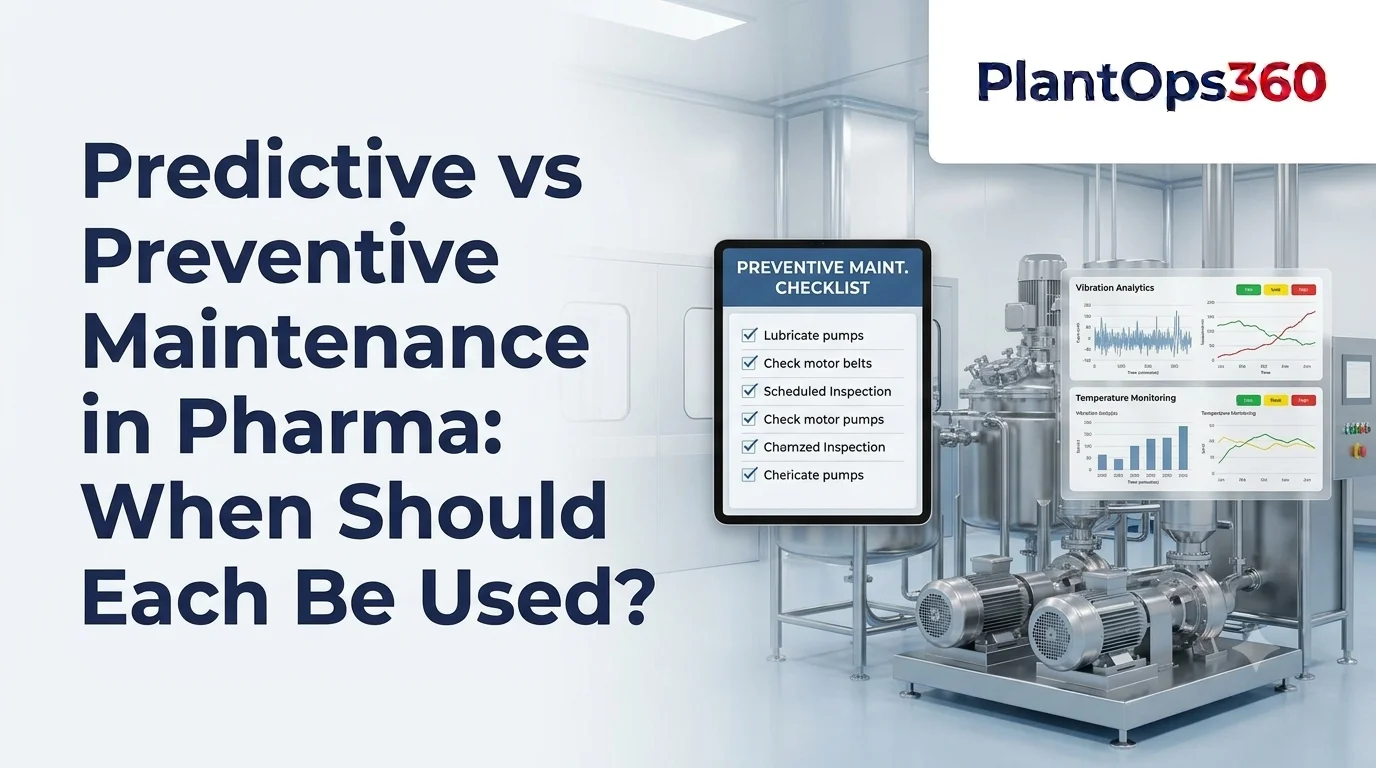
Predictive vs Preventive Maintenance in Pharma: When to Use Each with AI Pharma Maintenance Software
Pharmaceutical manufacturers cannot treat equipment maintenance as a simple repair activity. Equipment reliability can affect production continuity, product quality, documentation, and compliance.
Preventive maintenance follows planned schedules before equipment fails. Predictive maintenance uses condition and performance data to identify developing problems and determine when attention may be needed. AI pharma maintenance software can help teams manage both approaches while keeping maintenance activities organized and traceable.
The right strategy is usually not choosing one over the other. It is knowing where each method fits.
What Is Preventive Maintenance in Pharmaceutical Manufacturing?
Preventive maintenance is work performed at planned intervals to keep equipment operating correctly and reduce the likelihood of failure.
Schedules may be based on:
- Calendar periods
- Operating hours
- Production cycles
- Manufacturer recommendations
- Equipment criticality
- Established maintenance procedures
Typical tasks include lubrication, inspections, filter changes, belt checks, cleaning, adjustments, and component replacement.
Preventive maintenance is especially important in regulated pharmaceutical environments. FDA guidance for API manufacturing states that schedules and procedures should be established for preventive maintenance of equipment.
WHO guidance also emphasizes documented maintenance procedures, schedules, records, and appropriate equipment control.
What Is Predictive Maintenance in Pharma?
Predictive maintenance takes a condition-based approach.
Instead of servicing equipment only because a fixed date has arrived, teams monitor indicators that may show changes in equipment condition.
These indicators may include:
- Vibration
- Temperature
- Pressure
- Energy consumption
- Motor condition
- Operating trends
- Equipment alarms
The objective is to identify abnormal behaviour early enough to investigate and plan maintenance before a significant failure develops.
AI pharma maintenance software can support this process by helping teams analyze equipment information, recognize patterns, and highlight conditions that may require attention.
Predictive vs Preventive Maintenance: What Is the Main Difference?
Both approaches aim to improve reliability, but they decide when maintenance should happen differently.
Preventive Maintenance Uses a Defined Schedule
Preventive maintenance is usually based on predefined intervals.
For example, a machine may require inspection every month or servicing after a certain number of operating hours.
This makes maintenance easier to plan and helps ensure required tasks are not forgotten.
Predictive Maintenance Uses Equipment Condition
Predictive maintenance responds to changes in actual equipment behaviour.
If condition data indicates deterioration, maintenance teams can investigate even if the next planned service date is still weeks away.
This approach may help avoid unnecessary interventions while giving earlier warning of developing problems.
When Should Pharma Plants Use Preventive Maintenance?
Preventive maintenance remains important where equipment must follow documented servicing requirements.
It is particularly suitable when:
- Manufacturers specify maintenance intervals
- Regulations or procedures require scheduled work
- Filters or consumables need periodic replacement
- Calibration and inspection activities have defined intervals
- Equipment failure could affect critical operations
WHO guidance supports defined maintenance and calibration programmes and emphasizes keeping records of these activities.
A digital system can help teams ensure that these recurring activities are scheduled, assigned, completed, and documented consistently.
When Does Predictive Maintenance Make More Sense?
Predictive maintenance can add value when equipment condition can be measured reliably.
It may be useful for assets such as:
- Motors
- Pumps
- Compressors
- HVAC equipment
- Utility systems
- Rotating machinery
- Critical production equipment
For example, increasing vibration on a motor may suggest developing mechanical deterioration. A gradual change in temperature or energy consumption may also justify investigation.
Predictive maintenance is most valuable when the monitored data provides meaningful information about equipment condition.
It should complement established maintenance and quality processes rather than automatically replace required schedules.
Can Preventive and Predictive Maintenance Work Together?
Yes. For many pharmaceutical plants, a combined approach is more practical.
Keep Required Preventive Tasks Scheduled
Activities required by approved procedures, manufacturer recommendations, validation strategies, or quality systems should remain controlled through planned schedules.
Digital scheduling can help ensure these tasks are completed on time.
Use Predictive Data to Add Early Warning
Condition monitoring can then provide another layer of information.
If equipment begins showing unusual behaviour between scheduled services, maintenance teams can investigate sooner.
This creates a strategy where preventive maintenance provides structure while predictive maintenance provides additional equipment insight.
How Can AI Pharma Maintenance Software Support Both Approaches?
Managing hundreds of assets manually can make maintenance planning difficult.
AI pharma maintenance software can help centralize equipment information and support workflows such as:
- Preventive maintenance scheduling
- Work order generation
- Equipment history
- Condition monitoring
- Alerts and notifications
- Maintenance documentation
- Technician assignments
- Failure trend analysis
- Maintenance reporting
AI-based analysis may also help teams identify unusual patterns in equipment data. However, maintenance decisions should still consider engineering judgment, approved procedures, equipment criticality, and quality requirements.
How Should Pharma Plants Decide Which Strategy to Use?
Start with equipment criticality and risk.
Ask questions such as:
- Could failure affect product quality?
- Could failure stop an important process?
- Is there a defined maintenance requirement?
- Can equipment condition be measured reliably?
- Is enough historical or sensor data available?
- Would early warning provide operational value?
High-criticality equipment may benefit from scheduled preventive maintenance combined with condition monitoring.
Lower-risk assets may require a simpler approach.
The maintenance strategy should always reflect the role of the equipment and the risks associated with failure.
Frequently Asked Questions
Can predictive maintenance replace preventive maintenance in pharma?
Not automatically. Required scheduled maintenance should remain in place where procedures, manufacturer recommendations, validation requirements, or applicable quality controls require it. Predictive information can support and improve the overall maintenance strategy.
Does predictive maintenance require sensors on every machine?
No. Sensors are most useful where measurable condition data can provide meaningful warning of deterioration. Not every asset needs continuous condition monitoring.
Can AI automatically decide when pharmaceutical equipment should be serviced?
AI can support analysis and highlight unusual patterns, but maintenance decisions should still follow approved procedures, engineering evaluation, equipment criticality, and applicable quality requirements.
Should maintenance records be kept for pharmaceutical equipment?
Yes. Documented maintenance records are an important part of equipment control. WHO GMP guidance specifically addresses maintaining records of repair and maintenance activities.
Conclusion: Use the Right Maintenance Strategy for Each Asset
Preventive and predictive maintenance solve different parts of the equipment reliability challenge.
Preventive maintenance provides structured, scheduled servicing. Predictive maintenance adds condition-based insight that can help teams identify developing problems earlier. In pharmaceutical manufacturing, the strongest approach may combine both according to equipment criticality, approved procedures, and available data.
If your plant wants to improve maintenance scheduling, equipment visibility, condition tracking, and maintenance records, explore PlantOps360 AI pharma maintenance software to build a more connected approach to pharmaceutical maintenance.