Sign up with Google
 Sign in with Zoho

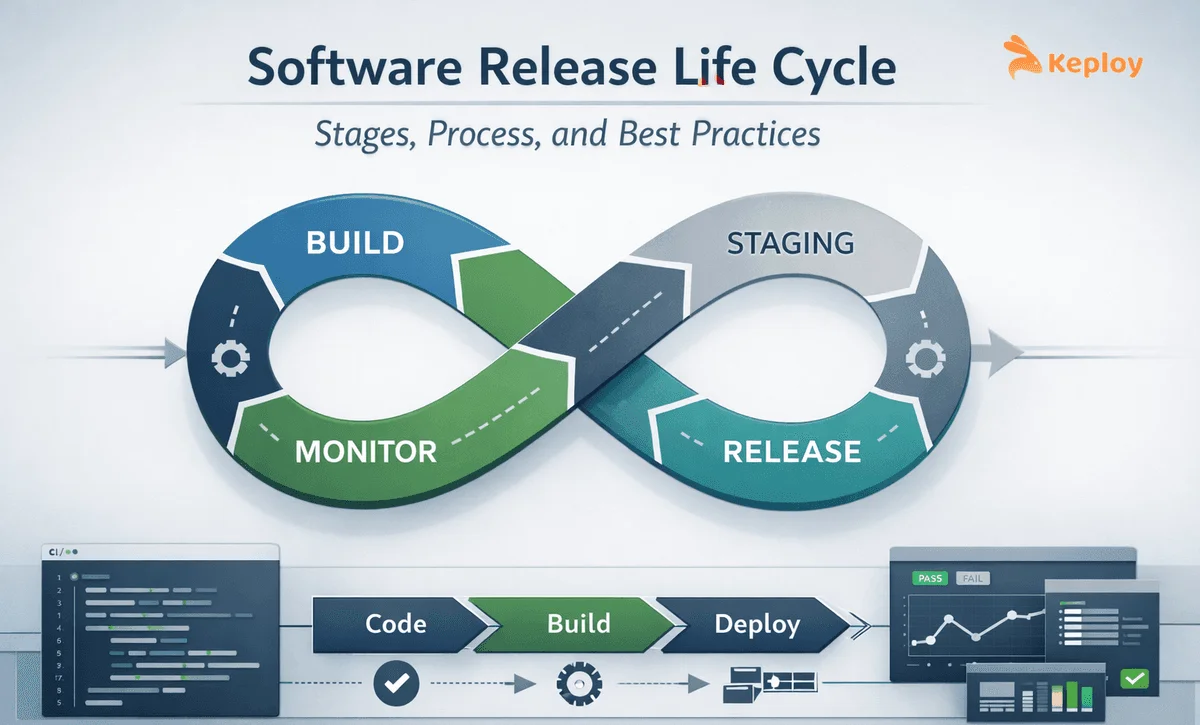
Releasing software is one of the most critical stages of the software development lifecycle. A successful deployment delivers new features, bug fixes, and improvements to users without disrupting the application's performance or availability. However, poor deployment practices can lead to downtime, service interruptions, and frustrated customers.
This is why modern engineering teams rely on well-defined deployment strategies to reduce risk and ensure smooth software releases. Whether you're deploying a small web application or a large-scale cloud platform, choosing the right deployment approach can significantly impact reliability, user experience, and business outcomes.
What Are Deployment Strategies?
A deployment strategy is the method used to release new versions of software into production environments. It defines how updates are delivered to users, how risks are managed, and how rollbacks are handled if issues occur.
The ideal deployment strategy should:
- Minimize downtime
- Reduce deployment risk
- Ensure application stability
- Enable quick rollbacks
- Support continuous delivery
Different organizations choose different strategies based on their infrastructure, business requirements, and risk tolerance.
Why Deployment Strategies Matter
In today's competitive landscape, businesses release software more frequently than ever before. Continuous integration and continuous delivery (CI/CD) pipelines have accelerated development cycles, making efficient deployment processes essential.
Effective deployment strategies help organizations:
Reduce Downtime
Users expect applications to be available 24/7. Modern deployment methods help minimize service interruptions.
Improve User Experience
Smooth releases ensure users receive updates without experiencing performance issues or outages.
Lower Risk
Gradual rollout strategies allow teams to identify and resolve issues before they impact all users.
Enable Faster Innovation
Reliable deployment processes empower development teams to ship features more frequently.
Support Business Continuity
A well-planned deployment strategy ensures critical systems remain operational during updates.
Common Deployment Strategies
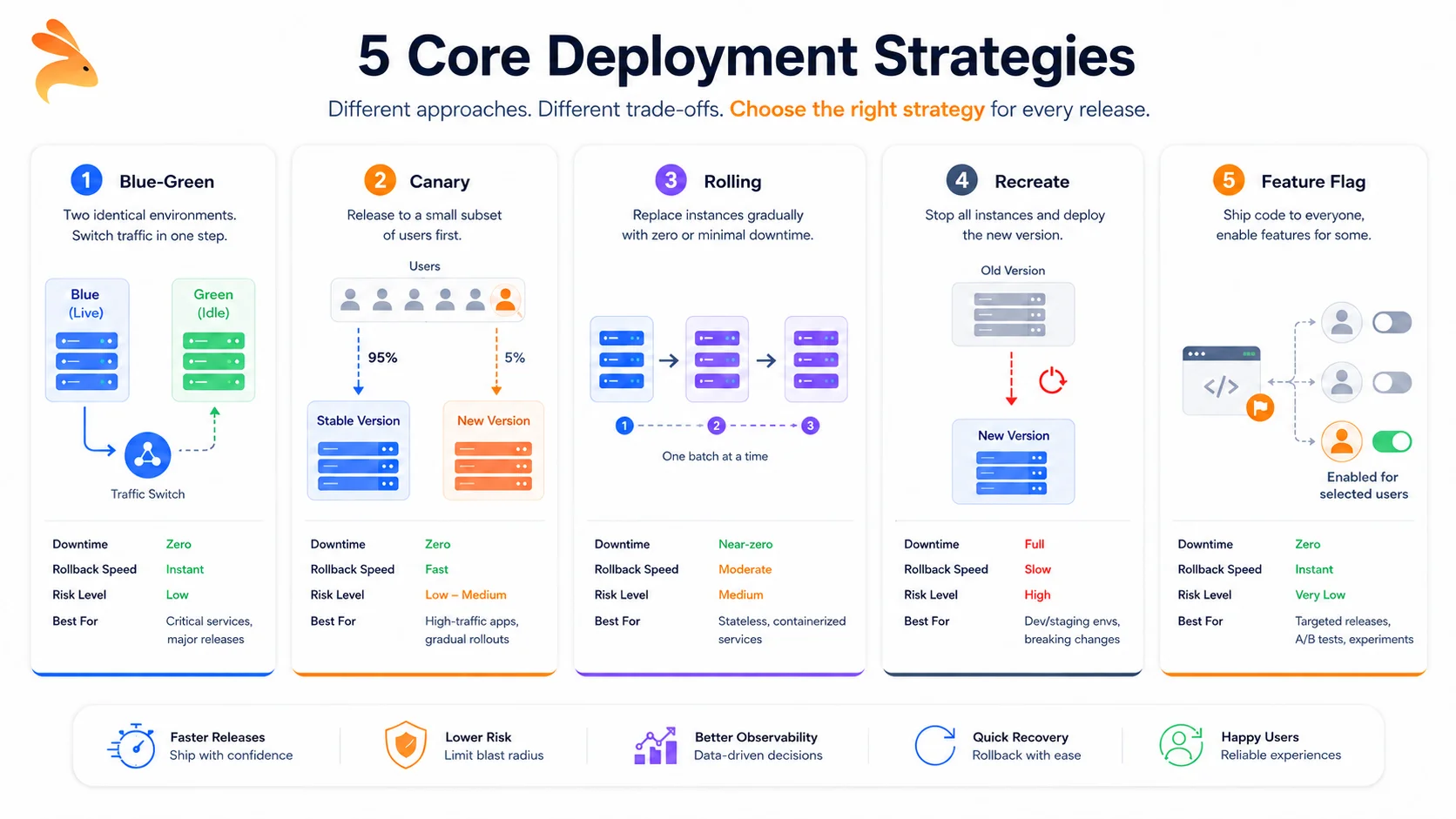
1. Recreate Deployment
The recreate strategy is one of the simplest deployment methods.
In this approach:
- The current application version is shut down.
- The new version is deployed.
- Services are restarted.
Advantages
- Easy to implement
- Minimal infrastructure requirements
- Suitable for non-critical applications
Disadvantages
- Causes downtime
- Risk of service interruption
- Poor user experience during updates
While simple, recreate deployments are rarely suitable for high-availability systems.
2. Rolling Deployment
Rolling deployment gradually replaces old application instances with new ones.
Instead of updating everything at once, servers are updated incrementally.
Advantages
- Reduced downtime
- Lower deployment risk
- Efficient resource utilization
Disadvantages
- Multiple versions may run simultaneously
- Rollbacks can be more complex
- Requires careful compatibility management
Rolling deployments are commonly used in Kubernetes and cloud-native environments.
3. Blue-Green Deployment
Blue-Green deployment uses two identical environments:
- Blue Environment (current production)
- Green Environment (new version)
The new release is deployed to the inactive environment. Once validated, traffic is switched to the new version.
Advantages
- Near-zero downtime
- Quick rollback capability
- Safer deployments
Disadvantages
- Requires duplicate infrastructure
- Higher operational costs
- More complex environment management
Blue-Green deployment is popular for mission-critical applications where reliability is essential.
4. Canary Deployment
Canary deployment releases new software to a small percentage of users before a full rollout.
The process typically involves:
- Deploying the new version to a limited audience.
- Monitoring performance and user feedback.
- Expanding rollout if no issues are detected.
Advantages
- Reduced risk exposure
- Early detection of problems
- Better user impact control
Disadvantages
- Requires advanced monitoring
- More complex deployment pipelines
- Additional operational overhead
Many large technology companies use canary deployments to validate changes in production safely.
5. A/B Deployment
A/B deployment delivers different application versions to separate user groups.
This strategy is often used for:
- Feature experimentation
- Performance testing
- User behavior analysis
Advantages
- Data-driven decision making
- Improved feature validation
- Better understanding of user preferences
Disadvantages
- Increased operational complexity
- Requires analytics infrastructure
- More difficult maintenance
A/B deployments are particularly useful for product teams focused on optimization and experimentation.
6. Shadow Deployment
Shadow deployment runs the new application version alongside the existing one without exposing it directly to users.
Production traffic is mirrored to the new version for evaluation.
Advantages
- Real-world testing conditions
- No impact on end users
- Early issue detection
Disadvantages
- Increased infrastructure costs
- Additional monitoring requirements
- More complex setup
Shadow deployments provide valuable insights before full production releases.
Choosing the Right Deployment Strategy
There is no universal deployment strategy that works for every organization.
Factors to consider include:
Application Criticality
Mission-critical systems often require Blue-Green or Canary deployments.
Infrastructure Budget
Some strategies require additional environments and resources.
Team Expertise
Complex deployment approaches demand experienced DevOps and engineering teams.
Release Frequency
Organizations deploying multiple times daily benefit from automated and low-risk strategies.
Rollback Requirements
Fast rollback capabilities are essential for minimizing production incidents.
The best strategy balances reliability, cost, and operational complexity.
The Role of CI/CD in Modern Deployments
Continuous Integration and Continuous Delivery have transformed software deployment processes.
CI/CD pipelines automate:
- Code integration
- Testing
- Build creation
- Deployment execution
- Rollback procedures
Benefits include:
- Faster releases
- Consistent deployments
- Reduced human error
- Improved developer productivity
However, successful CI/CD depends heavily on reliable automated testing.
Why Testing Is Critical Before Deployment
Even the most advanced deployment strategy cannot compensate for insufficient testing.
Before deploying software, teams should validate:
- Functional requirements
- API behavior
- Integration workflows
- Security controls
- Performance expectations
Comprehensive testing reduces deployment failures and improves release confidence.
How Keploy Improves Deployment Confidence
Modern testing platforms like Keploy help teams strengthen deployment pipelines by automatically generating test cases from real application traffic.
Instead of manually creating extensive test suites, developers can:
- Capture real-world API interactions
- Generate automated tests
- Create mocks and stubs
- Run regression tests before deployment
- Integrate validation directly into CI/CD pipelines
This approach enables faster feedback and reduces the risk of introducing defects into production.
For teams practicing frequent deployments, Keploy helps ensure that every release is validated against realistic application behavior.
Best Practices for Successful Deployments
To improve deployment success rates, organizations should follow several best practices:
Automate Testing
Automated validation catches issues before they reach production.
Monitor Application Health
Track performance, errors, and resource utilization during deployments.
Implement Rollback Plans
Every deployment should include a tested rollback strategy.
Deploy Incrementally
Gradual rollouts reduce user impact and deployment risk.
Use Infrastructure as Code
Automating infrastructure improves consistency and reliability.
Validate Production Readiness
Perform final checks before exposing updates to users.
Conclusion
Deployment strategies play a crucial role in modern software delivery. Whether using Rolling, Blue-Green, Canary, A/B, or Shadow deployments, the goal remains the same: delivering high-quality software with minimal risk and maximum reliability.
As release cycles continue to accelerate, organizations must combine effective deployment practices with robust automated testing. Tools like Keploy help bridge this gap by generating realistic tests, enabling continuous validation, and improving deployment confidence.
By choosing the right deployment strategy and investing in automated quality assurance, teams can release software faster, reduce failures, and create better experiences for users.