Sign up with Google
 Sign in with Zoho

There's a peculiar blind spot in how most businesses approach their About page. They invest heavily in homepage design, agonize over service page copy, and A/B test their pricing — then treat the About page as an afterthought filled with whatever sounded good at the time.
That's backwards, and the consequences are measurable. The About page is where trust either crystallizes or collapses. It's the destination people navigate to when they're close to a decision but need one final piece of reassurance. Treat it casually and you're handing that decision-making moment to a competitor who didn't.
For someone running a web design company or working as an independent website designer, the stakes are even higher. Potential clients in creative service industries scrutinize the About page more than almost any other audience. They're evaluating not just your competence, but your taste, your communication style, and your professional identity. Below is a structural approach that accounts for all of those dimensions.
Reverse the Conventional Opening
The overwhelmingly popular approach is to begin with your company's origin. Year of establishment, founder names, initial vision. This is a reflex, not a strategy.
Here's the problem with that reflex: it asks the reader to care about your timeline before you've given them any reason to care at all. A sentence like "We started in a small garage in 2008" might make for a charming anecdote among friends. To a first-time visitor evaluating your professional services, it's inert data.
The far more effective move is to open with an observation about the visitor's world. Not a sales pitch — an insight. A web design company might write: "Every day, your website either moves a stranger closer to becoming a client or pushes them toward the next search result. There's very little middle ground." That observation forces self-reflection. It's about their reality, not your résumé.
Keep this opening compressed. Two or three sentences that establish relevance and signal understanding. The biography, the credentials, the narrative — those belong deeper in the page, where they'll be received by someone who's already engaged.
Build Around the Visitor's Three Core Questions
Regardless of industry or audience, every person reading your About page is quietly evaluating three things. Your job is to answer them in order:
- 1.Is this person genuinely skilled at what they claim?
- 2.Have they produced results for others in a comparable position?
- 3.Would I feel at ease working with them?
Each question deserves dedicated space and a distinct approach.
Replace Promises With Proof
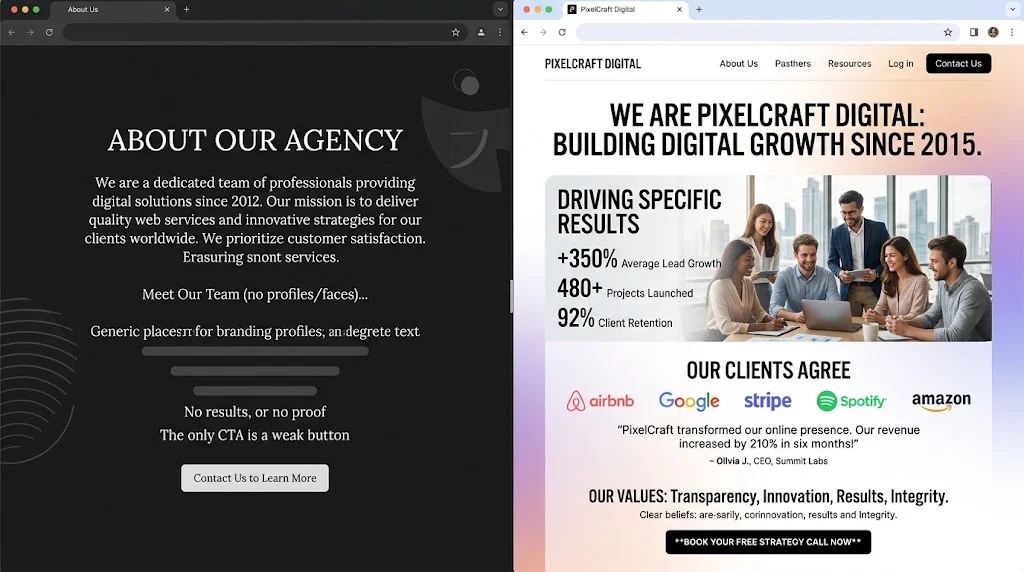
This is where the majority of About pages lose their audience. Filled with declarations about passion, excellence, and innovation, they read like a collection of unfounded assertions. The reader's internal response is predictable: says who?
Credibility is built through specifics that can be verified or at least visualized. Rather than claiming to be passionate about design, a website designer might share: "I've spent the last six years building portfolio sites for photographers — from emerging artists in Brooklyn to established commercial studios in Los Angeles." That sentence gives the reader something concrete to hold onto. It paints a picture. If you're earlier in your career, narrow the focus further. "I work exclusively with boutique fitness studios on their branding and web presence" communicates a clear specialty that a broader claim never could.
Demonstrate Industry Fluency
Trust deepens when a visitor feels understood. Not in a general sense, but in a way that suggests genuine familiarity with their specific professional landscape.
Make your audience obvious. Name the fields you operate within. Reference the kind of work you typically produce for them. When a web design company serving independent veterinary clinics states that specialty clearly, the clinic owner reading the page recognizes their own world reflected back at them. That recognition accelerates trust faster than any credential list.
You don't need to build entire case studies into this section. A focused data point accomplishes the goal efficiently. "Clinics we've redesigned have seen a 38% improvement in new client appointments booked online." One sentence. Let your dedicated case study pages handle the fuller narrative.
Make It Personal — Genuinely
Knowing that human connection builds trust and actually engineering your About page to facilitate it are two different things. The gap between the two is where most businesses fail.
If you're a solo website designer, post an actual photograph of yourself. Not a heavily retouched studio portrait unless that happens to be your authentic aesthetic. Something that communicates approachability — a clear image of a person a client could sit across from and feel comfortable. The goal isn't glamour. It's relatability.
For teams, take the time to introduce each member individually. Pair a name and role with a brief human detail. "Kenji, our visual designer, came to web design through a background in architectural rendering, which explains his obsession with spatial balance." That kind of detail accomplishes something extraordinary on a page. It collapses the distance between "company" and "collection of real human beings with real paths." And real human beings inspire trust at a level no institutional voice can replicate.
Place Your Origin Story Where It Earns Its Keep
Your founding story has genuine value. It provides context, builds emotional resonance, and helps visitors understand the trajectory that led to your current practice. But its placement matters enormously.
Opening with it puts the cart before the horse. By the middle of the page, however, the reader has encountered proof of your competence and evidence of your relevance to their world. Now they're genuinely curious about the person or team behind the work. That's when a well-told story lands with maximum impact.
Distill it to its essential shape. What was the catalyst? What principle emerged? How does that principle guide your current approach? Three narrative beats, each one purposeful.
Consider this version: "My interest in web design began while working at a print agency where I watched clients invest in beautiful brochures that nobody read. I realized early that visual appeal without strategic thinking produces nothing. Every project since then starts with a question: what does the visitor actually need?" That narrative communicates origin, philosophy, and methodology in a single compact arc. It answers the reader's unspoken question — why should this story matter to me?
Strip away any historical detail that doesn't directly enhance the reader's understanding of who you are today.
Declare Your Non-Negotiables
A concise section on your professional values does something unusual. It simultaneously establishes authority and performs early-stage client qualification.
Consider a website designer who publicly commits to testing every site across multiple devices and browsers before launch, even for the smallest projects. Publishing that commitment communicates that you hold firm standards independent of project size. It naturally appeals to clients who care about quality and craftsmanship. Those looking for the cheapest possible route will move on — which is precisely the right outcome.
Depth matters more than breadth here. Two or three specific convictions leave a lasting mark. "We believe in honest, innovative work" blends into the noise. "We'll recommend against a feature if we believe it will confuse your visitors, even if it increases our billable hours" is a principle people remember because it implies a sacrifice. That's what makes a value statement compelling — it costs something.
Close the Loop With One Clear Action
Every About page needs an exit strategy — not in the sense of losing the visitor, but in the sense of giving them a precise next step. Without one, even exceptional content becomes a dead end.
Choose a single call to action and present it with visual prominence. "Explore our work" or "Start a conversation with us" both perform well depending on your sales model. The key is singularity. Multiple options create hesitation. One option creates momentum.
For a web design company, linking to a curated selection of recent work is typically the most natural transition. The reader has just absorbed your philosophy and your story. Their immediate curiosity is to see proof of those ideas in practice. Meet that curiosity at the exact moment it arises.
Small Practices That Build Compounding Trust
Write like a human. First person is warmer and more trustworthy than corporate third-person phrasing. "We" signals a team of people. "XYZ Solutions is committed to" signals a press release.
Read every sentence aloud. Your ear catches rhythmic problems your eyes miss. If something sounds forced or unnatural in speech, it reads the same way.
Audit on a schedule. An outdated About page damages the trust it was designed to earn. References to wrong team sizes, past services, or stale accomplishments do active harm. Review thoroughly at least twice each year.
Delete every generic line. Take each sentence and ask honestly: could a competitor publish this unchanged? If the answer is yes, that sentence isn't earning its place on the page. Replace it with something rooted in your specific experience and point of view.
The Shift That Makes Everything Click
Your About page is not a self-portrait. It's a response to one question the visitor carries: what do I need to know before I trust you?
Answer that question with evidence of real capability. Show them the actual people they'd be working with. Then guide them toward the next step with zero ambiguity. Those three moves put you ahead of the overwhelming majority of competitors — many of whom operate with larger budgets and longer track records.
Open your About page right now and read it through the lens of someone encountering your business for the first time. Identify the gaps between what you've written and what that person actually needs to discover. Closing even one of those gaps can meaningfully shift how the page performs.