Sign up with Google
 Sign in with Zoho
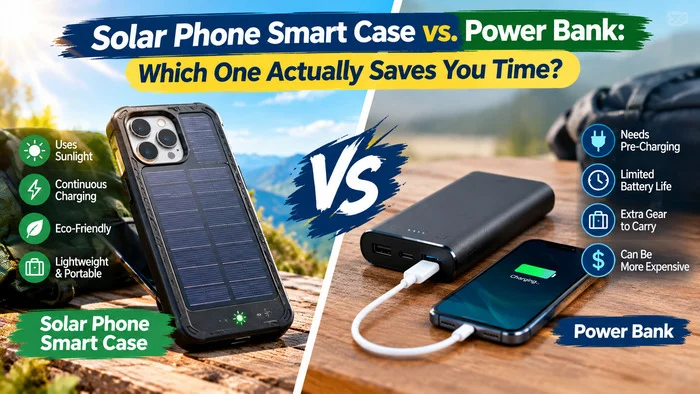
We all know the feeling: you're halfway through your day, your phone hits 15%, and you're suddenly digging through a bag for a cable, hoping the power bank you packed is actually charged. It's a small annoyance, but it adds up — and it's exactly the kind of friction that a solar phone smart case claims to eliminate.
But does it actually save you time compared to a traditional power bank? Or is it just a different way of solving the same problem? Let's break it down honestly.
The Core Difference: Passive vs. Active Charging
The biggest distinction between these two options isn't capacity or price — it's how much effort each one requires from you.
A power bank is an active solution. You have to remember to charge it, remember to pack it, remember to bring a cable, and remember to actually plug your phone in when it's low. Every single one of those steps is a point where the system can fail — usually right when you need it most.
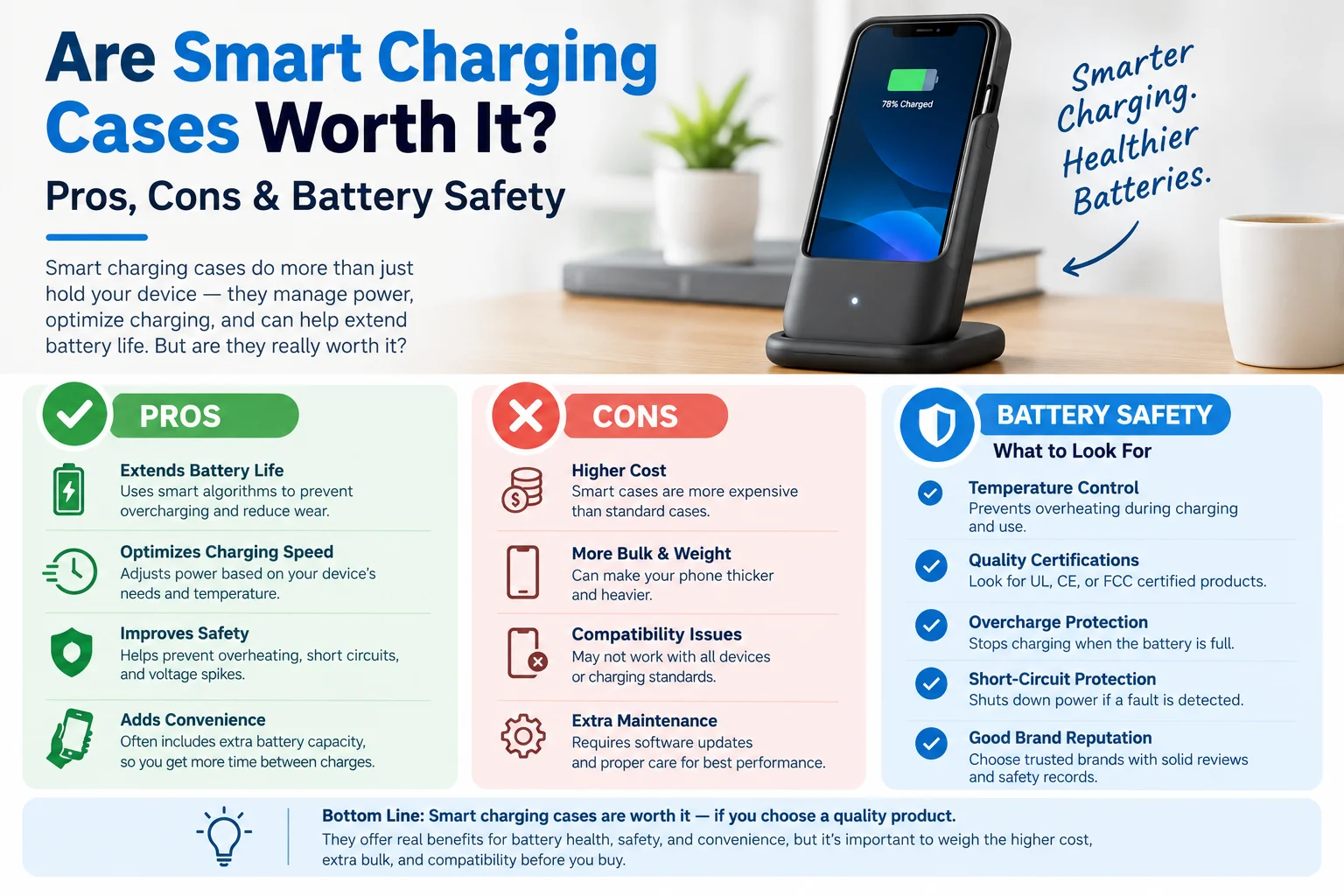
A solar phone smart case is a passive solution. It's already attached to your phone, so there's nothing extra to carry. Many smart cases also use built-in intelligence to manage charging automatically — tracking usage patterns, prioritizing solar input when available, and alerting you before your battery gets critically low, instead of leaving you to guess.
That difference in effort is really what "saves time" comes down to.
Where a Power Bank Still Wins
To be fair, power banks aren't obsolete. They have real advantages:
- Higher raw capacity — a good power bank can hold 20,000mAh or more, often multiple full phone charges
- Faster charging speed — most support USB-C Power Delivery, charging your phone significantly faster than solar input ever could
- Lower upfront cost — decent power banks are widely available at lower price points
- Universal compatibility — one power bank can charge multiple devices, not just your phone
If your priority is charging speed or you need to top up several devices at once, a power bank is still the more practical tool for that specific job.
Where a Solar Phone Smart Case Actually Saves Time
The time savings from a smart case show up in smaller, everyday moments rather than one big advantage:
You Never Forget It
Since it's attached to your phone, there's no "did I pack it?" moment. This alone eliminates a huge chunk of the daily friction people experience with backup chargers.
No Cable Hunting
You're not searching for a compatible cable or an open outlet to recharge a separate device — the case charges passively throughout the day, often via sunlight or ambient use.
Predictive Charging Reduces Decision-Making
This is where "smart" earns its name. Instead of manually checking a power bank's charge level, a smart case can track your typical battery drain and proactively manage power delivery — so you're not the one making constant charging decisions.
One Less Object to Manage
A power bank is another item in your bag with its own charge level, its own cable, and its own chance of being left behind. A smart case removes that entirely from your daily checklist.
A Simple Way to Compare Them
Who Actually Benefits More From a Smart Case
A solar powered smart case tends to save the most time for people whose daily routine already involves a lot of small charging friction:
- Commuters and professionals who don't want to think about battery management between meetings
- Outdoor workers who spend hours away from outlets and can't rely on remembering to bring a charger
- Travelers who want to reduce the number of items they're responsible for tracking
- Parents and caregivers juggling enough logistics without adding "charge the power bank" to the list
Brands like iPowerUp Corporation have leaned into this exact use case, building smart cases with app-based tracking and predictive alerts specifically so users aren't manually monitoring charge levels the way they would with a standalone power bank. That shift — from active monitoring to passive management — is really the time-saving mechanism at the core of smart case technology.
Who Still Benefits More From a Power Bank
On the other hand, a power bank still makes more sense if:
- You need to charge multiple devices, not just your phone
- You want the fastest possible charging speed
- You're on a tighter budget
- You don't mind the extra step of carrying and managing a separate device
Final Verdict: It Depends on What "Saving Time" Means to You
If saving time means charging faster, a power bank wins — nothing beats direct, high-wattage charging speed.
If saving time means removing daily mental load — not forgetting a charger, not hunting for cables, not manually tracking battery percentage — a solar phone smart case is the clear winner. It trades raw speed for consistency and reduced effort.
For most people, the real question isn't "which is objectively better," but "where does my time actually get wasted?" If it's in the small daily friction of managing a separate device, a smart case solves that. If it's in slow charging speeds during rare high-drain days, a power bank still has the edge.
Frequently Asked Questions
Q1. Is a solar phone smart case as fast as a power bank?
No, solar charging is generally slower than a wired power bank, especially one with USB-C Power Delivery. Smart cases prioritize convenience and passive charging over raw speed.
Q2. Can a solar phone smart case fully replace a power bank?
For daily, moderate use, yes for many people. But if you regularly need fast, high-capacity charging or need to power multiple devices, a power bank is still more practical as a backup or supplement.
Q3. Do smart cases actually track battery usage automatically?
Many modern smart cases include companion apps that monitor usage patterns and alert users before battery levels get critically low, reducing the need for manual checking.
Q4. Which option is better for travel?
It depends on trip length and access to outlets. For daily convenience and shorter trips, a smart case reduces what you need to pack. For extended off-grid travel, a high-capacity power bank may still be necessary as backup.
Q5. Do solar phone smart cases work well in cloudy weather?
Solar input drops significantly in low light, so most smart cases rely on a combination of stored battery charge and occasional solar top-ups rather than sunlight alone.