Sign up with Google
 Sign in with Zoho

Picture this: you're on a hiking trail, a long train ride, or in the middle of a power cut, and your phone drops to 5%. A solar charger for mobile sounds like the perfect rescue, because free energy from the sun is hard to argue with. The catch is that the market is crowded, and plenty of products promise far more than they can deliver.
This guide explains how these chargers work, how fast they really are, and what to check before you spend any money. You'll also find honest advice on who should buy one and who shouldn't.
How Does a Solar Charger for Mobile Work?
A solar charger for mobile uses photovoltaic cells that turn sunlight into electricity. That electricity passes through a small controller, which regulates the voltage so it's safe for your phone, and then flows out through a USB port to your device.
Some chargers send power straight to the phone. Others store it first in a built-in battery, so you can charge your phone later, even at night. The second type is usually more practical, because sunshine rarely arrives at the exact moment you need it.
Types of Solar Chargers for Phones
Foldable Solar Panels
A foldable solar panel is a set of panels that open up like a book and can be clipped onto a backpack or tent. Because the surface area is larger, it collects more sunlight, which makes it the best option if you want a serious portable solar charger. Many models come with USB-A and USB-C ports, and some offer power delivery for faster charging. The trade-off is that they are bulkier than other types.
Solar Power Banks
A solar power bank is a regular battery pack with a small panel on top. You can charge it from a wall socket, and the panel adds a little extra power outdoors. The panel on most of these is very small, so treat it as an emergency trickle charger, not a main power source. Don't rely on it to fill a large battery in a day.
Hybrid Setups
Some travelers pair a foldable panel with a normal power bank. The panel charges the bank during the day, and the bank charges the phone at night. It costs more, but it's the most reliable way to use a solar charger for mobile on longer trips.
How Fast Is a Solar Charger for Mobile, Really?
This is where many buyers get disappointed, so here is the honest picture. Every solar charger for mobile is rated under ideal lab conditions: bright, direct sun, a perfect angle, and no clouds. Real life rarely matches that.
A rough rule: expect real-world output to be well below the number printed on the box. A small panel may only deliver a couple of watts in good sunlight, while a larger foldable solar panel can do much better. A typical phone battery holds roughly 15 to 20 watt-hours, so a small panel can take many hours to fill one, and a bigger one may do it in a few.
What changes the speed:
- Sunlight strength: Midday sun beats morning or evening light.
- Panel angle: Pointing the panel straight at the sun makes a big difference.
- Weather: Clouds, haze, and shade reduce output sharply.
- Heat: Panels lose some efficiency when they get very hot.
- Panel size and wattage: More surface area means more power.
What to Look for in the Best Solar Charger for Mobile
When you compare options, use this checklist.
Wattage. For a panel that charges a phone in a reasonable time, look for roughly 15W to 28W. Smaller panels work only as backups.
Battery capacity (mAh). If the unit has a built-in battery, check the mAh rating. A 10,000 mAh battery can recharge a typical phone about once or twice, though real results are lower because some energy is lost in conversion.
Panel type. Monocrystalline panels are generally more efficient than cheaper alternatives, which matters when sunlight is limited.
Ports and speed. A USB-C port with power delivery support charges modern phones faster than an old USB-A port alone.
Durability and waterproofing. For outdoor use, look for a waterproof or splash-resistant rating. A higher IP rating means better protection against dust and water.
Weight and size. If you'll carry it on a hike, every gram counts.
Safety protections. Choose a model with overcharge, overheat, and short-circuit protection so it won't harm your phone battery.
Honest reviews. Read feedback from buyers who actually used the product outdoors, not just launch-day praise.
Quick Comparison: Which Type Suits You?
Who Should Buy a Solar Charger for Mobile?
A solar charger for mobile makes sense if:
- You camp, trek, or spend long days outdoors.
- You live in an area with frequent power cuts.
- You want an eco-friendly backup for emergencies.
- You travel to places where sockets are hard to find.
It's probably not worth it if you mostly use your phone in a city. In that case, a regular power bank is cheaper, faster, and more dependable.
Tips to Get More Power from Your Solar Charger
- Face the sun directly and adjust the angle every hour or so.
- Keep it out of shade, because even a small shadow can cut output a lot.
- Charge the battery first. Use a built-in or separate power bank, then charge your phone from that.
- Keep the panel clean. Dust and smudges block sunlight.
- Don't leave it in extreme heat. High temperatures can wear out both the panel and the battery.
- Put your phone in airplane mode while it charges to speed things up.
Solar Charger for Mobile vs Power Bank
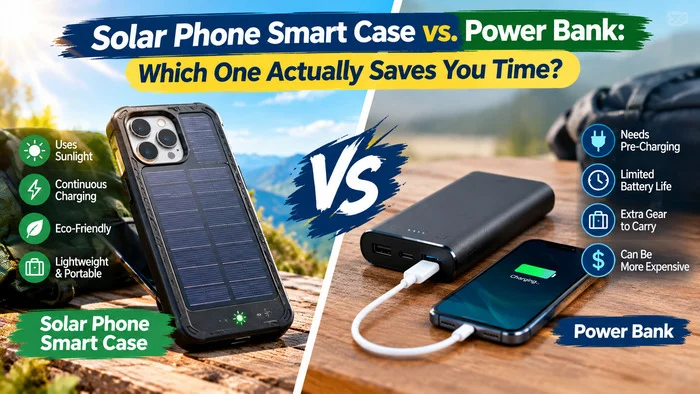
A regular power bank is the better everyday tool. It's smaller, charges fast from a wall socket, and works in any weather. A solar charger for mobile wins when you have no access to electricity for days. Many people sensibly carry both: the power bank for daily life and the solar option for trips and emergencies.
Our Buying Advice
Before you buy, match the charger to your real habits instead of the biggest number on the box. At iPowerUp Corporation, we encourage customers to choose certified products with proper safety protection, honest specifications, and a capacity that fits their phone. A well-chosen model will serve you for years, while a cheap, unrated one can disappoint you on the first trip.
Final Thoughts
The best solar charger for mobile is the one that suits how you live. If you hike, camp, or travel, a foldable solar panel paired with a battery is a smart investment. If you only need a safety net, a small solar power bank is enough. Keep your expectations realistic, check the wattage and safety features, and you'll avoid the most common mistakes. For safe, reliable power gear, iPowerUp Corporation is ready to help you find the right fit.
Frequently Asked Questions
1. How long does a solar charger for mobile take to charge a phone?
It depends on panel size and sunlight. A small panel can take many hours, while a larger foldable panel in strong sun may need only a few.
2. Can a solar phone charger work on cloudy days?
Yes, but at a much lower speed. Clouds cut output sharply, so charging a battery first when the sun is strong is a better strategy.
3. Is a solar charger for mobile worth buying?
It's worth it for campers, hikers, travelers, and people facing frequent power cuts. For daily city use, a normal power bank is usually the better value.
4. Can a solar charger damage my phone battery?
A good-quality charger with proper protection won't. Cheap, uncertified chargers with unregulated output are the real risk.
5. Can I charge my phone with a solar charger indoors?
Not effectively. Indoor light is far too weak, so panels work best outdoors in direct sunlight.
6. What wattage solar charger do I need for a phone?
For reasonable speed, roughly 15W to 28W works well. Smaller panels are better as emergency backups.
7. Is a solar power bank better than a foldable solar panel?
A foldable panel charges faster and collects more power. A solar power bank is more compact but its small panel is only a trickle charger.
8. How do I make my solar charger last longer?
Keep it clean, dry, and away from extreme heat, avoid fully draining the battery, and store it properly when it's not in use.