Sign up with Google
 Sign in with Zoho



Many Indians think that the contents of their home cannot be insured without insuring the home itself. There are others who think home insurance is just for the building. Both are wrong.
Pooja was one such person, whose home in Bangalore got broken into while she was away. Her TV, laptop, camera, gold jewellery and other belongings were stolen, and she had no insurance cover.
She never thought her high-end apartment could be robbed so easily. Even after reporting the theft, her belongings worth ₹6 lakh could not be recovered. They were likely sold off already. She could have prevented all this with insurance. But all she knew was that home insurance is for buildings.
To prevent a future mental breakdown from such financial disasters, she immediately consulted an insurance advisor, who happily directed her towards the lesser-known home contents insurance policy.
What is a Home Contents Insurance Policy?
A Home contents insurance plan covers only the contents of an insured home. The insured damage-causing events can include fire, theft, natural calamities, and other unforeseen risks. Their contents to insure may include furniture, appliances, electronics, valuable items, but subject to individual policy terms, with certain item types having additional limits, conditions, or exclusions.
Home Contents Insurance can be availed through two main policy types in India. The Bharat Griha Raksha (BGRP) is a standardized home insurance policy regulated by the IRDAI, and the base cover includes both home property and home contents. Policy buyers who are tenants can choose the “contents only” coverage. Many insurers provide this standardized policy, such as Bajaj General Insurance, New India, and ICICI Lombard. Specialized policies, like the New India Griha Suvidha Policy, may have varying policy wordings and coverage details, but they also offer “home contents only” coverage option.
Misconception 1: “I only need to Insure the Expensive things”
Pooja was worried about losing her most expensive and treasured belongings, like her laptop with all her work files, the camera that was a gift, her TV, and her jewellery that she regularly wore to cultural events. Their estimated total worth was ₹6 lakh. She assumed that was the amount she would need insurance for, as the rest of her belongings were easily replaceable.
Her insurance advisor interjected at this point, and asked her to list and categorize every item in her home, including the ones she had before the theft.
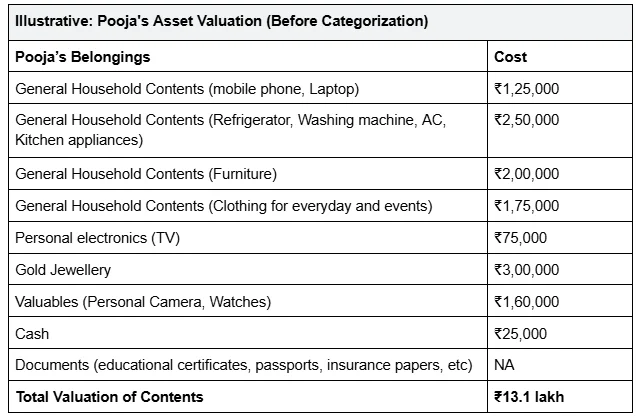
Pooja’s advisor was right in requesting a re-valuation of her contents. Pooja’s own estimates were off by ₹7.1 lakh. She did not realise that the general household items, that she deemed easily replaceable, were actually worth ₹6.85 lakh, and were contributing more than 50% to the entire valuation of her belongings.
If Pooja had any existing insurance, she could have saved ₹6 lakh worth of items that she lost in the theft, with only a nominal premium. For example, the New India Griha Suvidha Policy Features Brochure offers a Sum Insured limit of ₹10 lakh for general items, and ₹4 lakh for jewellery and valuables. This would have comfortably covered Pooja’s theft loss for a premium of ₹7,175 a year or around ₹598 a month.
Misconception 2: "All my belongings have the same Coverage Limit"
Next, Pooja’s advisor points out the need for categorization of her assets according to the policy of choice, as different item categories often have different applicable Sum Insured values, limits, and conditions. The New India Griha Suvidha Policy Features Brochure does have separate listed Sum Insured values and conditions for each of the item categories.
Pooja modifies her item valuations according to the item categories in the New India Griha Suvidha Policy, to get an estimate of her required coverage.
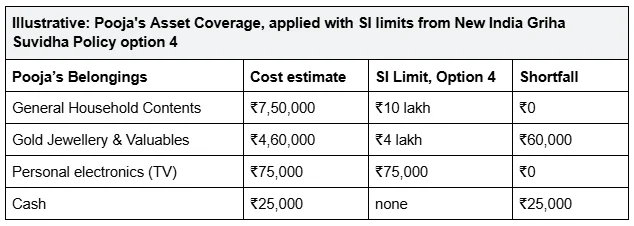
She notes the Sum Insured limits provided by this New India policy that matched her needs: ₹10 lakh for general household items, ₹4 lakh for jewellery and valuables, ₹75,000 for her TV. Loss of her cash or documents was not covered at all by this policy. And, in a future possible loss, she still would have to pay a minimum of ₹75,000 to replace her jewellery and cash. Thus, her new goal can be to insure the remaining ₹12.25 lakh of her assets.
The insurance advisor then introduces the concept of “First-loss basis”, and cautions Pooja that her Sum Insured estimations might be different.
Sum Insured on a First-loss Basis:
Even though Pooja had ₹12.25 lakh of assets to insure, she can insure a lesser amount. The basic idea is that any single covered event or peril has a very low probability of wiping out the entire ₹12.25 lakh worth of belongings. Instead, a part of the assets can be insured, and in return the policy buyer saves money on premiums.
There is no rule of thumb to arrive at this number. It can equal the amount Pooja thinks can be lost from a single peril or event. Her advisor again helped her to get a realistic assumption of that value, which would be recorded in the final policy as the Sum Insured limit on first-loss basis.
Pooja decides to settle on these new Sum Insured limits: ₹5 lakh for general household items, ₹2 lakh for jewellery and valuables, and ₹60,000 for her TV. These are the limits under option 3 of the New India Griha Suvidha Policy, and the relevant premium amounts were accessed in August 2026.
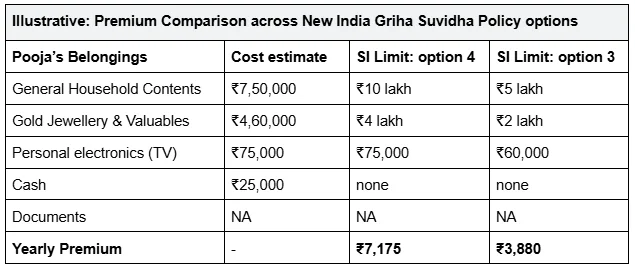
By choosing option 3 of the New India policy, Pooja could save ₹3,295 in yearly premiums, which is almost a 46% reduction from option 4 chosen earlier. The reduced premiums will cost her only around ₹323 per month. In return, she gets a maximum coverage of ₹7.6 lakh. The remaining ₹5.5 lakh of her belongings remains uninsured, but she will most probably not need to worry about it.
Misconception 3: "The Sum Insured is what I will actually receive"
Pooja’s insurance advisor cautions her again, stating that the applicability of other conditions can affect the Sum Insured limit. The New India Griha Suvidha Policy Clause has sections describing excess/deductibles, and Condition of Average/Underinsurance.
This policy does not apply any Underinsurance, in a way that is relevant to Pooja. If an Underinsurance clause was applicable, then Pooja with ₹7.5 lakh of general household contents and selecting a ₹5 lakh first-loss sum insured limit, would get proportional reduction in claim payout simply because ₹5 lakh is less than ₹7.5 lakh.
This policy does have an Excess clause for each item category, set at 1% of the Sum Insured limit.
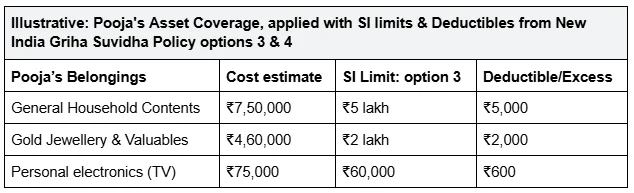
So if she files a single claim for general household contents, jewellery, and her TV, she has to pay ₹7,600, and the same amount would be reduced from her Sum Insured limit of ₹7.6 lakh. Pooja who had no previous knowledge of deductibles, was likely expecting the coverage limit of ₹7.6 lakh.
A point to remember is that even with a final stated Sum Insured limit, the actual payout for Pooja in any claim could be lower than that. Her insurance advisor would be able to walk her through that learning too.
Why SimpliInsure?
Initially, Pooja had no idea that a home contents insurance policy existed. Even after she was introduced to it, she had very limited understanding of what she should insure and how much maximum coverage she could expect. The SimpliInsure platform and its advisors exist to guide people like Pooja towards adequate protection for their home belongings.
1. Pooja held the misconception that only the loss of her expensive belongings would cause her financial shock. She later found out that her asset valuation estimates were off by half, and possible loss of many other could also cause significant financial loss.
SimpliInsure’s advisory team would help Pooja accurately value all her assets, so she is not left undercovered and in a state of mental breakdown.
2. Pooja held the misconception that she needed insurance for the complete loss of her assets happening from a single event. Instead, she found its probability to be very low. She can comfortably insure only a part of her assets and still save herself from any financial shock, by availing a cheaper plan with a lower stop-loss sum insured limit.
SimpliInsure’s advisors can help her with realistic estimates of that new sum insured limit. Pooja can then access the SimpliInsure platform for premiums and other details listed for multiple home contents insurance providers, by specifying that stop-loss sum insured limit.
3. Pooja held the misconception that she would receive the sum that she declares as the stop-loss limit for her policy. But she found additional deductions applicable to the payout as part of mandatory policy conditions.
SimpliInsure’s advisors would clarify in plain language all the deductibles, limits, and policy conditions, so that she does not have to bear another ₹7.6 lakh burden due to possible misinformation.
What Next?
Pooja had to absorb the intense shock of a ₹6 lakh loss within a day, because she didn’t know about home contents insurance and she could not imagine her high-quality apartment being robbed. After her learning journey, she found just ₹323 per month was enough for that protection.
Now that you know home contents insurance policies exist and understand how much they can protect you financially, will you start today and safeguard your belongings or sit with the assumption that your home will always be safe.
Call SimpliInsure on +91 95133 55661 /62 /63 /64 today. In 20 minutes, our advisory team will help you assess the value of your belongings, and guide you through policies with sum insured limits and premiums that match your budget and save you from a potential ₹6 lakh losses later.
Disclaimer: This content is for informational purposes only and should not be treated as financial, medical, or insurance advice. Policy terms, exclusions, and benefits vary across insurers. Please review official policy documents and seek professional guidance before making decisions