Sign up with Google
 Sign in with Zoho

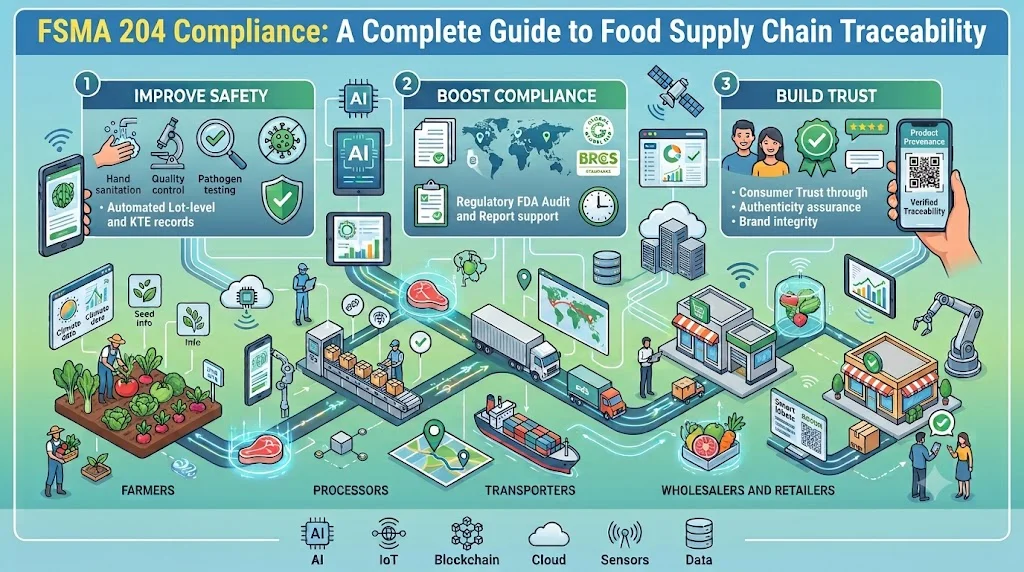
Modern supply chains are more connected than ever, but that connectivity does not always mean businesses have complete visibility.
A product may pass through multiple suppliers, manufacturers, warehouses, logistics providers, distributors, and retailers before reaching its final customer. At every stage, important information is generated. If that information remains fragmented across spreadsheets, emails, ERP systems, warehouse platforms, supplier portals, and paper records, businesses can struggle to understand what is happening across the entire supply chain.
This is why supply chain visibility has become a major business priority.
End-to-end visibility gives organizations a clearer picture of products, materials, suppliers, inventory, shipments, locations, and supply chain events. When visibility is combined with traceability, companies can go beyond simply knowing where something is—they can understand where it came from, what happened to it, and where it is going.
Digital technologies such as cloud platforms, IoT, RFID, QR codes, APIs, analytics, and artificial intelligence are helping businesses create more connected supply chains.
The result is a shift from reactive supply chain management toward proactive, data-driven decision-making.
What Is Supply Chain Visibility?
Supply chain visibility is the ability to access and understand information about activities and products across different stages of a supply chain.
Depending on the organization, visibility may include:
- Suppliers
- Raw materials
- Manufacturing
- Inventory
- Warehousing
- Transportation
- Shipments
- Distribution
- Customers
- Product locations
- Product status
- Supply chain events
Basic visibility may show where inventory is currently located.
More advanced visibility can provide information about the entire product journey.
For example:
Supplier → Manufacturer → Warehouse → Distributor → Retailer → Customer
A business with end-to-end visibility can connect information across these stages rather than treating each stage as an isolated operation.
Supply Chain Visibility vs Supply Chain Traceability
The two concepts are closely related, but they are not identical.
Supply Chain Visibility
Visibility focuses on understanding what is happening across the supply chain.
For example:
- Where is the shipment?
- How much inventory is available?
- Which supplier is delayed?
- What products are currently in transit?
- Which warehouse has available stock?
Supply Chain Traceability
Traceability focuses on tracking the history and movement of a specific product, lot, batch, material, or item.
For example:
- Where did the product originate?
- Which supplier provided the material?
- Which batch was produced?
- Which facilities handled it?
- Where was the product shipped?
In simple terms:
Visibility tells you what is happening.
Traceability helps you understand the product's journey and history.
Combining both creates a much stronger supply chain information system.
Why End-to-End Supply Chain Visibility Matters
Supply chains can contain hundreds or thousands of interconnected events.
A disruption in one area can affect multiple downstream activities.
For example:
Supplier Delay → Production Delay → Inventory Shortage → Shipping Delay → Customer Impact
Without visibility, businesses may discover the problem only after it becomes serious.
With connected supply chain information, teams can identify problems earlier and respond more effectively.
1. Better Inventory Management
Inventory visibility is one of the most important components of supply chain visibility.
Businesses need to know:
- What inventory is available?
- Where is it located?
- What is in transit?
- What has been allocated?
- Which products are approaching expiry?
- Which items are moving slowly?
Poor visibility can result in both excess inventory and stockouts.
Digital systems can connect inventory information across warehouses, facilities, and distribution locations.
This helps organizations make more informed decisions about replenishment and allocation.
2. Improved Supplier Visibility
Suppliers are an important part of any global supply network.
A business may depend on hundreds of suppliers for:
- Raw materials
- Components
- Packaging
- Ingredients
- Services
- Finished products
Without supplier visibility, businesses may struggle to identify potential risks.
A digital supply chain platform can connect supplier information with:
- Orders
- Deliveries
- Quality data
- Certifications
- Product information
- Traceability records
- Performance metrics
This creates a more complete view of supplier relationships.
3. Faster Response to Supply Chain Disruptions
Disruptions can come from many sources.
Examples include:
- Supplier delays
- Transportation problems
- Port congestion
- Equipment failures
- Product quality issues
- Natural disasters
- Geopolitical events
- Demand fluctuations
Businesses cannot always prevent disruptions.
But better visibility can help them identify and respond to disruptions sooner.
For example, if a supplier shipment is delayed, a company with connected supply chain data may be able to identify affected production schedules and inventory levels earlier.
That creates an opportunity to take corrective action before customers are significantly affected.
4. Better Product Traceability
Visibility becomes particularly valuable when businesses need to investigate a specific product.
Imagine a food manufacturer discovers a quality issue associated with an ingredient.
The company may need to determine:
Which supplier provided the ingredient?
Which lot was involved?
Which production batches used it?
Where were those products shipped?
Which customers received them?
A connected traceability system can help establish these relationships.
This is one reason why traceability and visibility are increasingly being integrated into modern supply chain platforms.
5. Faster Recall Management
Product recalls can create significant operational and financial challenges.
A business needs to determine the scope of affected products as quickly as possible.
Without reliable traceability data, teams may need to manually search through:
- Purchase orders
- Production records
- Shipping documents
- Warehouse records
- Supplier communications
- Customer records
- Spreadsheets
Digital traceability can connect these records and make product relationships easier to investigate.
This can help businesses conduct more targeted recall investigations.
6. Better Supply Chain Compliance
Many industries have specific requirements around product identification, traceability, recordkeeping, safety, and reporting.
Examples include:
- Food
- Pharmaceuticals
- Medical products
- Chemicals
- Manufacturing
- Consumer goods
A centralized traceability environment can help organizations organize relevant supply chain information.
However, businesses should evaluate their specific regulatory obligations rather than assuming that a software platform automatically creates compliance.
Technology supports compliance processes; it does not replace them.
The Technologies Driving Supply Chain Visibility
Modern supply chain visibility is supported by several technologies.
IoT
Internet of Things devices can collect information from physical environments.
Depending on the use case, sensors can monitor:
- Temperature
- Humidity
- Location
- Movement
- Equipment conditions
- Environmental conditions
This can be valuable for cold-chain and temperature-sensitive products.
RFID
Radio-frequency identification allows businesses to identify and track products using RFID tags and readers.
It can support automated inventory and movement tracking in suitable environments.
RFID can be particularly useful in:
- Warehouses
- Manufacturing
- Retail
- Logistics
- Asset tracking
QR Codes
QR codes provide an accessible method for connecting physical products with digital information.
Businesses can use QR-based identification for:
- Product information
- Lot tracking
- Batch identification
- Product authentication
- Consumer engagement
- Traceability
QR codes can also support product-level digital experiences.
Cloud Technology
Cloud platforms can connect data from multiple locations and systems.
This is particularly useful for global supply chains where teams may operate across different facilities and countries.
Cloud-based systems can provide centralized access to relevant supply chain information while supporting integrations with other business systems.
APIs and System Integration
Supply chain data often exists across multiple systems.
For example:
ERP + WMS + TMS + CRM + Supplier Systems + Traceability Platform
APIs can help connect these systems.
Instead of manually moving information between platforms, integrated systems can exchange data automatically.
Artificial Intelligence
AI can analyze large volumes of supply chain information to identify patterns and potential risks.
Potential applications include:
- Demand forecasting
- Supplier risk analysis
- Anomaly detection
- Predictive maintenance
- Inventory optimization
- Shipment risk analysis
- Quality monitoring
- Supply chain forecasting
AI becomes more useful when the underlying supply chain data is accurate, structured, and connected.
Real-Time Supply Chain Visibility
Businesses increasingly want supply chain information closer to real time.
Traditional reporting may provide information after an event has already occurred.
For example:
Shipment delayed → Data updated later → Business discovers issue
Real-time or near-real-time systems can shorten this gap.
The workflow can become:
Shipment delayed → System receives update → Alert generated → Team investigates → Action taken
The exact level of real-time visibility depends on available data sources, integrations, sensors, and operational processes.
The Role of Digital Traceability
Digital traceability provides a foundation for connecting product information throughout the supply chain.
A digital traceability record might connect:
Product
↓
Supplier
↓
Lot / Batch
↓
Production Event
↓
Warehouse
↓
Shipment
↓
Customer
This creates a product history that can be searched and analyzed.
For businesses, this can support both operational visibility and product investigations.
How Supply Chain Visibility Improves Decision-Making
Good supply chain decisions require reliable information.
Consider a company deciding whether to increase production.
Without visibility, managers may rely on assumptions.
With connected data, they may have access to:
- Current inventory
- Supplier availability
- Open purchase orders
- Production capacity
- Customer demand
- Products in transit
- Warehouse inventory
- Historical sales
- Supply chain risks
This creates a stronger foundation for planning.
Supply Chain Analytics: Turning Visibility Into Action
Visibility is only valuable when businesses can use the information effectively.
This is where supply chain analytics becomes important.
Analytics can help organizations identify:
- Inventory trends
- Supplier performance
- Delivery patterns
- Product movement
- Demand changes
- Quality issues
- Operational bottlenecks
For example, an organization could analyze historical delivery data to identify suppliers that consistently experience delays.
Instead of simply reporting that a shipment was late, analytics can help identify patterns across hundreds or thousands of shipments.
Supply Chain Visibility and Customer Experience
Customers increasingly expect reliable information.
Depending on the industry, customers may want to know:
- When an order will arrive
- Where a shipment is located
- Whether a product is authentic
- Where a product was produced
- What materials were used
- Whether a product meets specific standards
Greater supply chain visibility can help businesses provide better information to customers.
For consumer products, digital product experiences can connect customers with product information through QR codes, digital identities, or other technologies.
Supply Chain Visibility for Food Businesses
Food supply chains have particularly strong requirements for traceability and product visibility.
A food product can move through:
Farm → Processor → Manufacturer → Distributor → Retailer
At each stage, important information may need to be recorded.
Digital food traceability can help businesses connect:
- Suppliers
- Ingredients
- Lots
- Production batches
- Shipments
- Distribution locations
This can become especially valuable during food safety investigations or recalls.
Supply Chain Visibility for Pharmaceutical Businesses
Pharmaceutical supply chains require careful product identification and tracking.
Visibility can support:
- Product movement
- Batch tracking
- Inventory monitoring
- Distribution information
- Product verification
- Temperature monitoring
For temperature-sensitive pharmaceutical products, IoT sensors can also provide information about environmental conditions during transportation.
Supply Chain Visibility for Manufacturing
Manufacturers often manage complex networks of suppliers, components, production facilities, warehouses, and customers.
Visibility can help connect:
Raw Materials → Components → Production → Finished Goods → Distribution
This can support:
- Production planning
- Quality management
- Inventory optimization
- Supplier monitoring
- Product recalls
- Operational analytics
Traceability can also help manufacturers investigate quality issues by connecting finished products to specific production batches and input materials.
Common Challenges to Achieving End-to-End Visibility
Although visibility offers significant benefits, implementation can be challenging.
Data Silos
Different departments may use different systems.
Supplier Participation
External suppliers may have different technology capabilities.
Inconsistent Data
Product, location, and supplier information may not follow consistent formats.
Legacy Technology
Older systems may be difficult to integrate with modern platforms.
Poor Data Quality
Incomplete or inaccurate information can reduce the value of analytics.
Integration Complexity
Connecting multiple systems can require technical planning and ongoing maintenance.
Organizational Resistance
Employees may be accustomed to manual processes and existing workflows.
How to Build Better Supply Chain Visibility
Businesses can take a phased approach.
Step 1: Map the Supply Chain
Document suppliers, facilities, logistics partners, warehouses, and customers.
Step 2: Identify Critical Data
Determine which information is necessary for visibility and traceability.
Step 3: Identify Data Gaps
Find areas where information is missing or difficult to access.
Step 4: Standardize Identification
Create consistent identifiers for products, lots, batches, suppliers, and locations.
Step 5: Integrate Systems
Connect ERP, WMS, TMS, manufacturing, inventory, and traceability systems where appropriate.
Step 6: Automate Data Capture
Use barcodes, QR codes, RFID, IoT, and APIs to reduce unnecessary manual entry.
Step 7: Build Analytics
Create dashboards and reports that help teams understand supply chain performance.
Step 8: Add Advanced Intelligence
Once the data foundation is strong, businesses can introduce AI and predictive analytics.
Key Features to Look for in Supply Chain Visibility Software
When evaluating a digital platform, businesses should consider capabilities such as:
- End-to-end product tracking
- Supplier management
- Lot and batch traceability
- Inventory visibility
- Shipment tracking
- Digital product records
- QR and barcode support
- RFID integration
- IoT connectivity
- Real-time or near-real-time updates
- API integrations
- Analytics dashboards
- Alerts and notifications
- Recall management
- Audit trails
- Role-based access
- Data export
- Reporting
The right feature set depends on the organization's industry and supply chain complexity.
The Future of Supply Chain Visibility
The next generation of supply chain visibility will likely become increasingly intelligent and connected.
Several technologies are contributing to this transformation:
AI
AI can help predict risks and identify unusual patterns.
IoT
Sensors can provide real-world information from products, vehicles, facilities, and equipment.
Digital Product Passports
Digital product identities can connect physical products with information about their origin, materials, lifecycle, and supply chain.
RFID
Automated identification can improve visibility across warehouses and logistics operations.
Cloud Platforms
Cloud infrastructure can connect supply chain participants across geographic locations.
Advanced Analytics
Analytics can turn large volumes of supply chain information into actionable insights.
Together, these technologies can move businesses toward more proactive supply chain management.
Why Traceability Is Becoming a Business Priority
Traceability was once viewed primarily as a compliance or recall requirement.
Today, its business value is much broader.
Traceability can support:
- Supply chain visibility
- Product quality
- Recall readiness
- Supplier management
- Customer transparency
- Sustainability reporting
- Operational analytics
- Risk management
- Inventory control
This means businesses can view traceability as part of their digital supply chain infrastructure rather than as a standalone compliance activity.
How TransGenie Supports Digital Supply Chain Visibility
Businesses need connected technology to manage product information across complex supply chains.
TransGenie provides digital traceability capabilities designed to help businesses create greater visibility across products, suppliers, lots, batches, and supply chain events.
A digital traceability platform can help organizations move away from fragmented records and toward connected product information.
Depending on the implementation, businesses can use digital traceability capabilities to support:
- Product tracking
- Lot and batch traceability
- Supplier visibility
- Recall management
- QR-based identification
- RFID-enabled tracking
- Digital product information
- Supply chain analytics
- Industry-specific traceability
The implementation should be designed around the organization's operational requirements, technology environment, and applicable industry standards.
Conclusion
Supply chain visibility is becoming an essential capability for businesses operating in increasingly complex global markets.
Companies need more than basic inventory information. They need connected data that helps them understand products, suppliers, shipments, production activities, and supply chain events.
End-to-end visibility can help businesses:
- Identify disruptions earlier
- Improve inventory management
- Monitor suppliers
- Strengthen product traceability
- Respond to recalls
- Support compliance processes
- Improve customer transparency
- Make better data-driven decisions
The combination of digital traceability, IoT, RFID, QR codes, cloud platforms, analytics, and AI is creating new opportunities for organizations to build more intelligent supply chains.
Businesses that invest in a strong digital data foundation today can be better positioned to respond to tomorrow's supply chain challenges.
Frequently Asked Questions
What is supply chain visibility?
Supply chain visibility is the ability to access and understand information about products, materials, suppliers, inventory, shipments, and other activities across different stages of a supply chain.
What is end-to-end supply chain visibility?
End-to-end supply chain visibility connects information across multiple stages, from suppliers and raw materials through manufacturing, logistics, distribution, and customers.
What is the difference between visibility and traceability?
Visibility focuses on understanding what is happening across the supply chain, while traceability focuses more specifically on tracking the history, origin, movement, and destination of products, lots, batches, or materials.
How does technology improve supply chain visibility?
Technologies such as cloud platforms, IoT, RFID, QR codes, APIs, analytics, and AI can help businesses collect, connect, analyze, and share supply chain information.
Why is supply chain visibility important for recalls?
Better visibility and traceability can help businesses identify affected products, lots, batches, suppliers, and distribution locations more efficiently during a recall investigation.
Can AI improve supply chain visibility?
Yes. AI can analyze connected supply chain data to identify patterns, anomalies, potential risks, demand changes, and other insights. Its effectiveness depends heavily on data quality and system integration.
How can businesses improve supply chain visibility?
Businesses can begin by mapping their supply chain, identifying critical data, standardizing product and location identifiers, integrating systems, automating data capture, and building analytics capabilities.
What should supply chain visibility software include?
Important capabilities can include product tracking, supplier visibility, lot and batch tracking, inventory management, shipment tracking, integrations, analytics, alerts, traceability, reporting, and recall management.