Sign up with Google
 Sign in with Zoho


Ask a growing company how it decided this year's marketing budget, and the honest answer is often "roughly what we spent last year, plus a bit". Channels are chosen because a competitor uses them, because a team member is comfortable with them, or because an agency recommended them.
That approach can work for a while. But once the business has real growth targets, unplanned spend becomes expensive. This is where marketing strategy consulting earns its place: it replaces habit with a plan the whole leadership team can stand behind.
The problem: activity without a strategy
Most companies are not short of marketing activity. They post on social media, run ads, send newsletters and attend events. What they lack is a clear answer to a few basic questions: who exactly are we trying to win, what do we want them to believe, and which channels are most likely to reach them at the right moment?
Without those answers, every new idea looks equally valid. The calendar fills up, but nobody can explain how the work connects to revenue.
Why companies end up here
Strategy usually gets skipped for understandable reasons. Early-stage teams are focused on product and sales, and marketing grows organically around whoever has time.
- Founders are close to customers but have never written the knowledge down
- Teams are measured on output, such as posts and campaigns, rather than outcomes
- Agencies are hired to execute, so nobody is asked to plan
- The company has added new products or markets without revisiting its positioning
- Data exists in several tools, but no one has time to turn it into decisions
What unplanned marketing costs
The direct cost is budget spread across too many channels, none of them funded well enough to work properly. Small tests never get the investment needed to show a result, so they are judged as failures and abandoned.
The indirect costs are harder to see. Sales teams receive leads that do not match the customers they can actually serve. Messaging changes every quarter, so the market never builds a clear picture of what the company stands for. Leadership meetings turn into debates about opinions, because there is no agreed framework to judge ideas against.
Over a year or two, these costs add up to slower growth and a brand that feels less focused than its competitors.
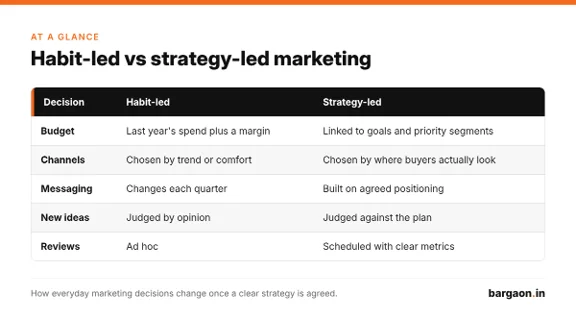
Habit-led vs strategy-led marketing – marketing strategy consulting
The solution: structured marketing strategy consulting
Good marketing strategy consulting does not produce a thick document that sits in a shared drive. It produces a small number of clear decisions: the priority customer segments, the core positioning, the offers that matter, the channels to focus on and the metrics that will show whether the plan is working.
It also links those decisions to the realities of the business, including budget, team capacity, sales cycle length and the markets you actually serve. A plan that ignores these constraints will not survive its first quarter.
How a strategy engagement works
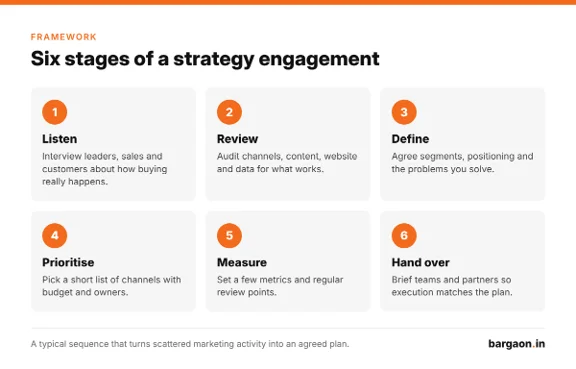
While every business is different, a well-run engagement usually moves through the same stages. Each stage builds on the previous one, so the final plan is grounded in evidence rather than assumptions.
- Listen: interview leadership, sales and a few customers to understand how buying really happens
- Review: audit current channels, content, website and data to see what is working
- Define: agree target segments, positioning and the main problems you solve for each
- Prioritise: choose a short list of channels and initiatives, with budget and owners
- Measure: set the few metrics and review points that will guide decisions
- Hand over: brief internal teams and partners so execution matches the plan
What changes once the plan is in place
The first benefit is focus. With priorities agreed, the team can say no to ideas that do not fit, and invest properly in the ones that do. Channels finally get enough budget and time to show what they can do.
The second benefit is alignment. Sales, marketing and leadership work from the same definition of the ideal customer and the same story about the company. Hand-offs become smoother and arguments about direction become shorter.
The third benefit is better decisions over time. Because the plan includes clear metrics and review points, the company learns from each quarter instead of starting over. Strategy becomes a living tool rather than a one-off exercise.
Where to start
If your budget is set by habit and your channels by trend, begin with a simple exercise. Write down your three most valuable customer types, what each one needs to hear, and where they look for solutions. If the leadership team gives different answers, that is a strong sign a structured strategy process would help.
Bargaon's strategy and brand direction page explains how this work is approached for startups, SMBs, D2C brands and B2B companies. It is a good next read if you want marketing decisions that are easier to make and easier to defend.