Sign up with Google
 Sign in with Zoho


7 Reasons an ABM Strategy Stalls, and How to Fix Each One
An ABM strategy usually starts with energy. Sales and marketing agree on target accounts, a campaign launches, and leadership expects bigger deals. Six months later, activity has faded and the account list sits untouched in a spreadsheet.
This is common, and it is rarely because the idea is wrong. Programmes stall for a handful of predictable reasons, most of them about focus, ownership and measurement.
Here are seven of the most frequent ones, with a practical fix for each.
1. The account list is too long
When the list runs to hundreds of companies, it becomes a renamed lead database. Nobody can research or personalise at that scale.
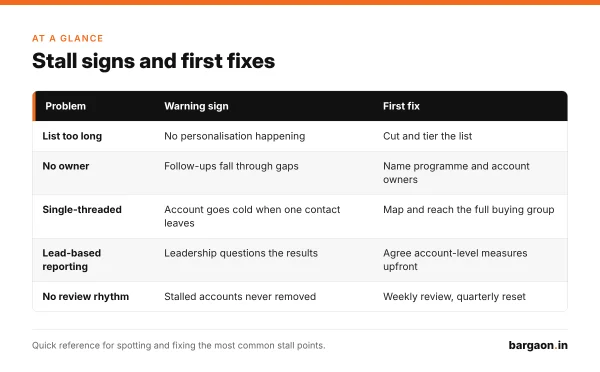
Fix: cut the list to a number your team can genuinely work. Add tiers so the top accounts get the most effort and the rest get industry-level relevance rather than individual attention.
2. Accounts are chosen on wishful thinking
Many lists are built from famous logos rather than evidence. Big names look good on a slide but may have little need for your offer.
Fix: base selection on your best existing customers. Look at who buys quickly, stays longest and expands. Then find companies with the same traits and a likely reason to act now.
Useful triggers include a new leader in a relevant role, funding, expansion into a new market or a public change in strategy. These give your outreach a timely reason to exist.
3. Nobody owns the ABM strategy
When the programme belongs to everyone, it belongs to no one. Marketing assumes sales will follow up, sales assumes marketing is warming accounts, and both wait.
Fix: name one owner for the overall ABM strategy and one sales and one marketing contact for each top-tier account. Write down who does what each week.
Ownership also means authority. The owner should be able to change the list, pause a weak campaign or move budget between accounts without waiting for a long approval chain.
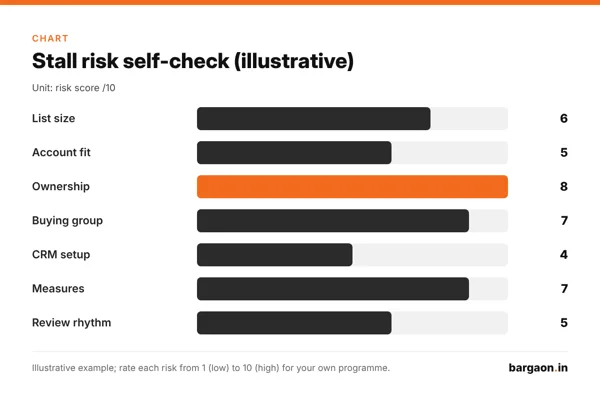
Stall risk self-check (illustrative) – ABM strategy
4. Only one contact per account is reached
Reaching a single person inside a target company is not account-based work. If that person leaves or loses interest, the account goes cold. It also leaves you blind to objections raised by people you never spoke to.
Fix: map the full buying group, including finance, technical reviewers and end users. Industry research from firms such as Gartner's marketing practice regularly highlights how many stakeholders now take part in B2B purchases, which is exactly why single-threaded outreach is fragile.
5. Content is generic
Sending the same brochure to every target account defeats the purpose. Buyers can tell when a message was written for nobody in particular.
Fix: build a small set of assets for each priority industry or problem, then add a personal note or account-specific example for the top tier. Relevance matters more than polish.
Ask sales which questions come up most often in early calls with each industry. Those questions make better content briefs than any keyword list, and they show buyers that you understand their situation.
6. The CRM does not reflect the programme
If target accounts, contact roles and engagement are not visible in the CRM, sales and marketing work from different pictures. Weekly reviews turn into debates about whose data is right. Over time, people stop trusting the system and keep private notes instead, which makes coordination even harder.
Fix: add a target-account field, a tier field and role tags for contacts. If you use Zoho, the Zoho CRM help centre explains how to set up custom fields and account views that support this.
- Target account: yes or no
- Tier: 1, 2 or 3
- Contact role: economic buyer, user, reviewer, champion
7. Progress is measured in leads and rarely reviewed
If the programme is judged on monthly lead counts, it will look weak, because it deliberately focuses on fewer companies. Leadership then loses patience.
Fix: agree account-level measures at the start: engaged accounts, contacts engaged per account, meetings, opportunities and deal size. Report against them consistently, and explain to leadership early that results build over full sales cycles, not weeks. Getting this right is one of the clearest ways ABM for B2B teams protect their budget.
Programmes also fade when nobody looks at them. Without a regular review, stalled accounts stay on the list, and promising signals are missed. Hold a short weekly account review and a deeper quarterly reset. Remove accounts that show no fit, add new ones based on fresh signals, and update messaging from what sales hears in conversations.
Most stalled programmes suffer from two or three of these issues at once. Fixing them restores focus without needing new tools. A durable ABM strategy is less about clever campaigns and more about steady, shared discipline. The full Bargaon guide on account-based marketing covers account tiering, buying-group plays and measurement in more depth for teams ready to go further.