Sign up with Google
 Sign in with Zoho

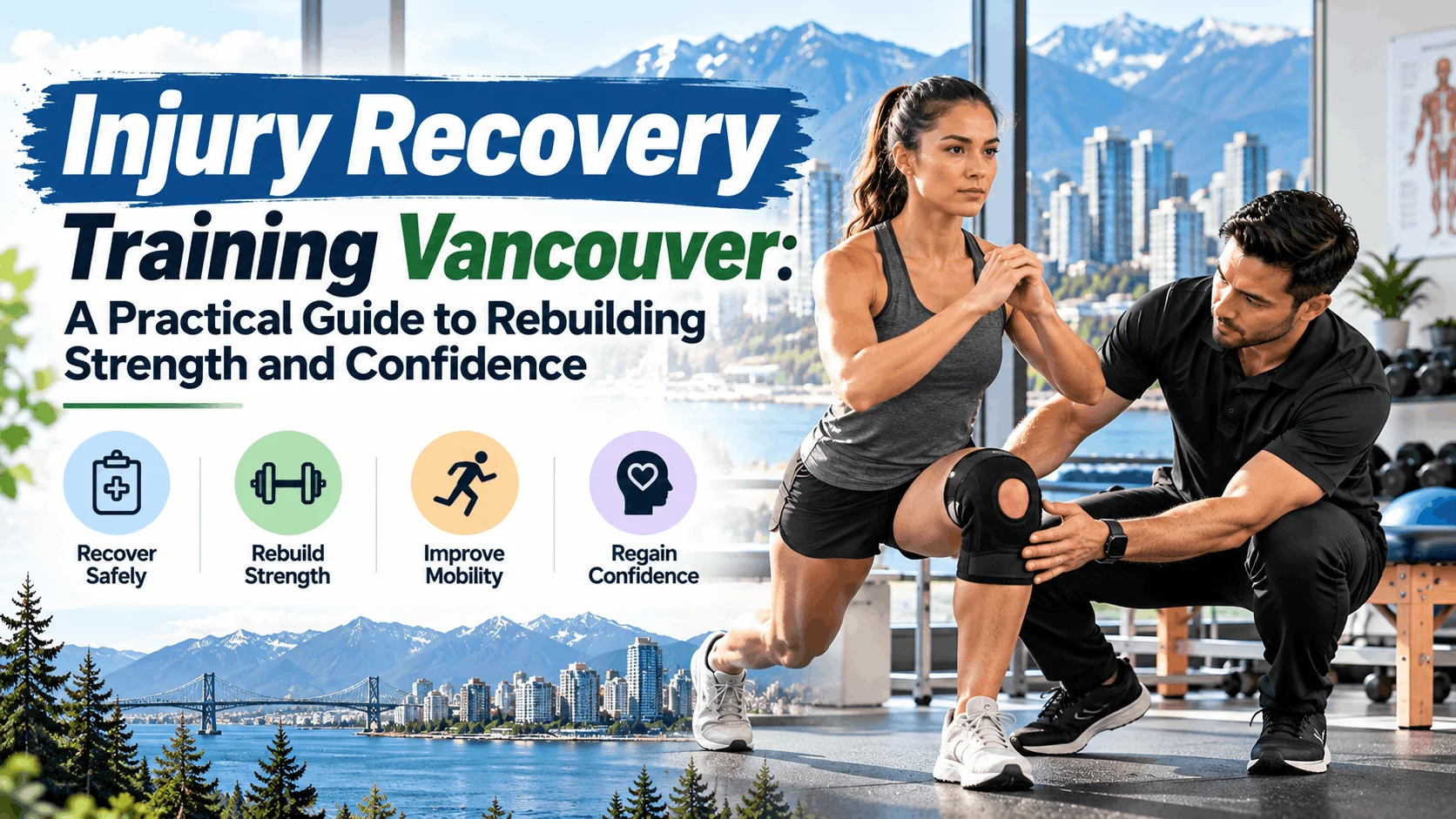
Getting back to exercise after an injury can be harder than getting injured in the first place.
The pain may have improved, but you might still feel weaker than before. Certain movements may feel unfamiliar. Your endurance may have dropped, and there can be a lingering hesitation about pushing yourself too far.
That is where injury recovery training in Vancouver can help.
The purpose is not to jump straight back into your old workout routine. It is to rebuild physical capacity progressively, starting at a level your body can handle and increasing the challenge as you become stronger and more confident.
At SNS Fitness & Rehab, training is built around the individual's body, history and goals, with an emphasis on personalized programming, evidence-based exercise and long-term progress.
What Is Injury Recovery Training?
Injury recovery training is structured exercise designed to help someone rebuild physical capacity after an injury, period of inactivity or rehabilitation.
It can address areas such as:
- Strength
- Mobility
- Balance
- Endurance
- Coordination
- Movement control
- Physical confidence
- Functional capacity
The exact program depends on the person.
Someone recovering from a knee injury may need to rebuild lower-body strength and stability. Someone dealing with a shoulder problem may need a very different approach. An athlete returning to sport may eventually need to progress toward sprinting, jumping, changing direction or other demanding movements.
The starting point should therefore be the individual's current ability—not the workout they were doing before they got injured.
Why Strength Often Changes After an Injury
When an injury limits normal activity, it is common to spend less time moving and exercising.
Over time, that can affect physical capacity.
You may notice:
- Reduced strength
- Lower cardiovascular fitness
- Stiffness
- Reduced balance
- Less movement confidence
- Difficulty with activities that previously felt easy
This does not necessarily mean that something has gone wrong with your recovery.
It can simply mean that your body has had less exposure to the physical demands it was accustomed to.
A structured training program can provide a way to gradually rebuild those abilities.
Injury Recovery Training Is Not the Same as Going Back to the Gym
One of the biggest mistakes after an injury is assuming that you can simply return to your previous workout.
If you were lifting heavy weights, running several kilometres or playing competitive sport before the injury, it can be tempting to pick up exactly where you left off.
But your current capacity may be different.
A better approach is to ask:
What can I do comfortably and safely today, and what do I need to be able to do later?
That might mean starting with relatively simple movements before progressing to heavier resistance, greater range of motion or more demanding exercises.
The workout may look less impressive at the beginning.
That does not make it less useful.
What Can Injury Recovery Training Include?
A personalized program can use several different forms of exercise.
Strength Training
Strength is often an important part of rebuilding physical capacity.
Depending on the individual, training may include:
- Bodyweight exercises
- Resistance bands
- Free weights
- Machines
- Single-leg exercises
- Core exercises
- Functional resistance movements
The amount of resistance, number of repetitions and exercise selection should match the person's current abilities.
The goal is progressive improvement rather than simply lifting as much as possible.
Mobility Work
Injury and inactivity can both affect how comfortably you move.
Mobility exercises may be used to work on:
- Joint movement
- Flexibility
- Controlled range of motion
- Movement quality
Mobility work should have a purpose. The objective is not necessarily to become exceptionally flexible, but to improve the movement needed for everyday activities, exercise or sport.
Balance and Coordination
Balance can become an issue after certain injuries or periods of inactivity.
Training may incorporate controlled exercises that challenge:
- Stability
- Weight shifting
- Coordination
- Single-leg control
- Movement awareness
These exercises can become progressively more demanding as the individual improves.
Cardiovascular Conditioning
When someone has been inactive, endurance can fall faster than expected.
Gradually rebuilding cardiovascular fitness can make everyday activities feel easier and help prepare the person for a return to exercise.
Depending on the individual's condition, this might involve walking, cycling, low-impact conditioning or other suitable activities.
Functional Training
The ultimate goal is often not to become better at doing exercises.
It is to become better at doing life.
Functional training can therefore reflect activities such as:
- Lifting
- Carrying
- Climbing stairs
- Getting up and down
- Reaching
- Walking
- Returning to recreational activities
For someone with a physically demanding job, training may eventually need to reflect the movements and workload required at work.
How Injury Recovery Training Should Progress
Recovery is rarely a straight line.
Some sessions may feel easier than others. Your physical capacity can change depending on sleep, workload, stress and how your body is responding.
A good program can therefore be adjusted rather than forcing you to follow the same workout regardless of how you feel.
A typical progression might look like this:
Mobility → basic strength → controlled resistance → greater workload → functional movements → sport or activity-specific training
Not everyone will follow this exact sequence.
Some people may need more time at one stage, while others can progress relatively quickly.
The important thing is that the difficulty matches the person's current capacity.
When Should You Start Injury Recovery Training?
There is no universal timeline.
The appropriate starting point depends on the injury, treatment history, current symptoms, physical capacity and professional guidance where applicable.
For someone who has recently undergone medical treatment or surgery, clearance and recommendations from the relevant healthcare professional should guide the transition into exercise.
For someone who has completed formal rehabilitation but still feels weak or uncertain about returning to normal activity, structured personal training may provide the next step.
The goal is not to rush recovery.
It is to avoid remaining stuck at the same level of activity indefinitely.
The Gap Between Rehabilitation and Fitness
This is an important part of the recovery process.
Formal rehabilitation may help restore basic movement and function, but returning to the gym, work, sport or an active lifestyle can require additional physical preparation.
Someone might be able to walk comfortably but still lack the strength needed for a long hike.
Someone might be able to perform daily activities but not yet be ready to return to recreational hockey.
Someone might have completed physiotherapy but still feel unsure about how to start lifting weights again.
Injury recovery training can help bridge that gap.
The focus shifts from simply recovering function toward rebuilding the physical capacity needed for the person's normal life.
What Should You Look for in Injury Recovery Training in Vancouver?
If you are comparing training options, look for a program that goes beyond a generic workout plan.
Useful questions to ask include:
- Is there an initial assessment?
- Does the trainer consider your injury history?
- Is the program adapted to your current abilities?
- How is progress measured?
- Can exercises be modified when symptoms change?
- Does the program reflect your work or recreational goals?
- Is there a clear progression?
- Does the trainer understand when another healthcare professional should be involved?
SNS Fitness & Rehab describes its approach as beginning with an in-depth assessment and using personalized, evidence-based training designed for long-term development.
That individualization is important because two people with the same diagnosis can still have very different strength levels, movement patterns, lifestyles and goals.
Injury Recovery Training for Different Goals
Returning to Work
If your job requires lifting, standing, walking, carrying or prolonged sitting, your eventual training should take those demands into account.
Returning to Exercise
You may simply want to get back to your normal gym routine.
That can involve gradually rebuilding resistance tolerance, endurance and confidence.
Returning to Sport
Sport usually introduces additional demands.
A return to running, skiing, hockey, soccer or another activity may eventually require higher levels of strength, power, balance, conditioning and movement control.
Returning to Everyday Life
Sometimes the goal is much simpler.
You may want to:
- Walk longer
- Carry groceries
- Use stairs
- Play with your children
- Hike
- Travel
- Move around without constantly thinking about the injury
Those are legitimate performance goals too.
Common Mistakes After an Injury
Trying to Do Too Much Too Soon
Feeling better does not necessarily mean that your previous training volume is immediately appropriate.
Progressive loading gives your body time to adapt.
Avoiding Exercise for Too Long
The opposite problem can occur when someone becomes afraid to move after an injury.
Appropriate exercise can help rebuild strength and confidence, although the right starting point depends on the individual.
Copying Someone Else's Program
A workout that works for your friend may be completely inappropriate for your current abilities.
Focusing Only on the Injured Area
Recovery often involves the whole body.
Strength, conditioning, balance and movement quality can all matter depending on the person's goals.
Treating Every Workout as a Test
A recovery session does not need to leave you exhausted to be productive.
Sometimes the most useful session is the one that gives you a manageable training stimulus and leaves you ready to progress again.
How Long Does Injury Recovery Training Take?
There is no standard number of sessions.
Recovery time depends on factors such as:
- The type and severity of the injury
- How long activity has been restricted
- Current strength and fitness
- Previous training experience
- Consistency
- Recovery capacity
- The demands of the person's goals
Someone returning to everyday activity may have a very different timeline from an athlete preparing to compete again.
Rather than focusing only on a deadline, look for measurable improvements.
These might include:
- Greater strength
- Improved range of motion
- Better endurance
- More controlled movement
- Increased activity tolerance
- Greater confidence
Frequently Asked Questions
Can personal training help after an injury?
It can be useful as part of the transition back to exercise when the program is appropriate for the individual's condition and goals. Training should complement, rather than replace, medical or rehabilitation care when that care is needed.
Do I need to be completely pain-free before exercising?
Not necessarily. The appropriate level of activity depends on the injury and individual circumstances. If you are recovering from an injury, it is important to follow relevant professional guidance and communicate any concerning or worsening symptoms.
Can I start injury recovery training after physiotherapy?
For some people, personal training can be a useful next step after formal rehabilitation. The program can focus on rebuilding strength, conditioning and confidence for everyday activities, work or sport.
Can injury recovery training help me return to sports?
It can be part of a return-to-sport progression. The later stages of training may incorporate movements and conditioning that reflect the demands of the athlete's sport.
Is injury recovery training only for serious injuries?
No. Training may be useful for people recovering from a range of injuries or periods of reduced activity. The appropriate program depends on the individual's condition and goals.
How often should I train while recovering?
There is no universal schedule. Training frequency should take into account your current capacity, other physical activity, recovery and the demands of your program.
What if an exercise makes my symptoms worse?
Tell your trainer or relevant healthcare professional. An exercise may need to be modified, replaced or temporarily removed depending on the circumstances. Don't assume that pushing through worsening symptoms is automatically part of recovery.
Final Thoughts
Injury recovery training in Vancouver is not about rushing back to the workout you were doing before you got hurt.
It is about rebuilding the foundation underneath it.
That might mean starting with basic mobility and controlled movements. From there, you can gradually work toward strength, endurance, balance and more demanding activities.
Eventually, the goal may be returning to the gym, going back to work, hiking on the North Shore, playing your sport or simply moving through everyday life without constantly thinking about what your injury will allow.
The right program should reflect where you are now and where you want to go.
SNS Fitness & Rehab offers personalized training built around an individual's body, history and goals, with an emphasis on assessment, evidence-based exercise and long-term progress.
If you are considering injury recovery training in Vancouver, you can learn more about the personal training approach at SNS Fitness & Rehab.










.webp)