Sign up with Google
 Sign in with Zoho

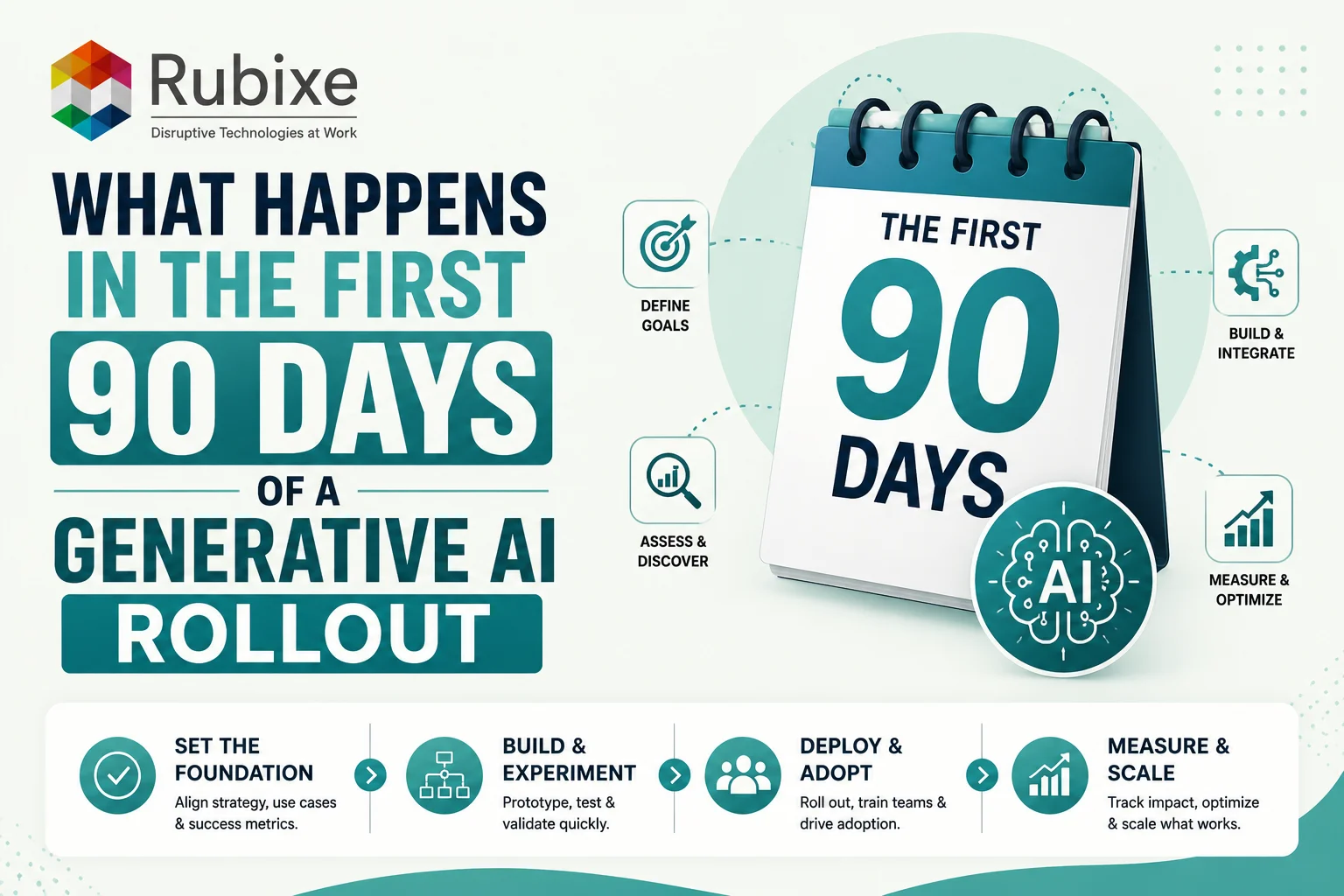
Two companies sign off on a generative AI rollout in the same week. Both have leadership buy-in, a reasonable budget, and a genuinely useful use case. By day 90, one has a working system embedded into daily operations, with a clear plan for expanding it further. The other has a tool that technically exists, quietly ignored by most of the team it was built for.
The difference between these two outcomes almost never comes down to the technology itself. It comes down to what actually happens, or doesn't happen, in three specific 30-day windows that most companies treat as a single, vague "rollout period" instead of three distinct phases requiring different attention.
This piece breaks down what should actually happen in each of those windows, and where most generative ai consulting services rollouts quietly start losing ground.
Days 1 to 30: Setting the Real Baseline
The first month is where expectations either get set clearly or get left dangerously vague. Companies that get this right define specific things upfront, before anyone starts actively using the system day to day.
A few things worth locking in during this window:
- A specific, measurable definition of success, not "improve efficiency" but a real number tied to a real task
- A named owner responsible for adoption, distinct from whoever led the technical build
- A baseline measurement of the current process, taken before the tool launches, so improvement can actually be measured against something real
- A communication plan for the team, explaining not just what the tool does but why it matters to their specific work
Companies that skip this and jump straight into "let's just start using it" tend to discover, weeks later, that nobody agrees on what success was even supposed to look like.
Days 31 to 60: Where Most Rollouts Quietly Start Slipping
This is the window where the gap between the two companies in the opening story actually starts forming, even though it usually isn't visible yet to anyone not specifically watching for it.
The companies that keep close track during this window tend to catch small problems while they're still cheap to fix. The companies that don't tend to discover the same problems much later, once they've already caused real disengagement.
Days 61 to 90: The Actual Decision Point
By day 90, a rollout is either heading toward genuine integration or heading toward quiet abandonment, even if nobody's explicitly made that call yet.
This is where the original success definition from day one actually gets tested. Did the tool hit the specific number that was defined back in month one? If not, is that because the tool genuinely isn't working, or because adoption never fully took hold? These are different problems requiring different fixes, and conflating them is one of the most common mistakes at this stage.
Companies handling this well typically do three things at the 90-day mark:
- Compare actual usage data against the original baseline, not general impressions of how things feel
- Interview a handful of actual users directly, asking specifically what's working and what isn't
- Make an explicit decision, expand, adjust, or pause, rather than letting the rollout drift on unchanged by default
What If You're Genuinely Not Sure by Day 90
Sometimes the data at day 90 is genuinely ambiguous, not a clear win, not a clear failure. This is the hardest moment in the whole process, and it's where a lot of companies default to inaction simply because a clear decision feels premature.
The better move is treating ambiguity as a signal to dig deeper, not a reason to delay. Extend the measurement window by 30 days, but only if you've also identified a specific, testable change to make during that extension, different training, adjusted workflow, a narrower use case. An unstructured extension, "let's just give it more time," tends to produce the same ambiguous result a month later, just further delayed.
Why This Matters Even More When Working With an Outside Partner
Companies bringing in ai consultants for this process should expect this same 90-day structure to be built into the engagement from the start, not something the client has to request separately.
This distinction matters because ai consultants who've run this process before know specifically what to watch for in each window, the kind of friction that resolves itself versus the kind that signals a deeper mismatch between the tool and the actual workflow. Companies working with genuinely experienced generative ai consulting services tend to move through this 90-day period with far more clarity than companies figuring out the structure for the first time on their own, since the checkpoint discipline described above is usually already built into how the engagement runs.
A Local Note Worth Mentioning
Companies working with an ai consulting company in Bangalore often benefit from deep technical bench strength during the build phase, but the 90-day adoption structure described here matters just as much regardless of where the technical team is based. Strong engineering doesn't automatically produce strong adoption tracking, and the two need to be planned for separately, ideally by the same partner from day one.
One Detail Worth Knowing
Rubixe treats day 30, day 60, and day 90 as three separate, formal checkpoints in every rollout engagement, each with its own specific questions and a written summary, rather than a single loosely scheduled "check-in sometime after launch."
Frequently Asked Questions
Q: What's the single most important thing to get right in the first 30 days? Defining a specific, measurable success metric before anyone starts using the tool. Without this, the entire 90-day window becomes much harder to evaluate objectively later.
Q: Is a 90-day timeline realistic for every type of generative AI rollout? For most well-scoped pilots handled through standard ai consulting services, yes. More complex, multi-department rollouts sometimes need a longer initial window, but the same three-phase structure still applies, just stretched over a longer calendar.
Q: What should happen if usage is strong but the actual output quality isn't quite there yet? This usually signals a training or prompt refinement issue rather than a fundamental mismatch, and it's typically fixable within the existing timeline rather than requiring a full restart.
Q: Should the same team that built the tool also be responsible for tracking adoption? Not ideally. A dedicated adoption owner, separate from the technical build team, tends to catch workflow and engagement issues that a purely technical team might miss or deprioritize.
Q: Does it matter whether the technical build comes from an ai consulting company in Bangalore versus elsewhere? Not for the adoption structure described here. Strong technical talent, wherever it's based, still needs an equally deliberate adoption process layered on top to actually deliver results.
The company with the working system embedded into daily operations by day 90 didn't get there through better technology. It got there by treating those first 90 days as three distinct, deliberately managed phases, rather than one long, loosely monitored rollout period. That's the actual value proposition behind well-structured generative ai consulting services, not a better model, but a better process for making sure the model gets a fair chance to prove itself.
That structure, more than any single feature or model choice, is usually what separates a generative AI investment that actually sticks from one that quietly fades into the background within a year. Companies evaluating ai consulting services for their next rollout would do well to ask directly whether this kind of phased checkpoint structure is already part of the standard engagement, rather than something they'd need to request and manage themselves.