Sign up with Google
 Sign in with Zoho

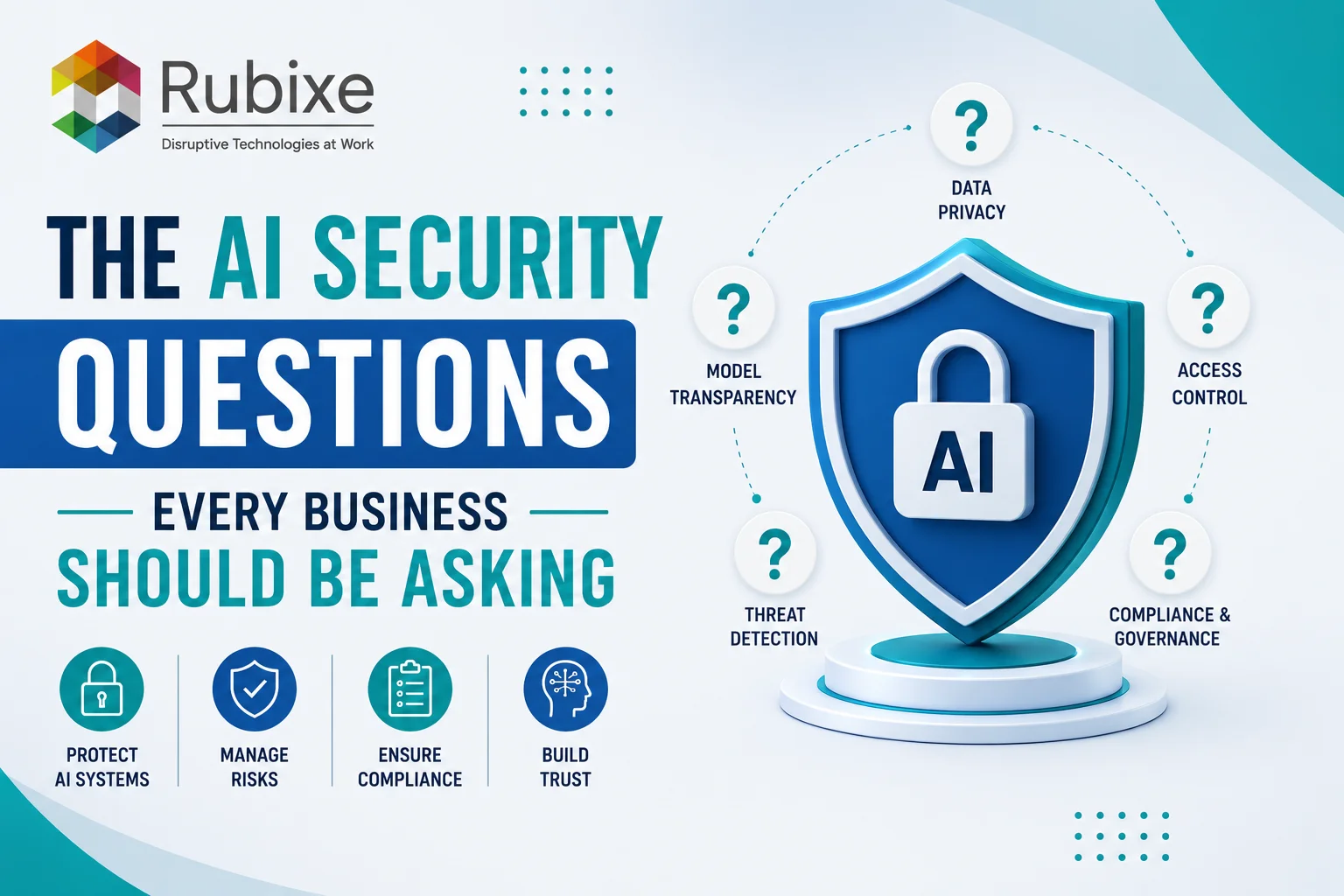
Most businesses have added some form of AI into their operations over the past two years — a chatbot handling customer queries, a model scoring transactions for fraud, an internal tool summarizing documents. Far fewer have stopped to ask what new risks those systems actually introduce. Traditional IT security checklists weren't built with AI-specific vulnerabilities in mind, which means a business can pass every conventional security review and still be exposed in ways nobody on the team has thought to check. This is exactly why AI cyber security has become a topic business leaders need to understand directly, not just delegate entirely to a technical team that may not have this specific expertise either.
The questions below aren't meant to make anyone a security expert. They're meant to surface the gaps most businesses don't realize exist until something goes wrong.
Why AI Systems Need a Different Security Lens
Traditional software security focuses on things like access control, encryption, and patching known vulnerabilities. AI systems introduce a separate category of risk that doesn't map cleanly onto that framework:
- Model behavior can be manipulated through crafted inputs, a risk category that doesn't exist in traditional software the same way
- Training data can be poisoned, subtly corrupting a model's behavior without triggering any conventional security alert
- Sensitive data can leak through model outputs, even when the underlying database is properly secured
- Third-party AI APIs introduce a new dependency layer, with data leaving your infrastructure entirely in many implementations
- Model outputs can be manipulated to bypass downstream safeguards, particularly in systems that automate decisions without human review
A business that hasn't specifically evaluated these categories likely has blind spots, regardless of how mature its general IT security posture is. This is where a structured approach to AI cyber security becomes less of a nice-to-have and more of a baseline requirement for any company deploying models into production.
Question 1: What Data Does Our AI System Actually Have Access To?
This sounds basic, but many teams can't answer it precisely. AI systems, especially those built on large language models, are sometimes given broader data access than necessary simply because it was convenient during development. Businesses should be able to clearly map:
- Which specific data sources feed into any AI system
- Whether that access is scoped as narrowly as the use case actually requires
- Who can modify what data the system can see, and how that's audited
Question 2: Have We Tested for Prompt Injection and Manipulation?
For any business using conversational AI or LLM-based tools, prompt injection is one of the most practical near-term risks. This is where a user crafts input specifically designed to make a model ignore its instructions or reveal information it shouldn't. Testing for this requires deliberate red-teaming, not just standard functional QA.
Question 3: What Happens If Our AI Vendor Has a Breach?
Many businesses now rely on third-party AI APIs rather than building models in-house. This introduces a dependency most companies haven't fully thought through. Worth confirming with any vendor:
- What data is sent to their systems, and is it retained or used for further training
- What their own security certifications and audit history look like
- What the contractual and legal exposure is if their systems are breached
- Whether there's a clear incident notification process built into the agreement
Question 4: Are We Auditing AI Cyber Security Solutions Before Deploying Them?
It's increasingly common for businesses to adopt AI cyber security solutions specifically to defend against these new risks — tools built to monitor model behavior, detect anomalous inputs, and flag potential manipulation attempts in real time. But not every product marketed this way delivers genuine protection. Evaluating these tools properly means checking:
- What specific threat categories the tool actually addresses, versus general marketing claims
- Whether detection is based on real behavioral analysis or simplistic rule matching
- How the tool integrates with existing security infrastructure and incident response processes
- Whether independent benchmarks or third-party validation exist, not just vendor-reported numbers
Question 5: Is Our Team Actually Trained on These Specific Risks?
Even strong security teams often lack specific training on AI-related vulnerabilities, simply because the field has moved quickly and formal training hasn't caught up everywhere. A practical readiness checklist:
- Has the security team received specific training on prompt injection and adversarial AI risks?
- Do developers building or integrating AI features understand data handling best practices for these systems?
- Is there a clear internal owner responsible for AI-specific security, or does it fall into a gap between IT and product teams?
- Are incident response plans updated to account for AI-specific failure modes?
Question 6: How Are We Monitoring for Anomalous Model Behavior?
Ongoing monitoring matters as much as pre-deployment testing, since model behavior can shift over time as inputs and usage patterns evolve. AI security monitoring should track:
- Unusual patterns in the type or volume of inputs a model receives
- Output patterns that deviate significantly from expected baselines
- Access pattern anomalies, particularly around systems with sensitive data exposure
- Performance degradation that might indicate manipulation rather than normal drift
Firms like Rubixe have worked with businesses specifically on building this kind of monitoring into AI deployments from the start, rather than treating it as something to bolt on after a system is already live and exposed.
Question 7: Do We Have a Response Plan Specific to AI Incidents?
A generic data breach response plan often doesn't map cleanly onto AI-specific incidents, since the source of the problem, the appropriate containment action, and the downstream cleanup can all look very different from a conventional data breach. Businesses should confirm their plan addresses:
- Who's responsible for taking a compromised model offline quickly, and whether that authority is clearly assigned rather than assumed
- How to determine whether an incident stems from the model itself, the data pipeline, or a third-party dependency, since the root cause changes the entire response
- What communication is required to customers or regulators depending on the nature of the exposure and the industry's specific compliance obligations
- How the model gets retrained, rolled back, or replaced safely once an issue is identified, without simply redeploying the same vulnerability
Building This Into Ongoing Operations
This shouldn't be treated as a one-time checklist completed before launch. A more durable approach includes:
- Scheduling regular reassessment as models are updated or retrained
- Including AI-specific scenarios in periodic security tabletop exercises
- Keeping vendor risk assessments current as third-party providers update their own systems
- Assigning clear ownership so these risks don't quietly fall between existing IT and product security responsibilities
Frequently Asked Questions
Q: Is this fundamentally different from general cybersecurity?
It overlaps significantly but adds a distinct set of risks — prompt manipulation, training data integrity, and model-specific data leakage — that traditional security frameworks weren't originally built to address.
Q: Do small businesses need to worry about this, or is it mainly an enterprise concern?
Any business using AI tools, even through third-party vendors rather than custom-built models, faces some version of these risks, though the scale and complexity of mitigation typically grows with the sophistication of the deployment.
Q: How often should AI systems be security tested?
At minimum, before any major update or retraining event, with many businesses adopting quarterly reviews as a baseline for systems handling sensitive data or customer-facing interactions.
Q: Can third-party AI vendors be trusted to handle security on our behalf? Partially. Vendors are responsible for their own infrastructure security, but businesses remain responsible for how they configure access, what data they send, and how they respond if something goes wrong.
Q: What's the first step a business should take if it hasn't addressed any of this yet?
Start with a data access audit — mapping exactly what each AI system can see and touch — since this single step often reveals the most immediate and easiest-to-fix exposure.
The questions businesses need to ask about AI cyber security have moved well beyond generic IT checklists, and treating AI deployments as just another software rollout leaves real gaps unaddressed. Understanding data access, testing for manipulation, vetting vendors carefully, and building ongoing monitoring into operations closes most of the exposure that catches businesses off guard. Companies that work through these questions deliberately, rather than assuming their existing security posture automatically covers AI-specific risk, tend to catch problems long before they become costly incidents.