Sign up with Google
 Sign in with Zoho

Generative AI is moving from experimentation into everyday business operations. McKinsey reported that 71% of surveyed organisations were regularly using generative AI in at least one business function in 2024, compared with 65% earlier that year. The growth shows why companies increasingly need structured ways to improve AI output, reliability and business value.
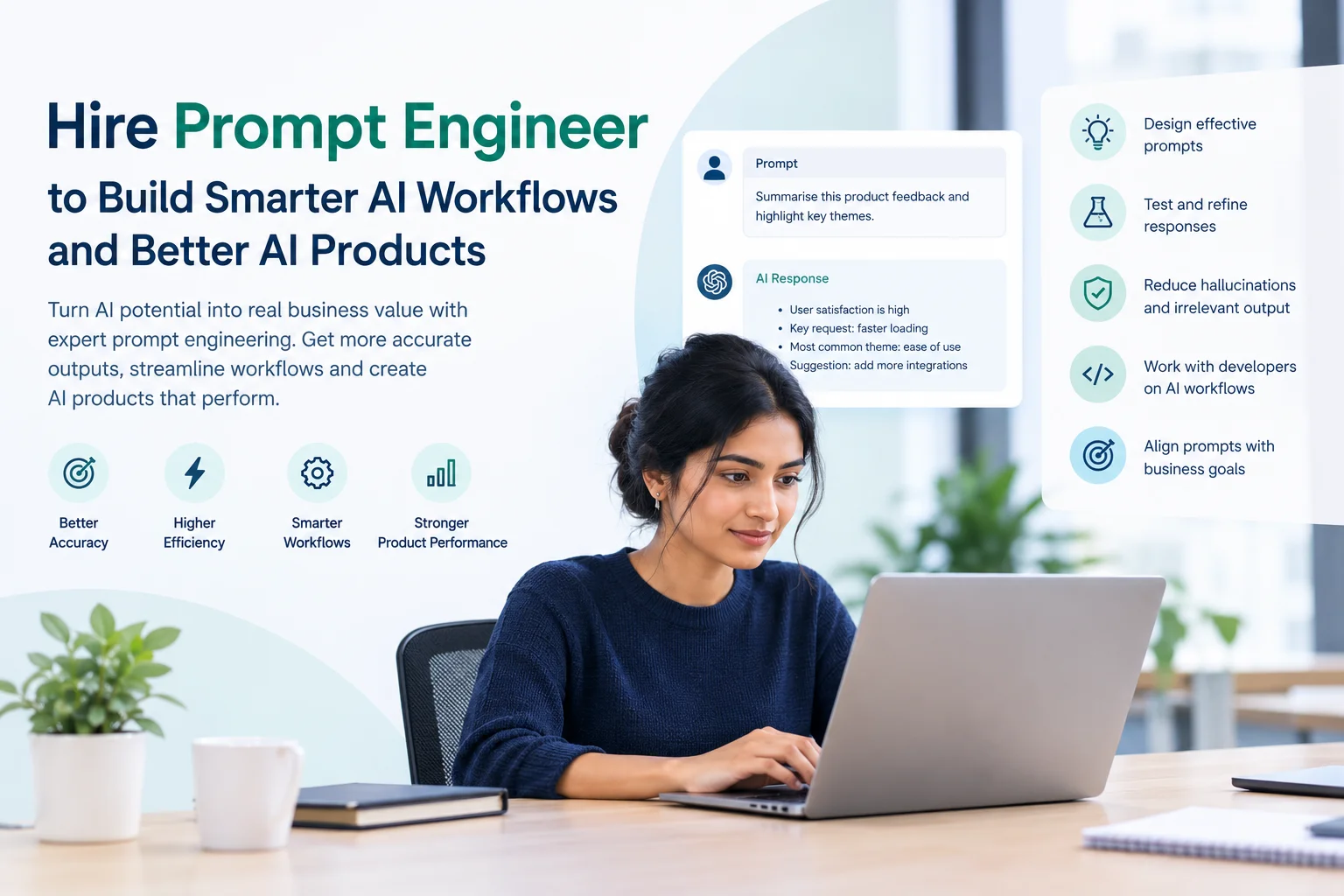
This is where the decision to Hire Prompt Engineer becomes relevant. Prompt engineering is not simply about writing better questions for an AI model. It involves designing instructions, testing responses, managing context and creating repeatable interactions that support specific business objectives.
Why Prompt Engineering Matters in Product Development
AI products can produce inconsistent results when prompts are poorly structured. A prompt engineer helps product and engineering teams turn broad AI capabilities into controlled workflows.
For example, an AI-powered customer support product may need to identify customer intent, retrieve relevant information, follow brand guidelines and produce a useful response. A prompt engineer can structure these stages so that the model receives clear instructions and appropriate context.
In projects we have supported, this type of structured approach has helped teams improve response consistency, refine AI-assisted workflows and reduce unnecessary manual review. The biggest gains often come from connecting prompt design with product requirements rather than treating prompting as an isolated technical task.
What Does a Prompt Engineer Actually Do?
A capable prompt engineer can contribute across several areas:
- Develop structured prompts for specific business use cases
- Test different instructions and model behaviours
- Improve response accuracy and consistency
- Design reusable prompt templates
- Work with developers on AI application workflows
- Identify hallucination and irrelevant-response patterns
- Create evaluation criteria for AI outputs
- Optimise prompts for different models and use cases
This becomes particularly important when AI is integrated into software products rather than used only as an internal productivity tool.
Prompt Engineer vs AI Developer
These roles can overlap, but their responsibilities are different.
An AI developer generally focuses on model integration, application architecture, APIs, data pipelines and deployment. A prompt engineer concentrates more heavily on how users, applications and AI models communicate through instructions and contextual information.
For a small AI feature, one professional may cover both areas. For a larger product, separating these responsibilities can provide clearer ownership. Product leaders should therefore assess the actual problem before deciding which expertise the project requires.
Building Reliable AI Workflows
A strong prompt is only one part of an effective AI system. Prompt engineers increasingly work with retrieval-augmented generation, structured outputs, tool calling and evaluation frameworks.
This matters because AI adoption does not automatically create business value. McKinsey found that more than 80% of surveyed organisations in its 2024 study had not yet seen a tangible enterprise-level EBIT impact from generative AI.
The finding highlights an important lesson for decision makers: deploying AI is different from creating measurable business value.
A prompt engineer can help bridge that gap by designing workflows around measurable outcomes such as response quality, processing time, task completion and human review rates.
How Businesses Can Measure Prompt Quality
Before hiring or assigning prompt engineering resources, companies should define what success means.
Useful measures include:
- Accuracy of generated responses
- Percentage of outputs requiring human correction
- Response consistency across similar requests
- Task completion rate
- Processing time
- Cost per AI interaction
- Compliance with business rules
For example, a company developing an AI knowledge assistant might measure how often the system provides a relevant answer from approved information rather than simply measuring how fluent the response sounds.
The Growing Role of Prompt Engineering
AI adoption is expanding across software engineering, product development, service operations and other functions. McKinsey found that organisations using generative AI were most commonly applying it in areas including marketing and sales, product and service development, service operations and software engineering.
This wider adoption is changing the role of prompt engineering. The focus is moving from isolated prompt writing towards building repeatable AI systems that can support business processes.
For technology leaders, the priority should therefore be practical: identify where AI can improve a process, establish measurable outcomes, and then use prompt engineering to make the interaction reliable and scalable.