Sign up with Google
 Sign in with Zoho

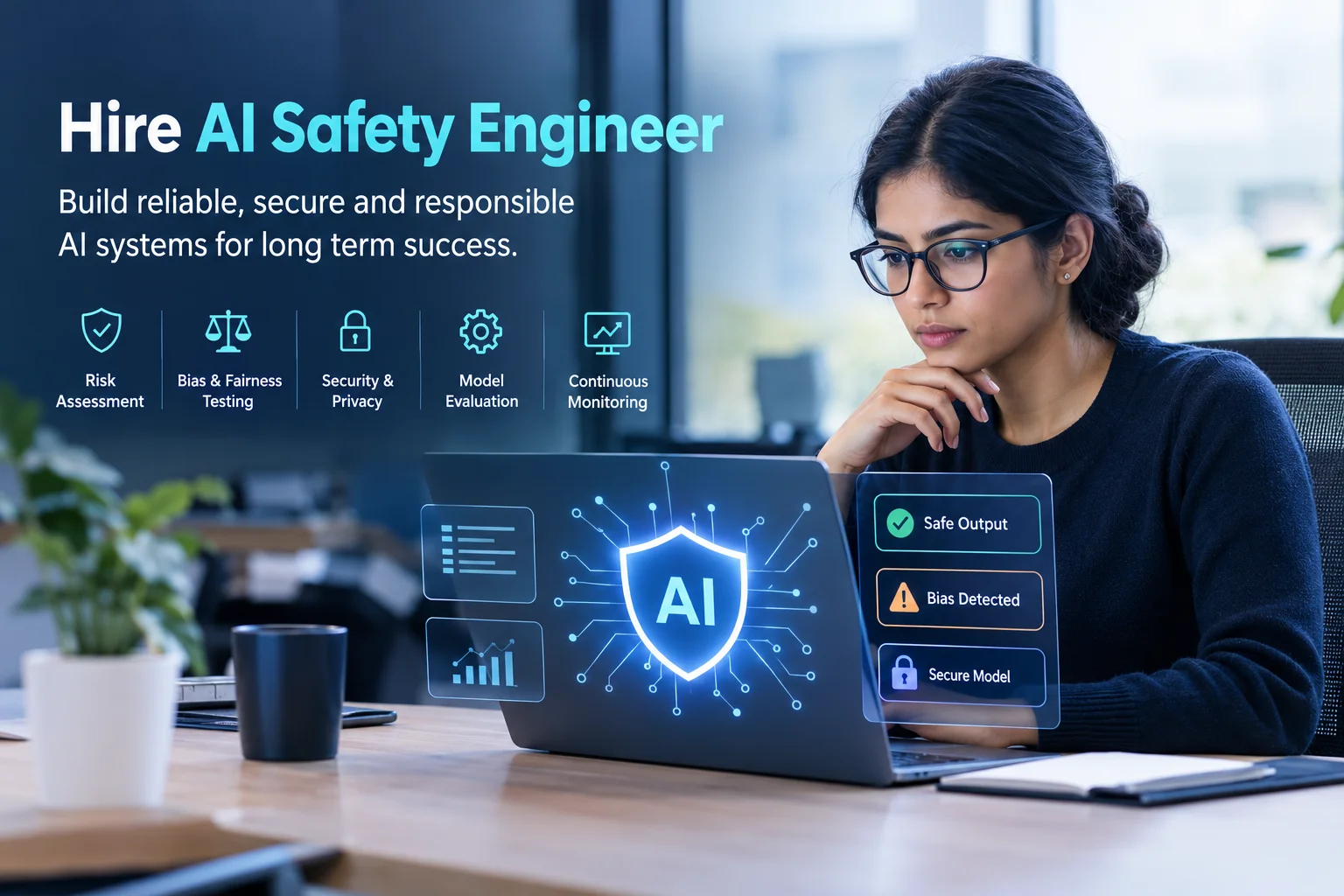
Artificial intelligence is becoming central to product development, customer service, healthcare, finance and business operations. However, as AI systems become more capable, organisations must address risks such as inaccurate outputs, biased decisions, data leakage and unpredictable model behaviour. Businesses that overlook these issues may face financial losses, reputational damage and reduced customer trust.
Choosing to Hire AI Safety Engineer professionals helps organisations build AI products that are not only intelligent but also reliable, secure and responsible. These specialists assess potential risks, test model behaviour and introduce safeguards throughout the AI development lifecycle.
Why AI Safety Matters in Modern Product Development
AI safety is no longer a final testing activity. It is an essential part of designing, developing and maintaining AI-powered products. A chatbot that provides misleading information, for example, can damage customer relationships. An AI recruitment tool that produces biased recommendations can create fairness and compliance concerns.
The 2025 AI Index Report from Stanford University highlights the growing importance of responsible AI. It reported that documented AI-related incidents reached 233 in 2024, a 56.4% increase from 2023. This trend demonstrates why businesses need structured processes to identify and manage AI risks.
For product managers, technology leaders and business decision-makers, the objective is to identify weaknesses before they affect users. AI safety engineers help achieve this through systematic testing, risk assessment and continuous monitoring.
What Does an AI Safety Engineer Do?
An AI safety engineer evaluates how an AI system behaves under normal, unusual and potentially harmful conditions. Their responsibilities extend beyond traditional software testing because AI outputs can change according to prompts, data and model updates.
Key responsibilities include:
- Risk assessment: Identifying possible failures, harmful outputs, privacy risks and misuse scenarios before deployment.
- Bias and fairness testing: Evaluating whether model responses create unfair outcomes for different user groups.
- Red teaming: Testing AI systems with challenging prompts and adversarial inputs to expose weaknesses.
- Security and privacy: Helping prevent sensitive data exposure, prompt injection and unauthorised access.
- Model evaluation: Measuring accuracy, consistency, instruction following and safe response behaviour.
- Continuous monitoring: Tracking production performance and identifying new risks as models and user needs change.
These activities provide product teams with practical evidence to support safer development decisions.
How AI Safety Engineers Improve Business Outcomes
Organisations developing generative AI applications often face a trade-off between product speed and risk management. Rushing deployment can expose weaknesses, while excessive manual testing can delay releases.
A structured safety process helps balance both priorities. For example, a business building an AI customer support assistant can establish evaluation datasets, test responses against known failure scenarios and introduce escalation rules for sensitive queries.
In a typical product development engagement, an engineering team might discover that a model answers confidently even when its information is incomplete. An AI safety engineer can help introduce uncertainty checks, improve retrieval quality and direct high-risk questions to human support.
The results should be measured using relevant indicators, such as harmful response rates, successful attack resistance, escalation accuracy and policy compliance. Actual improvements depend on the application, model and testing process, so organisations should establish a baseline before claiming measurable gains.
AI Safety Engineering Compared with Traditional QA
Traditional quality assurance focuses mainly on whether software functions according to specified requirements. AI safety engineering examines a wider range of possible behaviours, including harmful outputs, bias, manipulation and unexpected responses.
Traditional QA remains essential for testing interfaces, performance and functional defects. AI safety engineering complements it by evaluating probabilistic model behaviour and risks that cannot always be covered by fixed test cases.
For complex AI products, combining both approaches creates a more complete testing strategy.
When Should Businesses Hire AI Safety Engineer Specialists?
Businesses should consider dedicated AI safety expertise when launching generative AI applications, automating sensitive decisions, processing confidential information or integrating third-party foundation models.
Start-ups may initially assign safety testing to existing engineering teams, but dedicated specialists become increasingly valuable as product complexity, user numbers and regulatory obligations grow.
Building Trust Through Responsible AI
Responsible AI requires more than accurate model outputs. It demands clear accountability, robust testing, transparent limitations and ongoing improvement.
When organisations Hire AI Safety Engineer professionals, they can integrate safety into product planning rather than treating it as an afterthought. This approach helps teams identify risks earlier, make informed deployment decisions and build AI experiences that users can trust.
As AI adoption expands, safety engineering will remain an important part of sustainable product development and long-term business resilience.