Sign up with Google
 Sign in with Zoho

Hire OpenAI Developer to Build Intelligent, Scalable and Business-Ready AI Products
Artificial intelligence is changing how businesses develop software, automate operations and deliver customer experiences. From intelligent chatbots to automated workflows and advanced data analysis, OpenAI technologies are helping companies build products that respond more effectively to user needs. Businesses looking to turn AI opportunities into practical solutions increasingly recognise the importance of choosing the right expertise when they Hire OpenAI Developer resources.
OpenAI models, including GPT-based solutions, offer opportunities to improve productivity, reduce repetitive work and create more personalised digital experiences. However, successful implementation requires more than connecting an API. It involves understanding business requirements, selecting suitable models, managing data and ensuring that AI features deliver consistent results.
Why Businesses Are Investing in OpenAI Development
The growing adoption of generative AI reflects a shift in business priorities. Companies are moving beyond experimental chatbots towards AI-powered applications that support everyday operations.
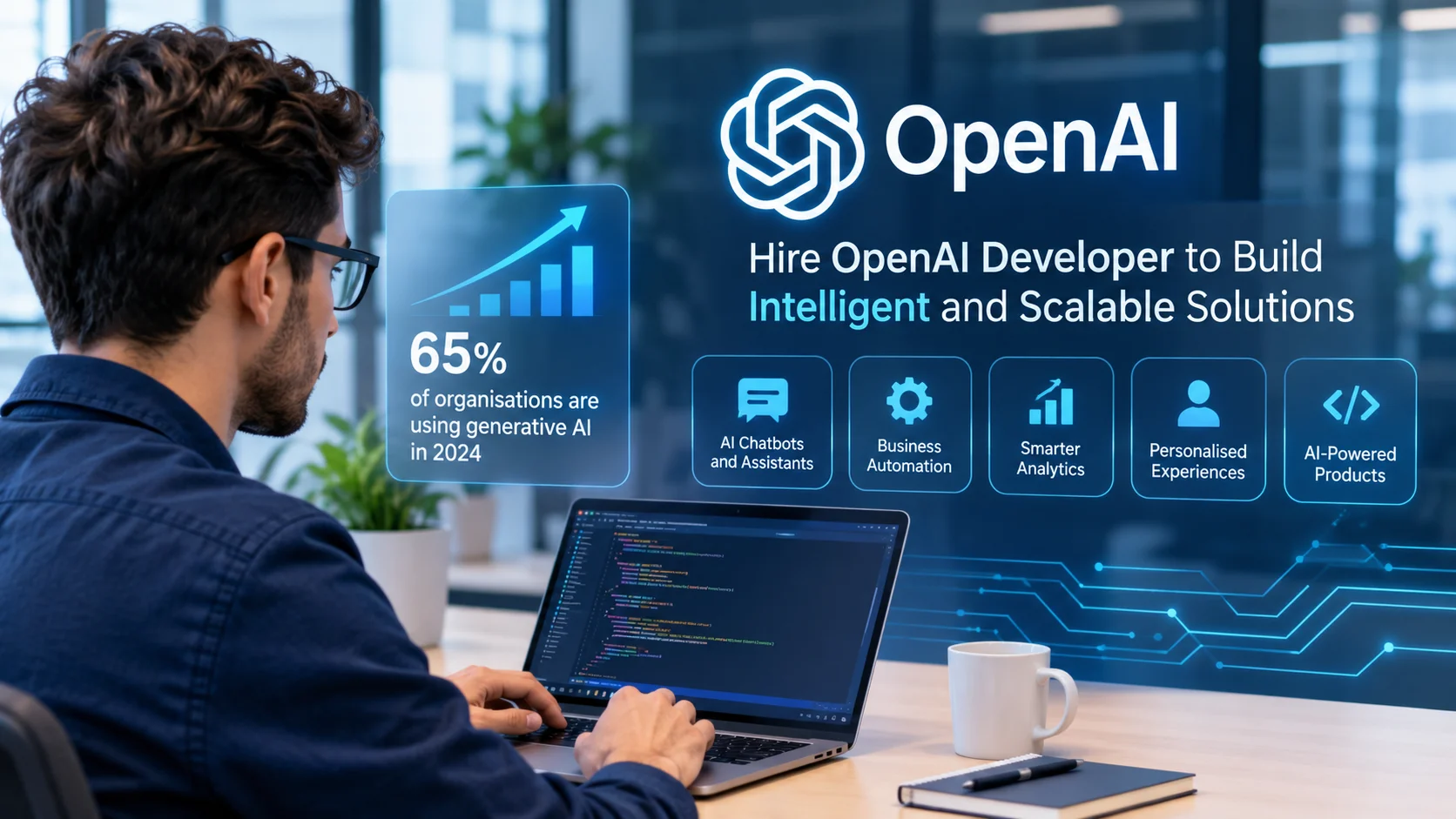
According to McKinsey's 2024 global survey, 65% of respondents reported that their organisations were regularly using generative AI, nearly double the proportion reported in the previous survey.
This growing adoption creates opportunities across several industries:
- Customer support: AI assistants can respond to common enquiries, retrieve relevant information and support customer service teams.
- Business automation: OpenAI integrations can automate document processing, content classification and repetitive administrative tasks.
- Knowledge management: AI-powered search systems help employees find information across internal documents and databases.
- Software development: AI tools can assist with code generation, documentation and technical support.
- Personalised experiences: Applications can provide more relevant recommendations and conversational interactions.
For CTOs and product managers, the main consideration is not simply adopting AI. It is identifying where AI can produce measurable business value.
What an OpenAI Developer Brings to Product Development
An experienced OpenAI Developer understands how to integrate language models into existing software environments while maintaining performance, security and usability.
Their responsibilities typically include:
- Integrating OpenAI APIs into web and mobile applications.
- Developing conversational AI assistants and intelligent chatbots.
- Implementing Retrieval-Augmented Generation (RAG) for knowledge-based applications.
- Designing effective prompts and managing model responses.
- Connecting AI systems with databases, CRM platforms and third-party services.
- Implementing authentication, monitoring and data protection measures.
- Testing response quality, accuracy and application performance.
For example, a business managing thousands of customer enquiries may benefit from an AI assistant that retrieves answers from approved documentation. Instead of relying entirely on manual searches, support teams can access relevant information more quickly.
OpenAI API Integration vs Custom AI Model Development
Choosing the right development approach can influence project costs, timelines and long-term flexibility.
OpenAI API integration is generally suitable for businesses that want to introduce advanced language capabilities without building and maintaining their own large language model. It can reduce infrastructure requirements and accelerate product development.
Custom model development or fine-tuning may be more appropriate when an application requires specialised behaviour, domain-specific outputs or greater control over model performance.
However, fine-tuning is not always necessary. Techniques such as prompt engineering and RAG can often address business requirements more efficiently.
The right decision depends on data availability, response accuracy, security requirements and expected usage.
How Acrosstek Approaches OpenAI-Powered Development
At Acrosstek, working with businesses on software development requires understanding how technology supports their wider product objectives. AI implementation follows the same principle: features should solve genuine operational problems rather than simply introduce new technology.
For businesses exploring AI-powered products, the development approach focuses on integrating intelligent capabilities into existing workflows, improving application functionality and supporting future scalability.
For instance, when a business wants to introduce conversational assistance, the development priorities include understanding user queries, connecting reliable information sources and testing responses against practical scenarios.
This approach helps product teams consider important factors such as response consistency, integration complexity and user experience before expanding AI functionality.
Challenges to Consider Before Hiring an OpenAI Developer
Despite its potential, OpenAI development involves several challenges:
- Hallucinations: AI-generated responses may contain inaccurate information, requiring validation and reliable data sources.
- Data privacy: Sensitive business information needs appropriate access controls and protection.
- API costs: Token consumption, model selection and usage patterns influence operating expenses.
- Response speed: Complex prompts and large context windows can increase latency.
- Scalability: Applications need monitoring, caching and suitable infrastructure to manage growing demand.
Businesses should establish measurable targets before development. For example, reducing average support response time by 20% or automating 30% of repetitive enquiries can provide practical benchmarks for evaluating an AI feature. These are illustrative targets, not guaranteed outcomes.
Choosing the Right OpenAI Development Expertise
When organisations Hire OpenAI Developer expertise, they should evaluate practical API experience, integration knowledge, security awareness and an understanding of real business requirements.
The most effective developers look beyond model capabilities. They consider how AI fits into the complete product, how its performance will be measured and how it can evolve as business requirements change.
OpenAI technology offers significant opportunities for product innovation. However, lasting value comes from combining the right technical approach with reliable data, thoughtful implementation and continuous evaluation.