Sign up with Google
 Sign in with Zoho

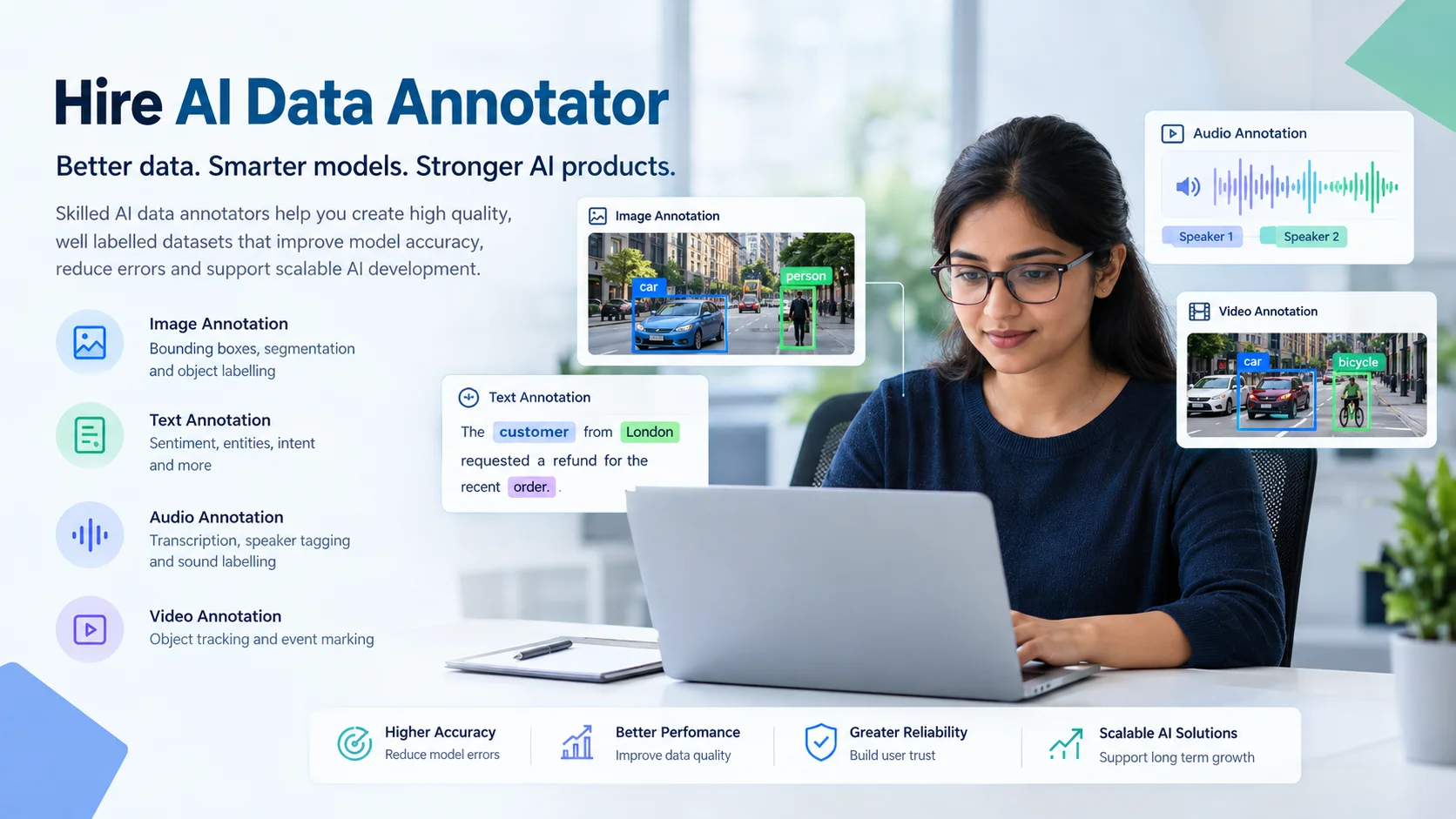
Artificial intelligence products depend on the quality of the data used to train and evaluate them. From customer support chatbots to computer vision systems, inaccurate labels and inconsistent datasets can reduce model performance, increase development costs and affect user trust. Businesses looking to build reliable AI solutions increasingly recognise the importance of skilled data annotation.
To Hire AI Data Annotator professionals is to invest in the quality of an AI system from the beginning. These specialists transform raw text, images, audio and video into structured, labelled datasets that machine learning models can learn from effectively.
Why AI Data Annotation Matters in Product Development
AI models identify patterns from training data. If that data contains errors, missing labels or inconsistent classifications, even a well-designed model may produce unreliable results.
For example, an e-commerce recommendation system may misclassify product categories, while a customer service chatbot may struggle to identify customer intent when conversational data is labelled inconsistently. In healthcare imaging and autonomous systems, annotation errors can create more serious risks.
Data quality should therefore be treated as a product development priority rather than a final preparation task. Product managers, machine learning engineers and data leaders should establish annotation standards before large-scale dataset creation begins.
Key Responsibilities of an AI Data Annotator
An AI Data Annotator prepares datasets according to defined project requirements and quality standards. Their responsibilities may include:
- Image annotation: Drawing bounding boxes, identifying objects and creating segmentation masks for computer vision models.
- Text annotation: Labelling sentiment, named entities, customer intent and other language patterns for natural language processing applications.
- Audio annotation: Transcribing speech, identifying speakers and tagging relevant sounds.
- Video annotation: Tracking objects and marking events across video frames.
- Quality validation: Reviewing labels, identifying inconsistencies and correcting errors before datasets enter the training pipeline.
The required expertise depends on the AI product. A document processing tool needs different annotation skills from a medical imaging model or a voice assistant.
How Better Annotation Improves AI Performance
Consider a business developing an AI-powered customer support platform. Its initial dataset contains thousands of conversations, but customer complaints, refund requests and product enquiries are labelled inconsistently.
An annotation process with clear guidelines, representative examples and independent quality checks can help standardise these categories. The resulting dataset gives the model a stronger foundation for recognising customer intent.
For AI development teams, useful quality indicators include annotation agreement, error rates, review time and the percentage of labels requiring correction. For instance, reducing a hypothetical label error rate from 10% to 4% across 50,000 records would reduce incorrect labels from 5,000 to 2,000.
This is an illustrative calculation, not a guaranteed industry benchmark. Actual improvements depend on dataset complexity, annotator experience and quality control procedures.
Human Annotation Versus Automated Labelling
Automated labelling tools can process large datasets quickly and reduce repetitive work. However, they may struggle with ambiguous language, unusual objects, cultural context and rare scenarios.
Human annotators can interpret context, resolve uncertain cases and review machine-generated labels. A hybrid approach often offers a practical balance: automation handles straightforward examples, while skilled annotators focus on difficult cases and validation.
Businesses should compare these approaches using accuracy, throughput, cost per accepted label and downstream model performance rather than annotation speed alone.
Choosing the Right AI Data Annotation Approach
When businesses plan to Hire AI Data Annotator professionals, they should evaluate domain knowledge, attention to detail, familiarity with annotation platforms and experience with structured quality assurance.
A strong workflow includes documented labelling guidelines, pilot annotation, regular audits and escalation procedures for uncertain examples. Sensitive datasets also require suitable access controls, privacy safeguards and clear data handling policies.
Teams should monitor quality throughout the project instead of relying on a single final review. This makes it easier to identify recurring errors, update instructions and maintain consistency as datasets grow.








.webp)