Sign up with Google
 Sign in with Zoho


For many small businesses, spreadsheets are a perfectly reasonable place to start managing inventory.
They are inexpensive, familiar, flexible, and easy to customize. A business owner can create a product list, add quantities, record purchases, and update sales without learning a complicated software system.
The problem usually appears later.
The product range grows. A second warehouse opens. More employees need access to inventory information. Orders begin arriving from multiple sales channels. Suddenly, the spreadsheet that once felt convenient becomes something employees have to constantly check, update, correct, and reconcile.
That is often the point when businesses start looking for the Best Inventory Management Software.
The Warning Signs Are Usually Easy to Recognize
There is no specific number of products that tells a business it has outgrown spreadsheets. The warning signs are operational.
If employees regularly ask, “Which number is correct?” something is probably wrong.
If sales teams cannot confidently tell customers whether an item is available, that is another warning sign. So is spending hours reconciling warehouse counts with spreadsheet records.
These problems are not necessarily caused by careless employees. Spreadsheets simply become harder to maintain when many people are updating information across different locations and processes.
Real-Time Information Changes the Workflow
One of the biggest differences between spreadsheets and modern inventory software is the way information is shared.
With a centralized inventory platform, authorized users can work from the same inventory records. Sales, purchasing, warehouse, and management teams can access information relevant to their responsibilities.
This can reduce the need to send spreadsheets back and forth or ask someone to confirm the latest stock figure.
It also means that inventory changes can become part of a broader workflow rather than an isolated manual update.
Multiple Locations Make the Difference Obvious
Managing inventory becomes particularly challenging when products are stored in multiple locations.
A company may have a main warehouse, a smaller fulfillment center, and inventory at retail locations. A spreadsheet can record these locations, but keeping everything synchronized becomes increasingly difficult as transactions increase.
Inventory software can provide location-level visibility and allow managers to see the overall picture without maintaining separate files for every facility.
Barcodes Make Physical Inventory Easier
There is also a practical difference in the warehouse.
An employee receiving 100 products does not necessarily want to type every product code into a spreadsheet. The same is true during picking, stock counts, and transfers.
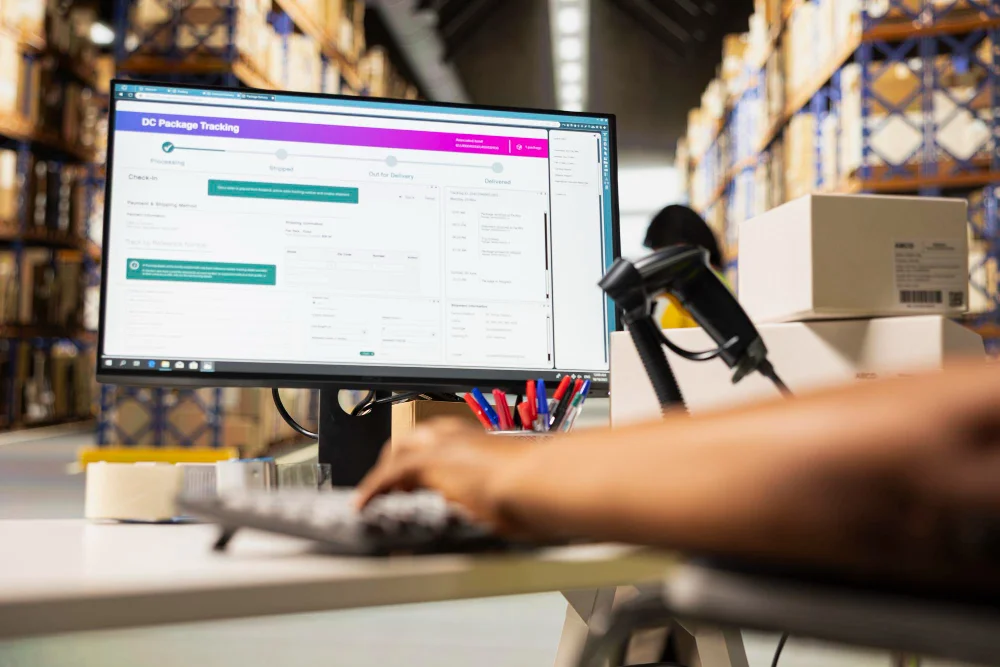
Barcode scanning allows employees to capture product information quickly. Mobile scanning can make this even more convenient because workers can update records directly from the warehouse floor.
For businesses processing significant inventory volumes, this can save time across thousands of routine transactions.
Inventory Should Connect With Sales
Imagine an online customer ordering the last available unit of a product.
If the ecommerce store and inventory records are not synchronized, another customer may be able to order the same product a few minutes later.
This is one of the practical reasons businesses with multiple sales channels need better inventory coordination.
A connected inventory system can help synchronize stock information between sales channels and operational processes, reducing the risk of overselling.
Purchasing Becomes Easier With Better Data
Good purchasing decisions require good inventory information.
Without reliable stock data, purchasing managers may order based on assumptions. They may buy too much because they do not realize that another warehouse has excess stock, or they may order too little because they do not see how quickly a product is selling.
Inventory software can provide current stock information and, depending on the platform, reorder alerts and forecasting tools.
That does not remove judgment from purchasing. It simply gives purchasing teams better information to work with.
Choosing the Right System
Once a business decides to move beyond spreadsheets, it should avoid choosing software solely because it has a long feature list.
Start with the actual problems.
Does the business need multiple warehouse support? Barcode scanning? Ecommerce integration? Purchase order management? Reporting? Mobile access? Forecasting?
The answers will help narrow the options.
Cost is important too, but it should be considered alongside implementation effort, usability, integrations, support, and scalability.
The Goal Is Simpler Operations
Technology should not make inventory management more complicated.
The purpose of moving from spreadsheets to dedicated software is to create a process that is easier to maintain as the business grows.
The Best Inventory Management Software will therefore depend on the company's specific situation. A small online retailer may need a very different solution from a manufacturer or distributor.
What matters is finding a platform that provides dependable inventory visibility, supports daily workflows, and can grow with the business.
Moving beyond spreadsheets is not about adopting technology for its own sake. It is about recognizing when the old way of working is consuming too much time and creating too much uncertainty.
At that point, a well-chosen inventory management system can turn stock control from a recurring headache into a more predictable part of running the business.


.webp)