Sign up with Google
 Sign in with Zoho

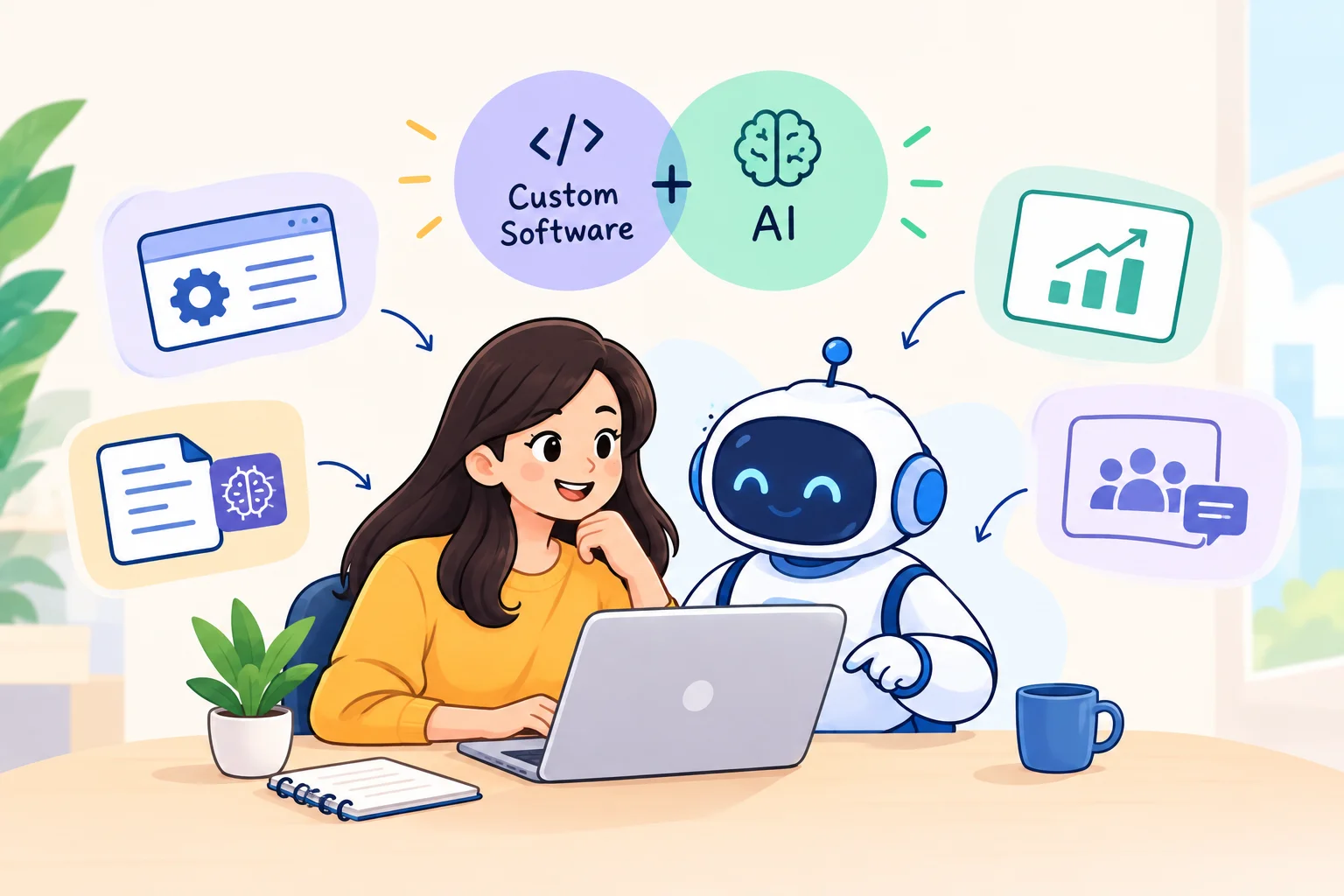
Running a business involves much more than selling a product or service. Behind the scenes, there are emails to answer, customer details to manage, reports to prepare, documents to review, orders to track, and plenty of information moving between different systems.
For a small team, these tasks may be manageable. But as the business grows, everyday processes often become more complicated. Employees can end up spending a surprising amount of time doing repetitive work instead of focusing on customers, strategy, and problem-solving.
This is where custom software and artificial intelligence (AI) can make a real difference.
They are not the same thing, and they shouldn't be used for the same purpose. However, when used in the right way, they can work together to make business operations smoother and easier to manage.
Custom Software Is Built Around the Way a Business Works
Most businesses have their own way of doing things.
A company might have a particular approval process, a unique way of managing projects, or several internal systems that need to share information. In these situations, using a standard software product can sometimes mean changing the business process just to fit the software.
Custom software takes the opposite approach.
Instead of forcing a business to adapt to a ready-made tool, the software can be designed around the actual workflow and requirements of the organization.
For example, a company may need one system that allows employees to:
- Manage customer requests
- Track projects
- Monitor orders
- Handle approvals
- Store important documents
- Connect information from different departments
Having these processes properly connected can save time and reduce confusion.
Of course, custom software isn't always necessary. Sometimes an existing tool is perfectly suitable. The important thing is identifying whether a business has a specific problem that existing software cannot solve effectively.
Where Does AI Fit Into the Picture?
AI is especially useful when a business has to deal with large amounts of information or repetitive tasks involving text, documents, images, or data.
For example, AI can help with:
- Organizing information
- Classifying customer requests
- Extracting details from documents
- Summarizing long content
- Identifying patterns in data
- Searching through large amounts of information
- Answering common customer questions
Think about a customer support team receiving hundreds of messages every day. Someone has to determine which messages are about payments, technical problems, account issues, or general questions.
An AI system could help sort those messages into categories before they reach the appropriate team.
That doesn't mean the AI replaces the support team. It simply helps employees spend less time sorting basic information and more time solving actual customer problems.
AI and Custom Software Can Work Better Together
One of the most useful ways to implement AI is to include it inside an existing business workflow.
Custom software can manage the overall process, while AI handles specific tasks that require analyzing or processing information.
Imagine a company that receives a large number of documents every day.
A custom-built system could collect and organize those documents. AI could then help identify important information inside them. The extracted details could be sent to the correct department or stored in the appropriate place.
The employee still has control over the process, but much of the repetitive work can be reduced.
This approach is often more practical than asking employees to constantly switch between different tools and platforms.
Less Time Spent on Repetitive Tasks
Almost every business has tasks that employees perform repeatedly.
Copying information from emails into spreadsheets is one example. Entering the same customer details into multiple systems is another. Creating similar reports every week can also take up valuable time.
These tasks may seem small individually, but together they can consume a significant part of the working day.
Custom software can connect different processes and systems. AI can assist when the work involves understanding text, documents, or patterns.
The goal isn't necessarily to automate everything.
Some tasks require human judgment, creativity, or communication. Technology works best when it handles unnecessary repetition while people focus on work that genuinely needs their expertise.
Making Business Data More Useful
Businesses collect information from many places.
There may be data from sales teams, customer support, websites, marketing platforms, internal systems, and customer feedback. The problem is that this information is often spread across different tools.
A well-designed software system can bring relevant information together.
AI can then help users find, summarize, or analyze that information more easily.
For example, imagine receiving hundreds of customer reviews. Reading every comment individually can take time. An AI-powered system could help identify common themes, such as complaints about delivery, positive feedback about customer service, or repeated requests for a particular feature.
The business team can then review those findings and decide what should happen next.
The technology provides assistance, but the final business decision should still involve people.
AI Isn't the Answer to Every Problem
AI has become extremely popular, and because of that, some businesses feel pressure to add it everywhere.
But not every business problem needs AI.
Sometimes a simple database, automation rule, software integration, or improved workflow is all that's required. Adding AI to a process unnecessarily can make a system more complicated instead of improving it.
Before investing in new technology, it helps to ask:
- What problem are we actually trying to solve?
- Where is the current process slowing people down?
- Can this issue be solved with simpler software?
- What data would an AI system need?
- How will we check whether the results are accurate?
Starting with these questions helps businesses make better technology decisions.
Start With the Workflow
The best starting point is usually not, “How can we use AI?”
A better question is, “What is causing problems in our current workflow?”
Businesses can look for areas where:
- Employees spend too much time on manual work
- The same information is entered repeatedly
- Errors happen frequently
- Information gets delayed
- Different systems don't communicate properly
Once the problem is clear, choosing the technology becomes much easier.
The solution might be custom software. It could be an existing platform, an integration between tools, AI, or a combination of several technologies.
There is no single solution that works for every business.
Final Thoughts
AI and custom software can be valuable tools for improving everyday business operations, but the technology itself isn't what creates value.
The value comes from solving a real problem.
Custom software can help businesses build systems around their specific workflows. AI can assist with information-heavy tasks, pattern recognition, and certain types of automation.
When businesses understand their processes first and choose technology based on actual needs, they are far more likely to create systems that employees can genuinely use and benefit from.
In the end, the smartest approach isn't about using the newest technology. It's about choosing the right solution for the problem at hand.