Sign up with Google
 Sign in with Zoho

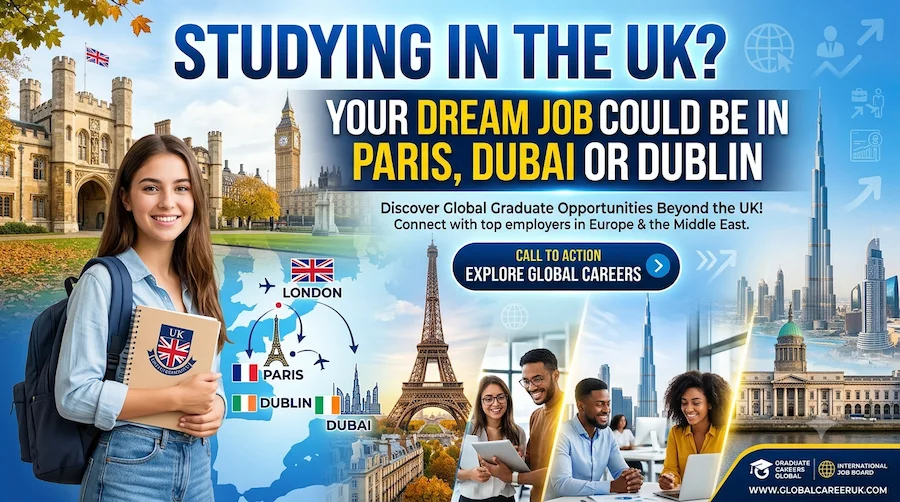
When most international students arrive in the UK, the mental map of their future career is drawn almost entirely around British cities. London, Manchester, Birmingham, Edinburgh. Graduate schemes, visa sponsorship lists, and LinkedIn searches tend to stay within the same borders.
That focus is understandable. But it is also incomplete.
A UK degree already signals something valuable to employers outside the country: the ability to study and live in a multicultural environment, handle academic pressure in English, and adapt to different systems. Those soft assets travel well. In practice, many graduates are discovering that roles in France, Germany, the Netherlands, Ireland and the United Arab Emirates are more accessible than they first assumed — provided they start looking early and understand the practical barriers.
Why the UK is only one possible chapter
The advantage is not the passport you hold. It is the combination of a recognised qualification plus real experience of navigating a foreign education system. Multinational companies in Paris, Berlin, Amsterdam, Dublin and Dubai regularly hire people who already know how to operate across cultures. The students who treat their UK years as a temporary base rather than a final destination tend to keep more options open.
That does not mean every application will succeed. Language requirements, local labour rules and visa sponsorship still matter. A UK student visa gives no automatic right to work in these countries. Each destination has its own process, and employers differ widely in how willing they are to support international hires.
A quick look at the five markets
France – Paris remains strong in finance, luxury and technology. French language skills are often expected, though some multinational teams operate in English. Work culture tends to be more formal and structured.
Germany – Demand continues in engineering, IT, research and sustainability. German proficiency is frequently required, especially outside the largest international firms. Professional credential recognition can also play a role.
The Netherlands – English is widely used in international workplaces, particularly in Amsterdam’s tech, finance and creative sectors. Some graduates may qualify for the Orientation Year residence permit, which offers a structured period to look for work.
Ireland – English is the main business language, which lowers one barrier. Dublin attracts talent in finance, technology and professional services. Non-EEA nationals usually need an employment permit unless an exemption applies.
United Arab Emirates – English dominates many private-sector roles in Dubai and Abu Dhabi. Sectors such as technology, digital marketing, energy and professional services continue to grow. Most international hires require an employer-sponsored work visa.
What actually helps
The students who move forward tend to do three things early:
- They research language expectations and typical visa pathways while still studying, rather than after graduation.
- They look for employers who already hire internationally instead of applying blindly.
- They treat the international search as a parallel track, not a last-minute alternative.
A useful starting point that gathers current examples and country-level notes is this overview: Studying in the UK? Your Dream Job Could Be in Paris, Dubai or Dublin. It lists real vacancies across the five destinations and links to more detailed country guides.
None of this guarantees a job. Visa rules change, competition is real, and living costs vary sharply between cities. But the core idea is straightforward: a UK degree does not have to end in the UK. The earlier you map the possibilities, the more realistic those possibilities become.
If you are currently studying in the UK and have been quietly wondering whether your next step has to be domestic, it is worth expanding the map. The options are wider than many students realise — as long as the research starts before the graduation photos are taken.