Sign up with Google
 Sign in with Zoho

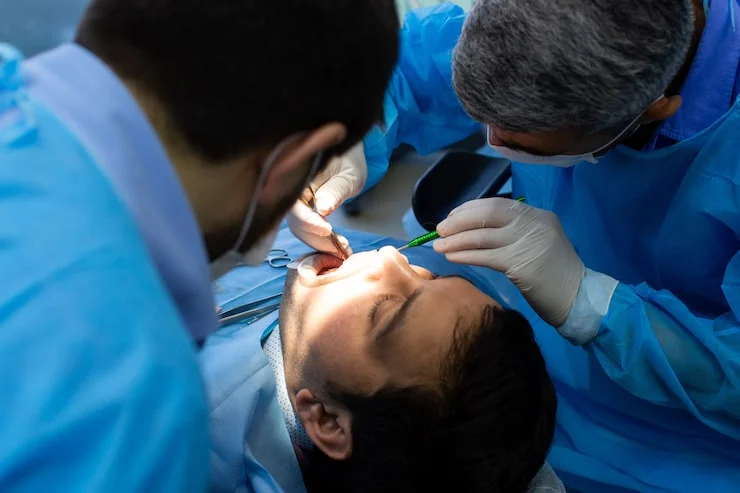
Nobody wants to hear "you need a surgical extraction." It sounds worse than it is, honestly. Most people picture something out of a horror movie, but in reality it's a routine procedure dentists do every single week. It just means the tooth needs a little extra help coming out.
Here's the difference, in plain terms: a simple extraction is when your dentist can grab a visible tooth and pull it out cleanly. A surgical extraction comes into play when the tooth is broken, hasn't fully come through the gum, or has roots that curve in a way that won't cooperate with a straightforward pull. Wisdom teeth are the classic example. They love to grow in sideways, half buried, at the worst possible angle.
So Why Would You Need One?
A few situations tend to come up over and over. Impacted wisdom teeth are the big one, probably 7 or 8 out of 10 surgical extractions we see are wisdom tooth related. Beyond that, you've got teeth that have snapped off near the gumline (this happens more than people think, especially with old fillings or deep decay), roots that are curved or fused together, or a tooth that broke during a previous extraction attempt and left fragments behind.
If any of that sounds like your situation, it's worth getting a proper look before assuming the worst. You can read more about how surgical extractions are handled here, it walks through what the consultation and imaging process looks like.
What the Actual Appointment Looks Like
You'll start with an exam and usually an X-ray or 3D scan so the dentist can see exactly where the roots sit and how the tooth is positioned relative to nerves and bone. That imaging step matters. It's how they plan the safest path in.
On the day itself, you're numbed up first. Depending on the case (and honestly, depending on how anxious you feel about dental work), you might just get local anesthesia, or you might opt for sedation. Both are completely normal choices. From there, a small incision is made if the tooth is hard to reach, and in some cases the tooth gets sectioned into pieces to come out with less trauma to the surrounding bone. Stitches go in, you get sent home with care instructions, and that's genuinely most of it.
Recovery Isn't as Bad as You'd Think
Give it a few days. Swelling peaks around day two, then starts settling down. Ice packs, soft foods, and taking it easy for the first 24-48 hours go a long way. The one rule people forget: no straws, no smoking, no aggressive rinsing. Sucking motion can dislodge the blood clot forming in the socket, and that leads to dry socket, which is genuinely more uncomfortable than the extraction itself.
Most patients are back to normal eating within a week. Full bone healing takes longer, but you won't feel that part.
If you're dealing with a tooth that's been bothering you and suspect it might need surgical removal, it's worth having it checked rather than waiting it out. The team at Smiley Dental can tell you pretty quickly during a consult whether it's a simple or surgical case. And if you already know you'll need replacement options afterward, it doesn't hurt to ask about implant timelines while you're in the chair, planning ahead saves a second consultation later.
Questions before booking? Reach out here and someone can walk you through next steps.
FAQs
1. Does a surgical extraction hurt more than a regular one?
Not during the procedure, you're numb either way. Afterward, yes, surgical sites tend to be a bit more sore, but it's manageable with normal pain relief.
2. How long until I'm back to normal?
Most people feel mostly fine within 3-7 days. Full healing underneath takes a few more weeks, but you won't notice that part day-to-day.
3. Do I need sedation? Not always.
It really comes down to how complex the extraction is and how you personally feel about dental procedures. Both local anesthesia and sedation are on the table.
4. What can I eat afterward?
Soft stuff for the first few days, think yogurt, soup, mashed potatoes. You can work back up to normal food as the site heals, usually within a week.