Sign up with Google
 Sign in with Zoho
Businesses across Dubai are looking for practical ways to use artificial intelligence to improve operations, serve customers faster, and make better decisions. From finance and healthcare to real estate, logistics, and retail, AI is becoming an important part of how organizations approach everyday business challenges.
Unlike traditional chatbots that mainly answer questions, enterprise AI agents can do much more. Depending on their design, they can retrieve information from company systems, analyze requests, coordinate tasks, and carry out approved actions with limited human intervention.
For organizations exploring enterprise AI agent development in Dubai, the challenge is not simply choosing an AI model. It is building a solution that fits existing business processes, protects sensitive information, and delivers measurable results. Businesses can explore AI agent development services in Dubai to understand how intelligent automation can be designed around their operational requirements.
This guide explains how to build an enterprise AI agent, from selecting the right architecture and implementing retrieval-augmented generation (RAG) to integrating business systems, managing security, and planning a successful rollout.
1. Introduction to Enterprise AI Agents
An enterprise AI agent is an AI-powered system designed to help a business complete specific tasks using company data, connected applications, and predefined rules.
For example, a sales agent might retrieve customer information from a CRM, summarize previous interactions, and prepare a follow-up message. A finance agent could extract invoice details, compare them with purchase orders, and flag discrepancies for review.
These systems combine artificial intelligence with business workflows, allowing employees to spend less time on repetitive tasks and more time on work that requires judgment and experience.
Why Dubai Businesses Are Exploring AI Agents
Dubai's business environment includes international companies, growing technology firms, government-related organizations, and businesses serving customers across multiple markets. Many of these organizations manage large amounts of data and rely on several applications to run their operations.
Artificial intelligence in Dubai offers opportunities to improve these processes by connecting information, reducing manual work, and helping teams respond more quickly.
Common enterprise AI use cases include:
- Customer support and inquiry management
- Sales lead qualification and CRM updates
- Employee onboarding and internal assistance
- Invoice processing and financial reporting
- Shipment tracking and supply chain coordination
- Document search and knowledge management
The potential economic benefit comes from improving productivity, reducing avoidable processing costs, and helping employees make better use of available information. However, results depend on the use case, implementation quality, operating costs, and employee adoption.
The best starting point is usually a specific business problem rather than an attempt to introduce AI across every department at once.
2. Understanding the Architecture of AI Agents
Before development begins, businesses need to understand how an AI agent will receive information, make decisions, interact with other systems, and complete tasks.
Enterprise AI architecture typically includes several connected components. Each has a different responsibility, and the design should reflect the complexity and risk of the intended workflow.
The Core Components
1. Language model
The language model interprets user requests, summarizes information, and helps determine the next step. The model should be selected according to the task's accuracy requirements, latency, cost, and data-handling needs.
2. Business data sources
The agent may need access to company documents, knowledge bases, customer records, databases, or operational reports. Access should be limited to the information required for its assigned responsibilities.
3. Tools and integrations
Tools allow the agent to interact with business applications. These may include CRM platforms, ERP systems, ticketing software, document repositories, and internal APIs.
4. Workflow orchestration
The orchestration layer manages the sequence of actions. It determines which tools can be called, what information is needed, and when the process should stop or request human approval.
5. Monitoring and access controls
Logging, permissions, validation, and performance monitoring help organizations understand what the agent is doing and identify errors or unusual behavior.
Choosing the Right Architecture
Not every enterprise requires a complex multi-agent system. A single agent connected to a reliable knowledge base may be enough for internal document search or customer support.
More complicated workflows may require multiple specialized agents or a central orchestration system. For example, a procurement workflow might involve document extraction, supplier comparison, policy validation, and approval routing.
The important consideration is reliability. A well-designed system should make its responsibilities clear, restrict unnecessary actions, and provide a predictable way to handle errors.
3. Implementing RAG (Retrieval-Augmented Generation) in AI Systems
Enterprise AI agents are only useful when they can work with relevant and trustworthy information. A general-purpose language model may not know a company's latest policies, internal procedures, product details, or customer records.
Retrieval-augmented generation, commonly called RAG, helps address this problem by allowing an AI system to retrieve relevant information from approved sources before generating an answer.
How RAG Works
A typical RAG workflow follows these steps:
- Company documents are collected from approved sources.
- The content is cleaned, divided into manageable sections, and indexed for retrieval.
- An employee or customer submits a question.
- The retrieval system finds relevant passages from the available information.
- The language model uses those passages to prepare a response.
- The system applies validation, permissions, and other checks before returning the answer.
For example, a Dubai-based company could use RAG to help employees find information about leave policies, procurement procedures, technical documentation, or internal reporting requirements.
Instead of relying entirely on information learned during model training, the agent can retrieve relevant company material when answering the question.
What Makes RAG Effective?
A successful RAG implementation requires more than connecting documents to a language model. Businesses should pay attention to document quality, search relevance, access permissions, and how frequently information is updated.
Useful practices include:
- Removing duplicate or outdated documents
- Organizing content into meaningful sections
- Applying access permissions during retrieval
- Testing responses against real business questions
- Providing source references where appropriate
- Defining what the agent should do when information is missing
RAG can improve the relevance of enterprise AI responses, but it does not eliminate hallucinations or guarantee accuracy. Important answers should be validated, especially when they affect financial, legal, healthcare, or compliance decisions.
4. Integrating AI Agents with CRM and ERP Solutions
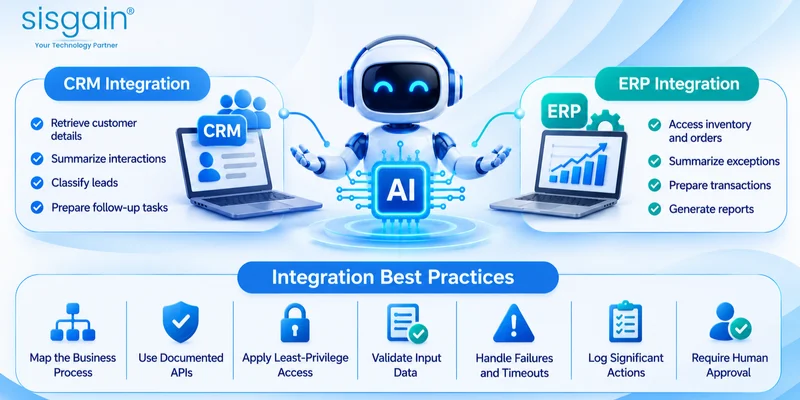
An AI agent becomes more useful when it can work with the applications employees already use. CRM integration and ERP integration allow agents to move beyond answering questions and assist with actual business workflows.
However, each integration should have a clear purpose. Connecting every available system at the beginning can increase complexity, cost, and security risks.
CRM Integration for Sales and Customer Service
A customer relationship management system contains information about leads, customer interactions, sales opportunities, and follow-up activities.
A connected AI agent could summarize a customer's interaction history, identify missing CRM fields, classify new inquiries, and prepare follow-up tasks for a sales representative.
For instance, when a new lead contacts a Dubai real estate company, the agent could record the prospect's preferred property type, budget, and location. It could then identify matching listings from approved data and help the sales team arrange the next step.
Sensitive actions, such as sending external communications or changing important customer records, should follow defined permissions and approval rules.
ERP Integration for Business Operations
Enterprise resource planning systems manage processes such as procurement, inventory, finance, and supply chain operations.
An AI agent connected to an ERP system might retrieve order information, summarize inventory levels, compare invoice records, or identify purchase requests awaiting approval.
Consider a distributor receiving several supplier invoices. The agent could extract invoice information, compare it with purchase orders, and flag differences for the finance team.
The ERP remains the authoritative source for business records, while the agent helps employees access and interpret the information.
Best Practices for Integration
Start with a small number of high-value workflows. Use authenticated APIs, restrict permissions, validate inputs, and maintain clear records of actions.
Before allowing an agent to update records or initiate transactions, test its behavior using realistic scenarios. Read-only access is often a sensible starting point, followed by carefully controlled write permissions when the system has been validated.
5. Ensuring Security in AI Deployment
Security should be part of the design from the beginning, not something added just before launch. Enterprise AI agents may interact with customer information, financial records, internal documents, and business applications, making access control particularly important.
Dubai businesses should assess applicable UAE laws and sector-specific requirements based on their activities, data, and operating arrangements.
Data Privacy and Regulatory Considerations
Depending on the organization, relevant requirements may include the UAE Personal Data Protection Law, applicable financial-sector rules, healthcare data requirements, and regulations governing particular free zones or government entities.
The UAE Personal Data Protection Law does not apply identically to every organization or processing activity, so businesses should assess its scope alongside any relevant sector-specific or free-zone requirements.
Organizations should consider:
- What information the agent can access
- Whether personal data is necessary for the task
- Where data is processed and stored
- Which providers can access the information
- How long records and logs are retained
- Whether cross-border data transfers are permitted
- How individuals can exercise applicable privacy rights
Healthcare, financial services, and other regulated industries may need additional controls based on their specific obligations.
Practical AI Security Measures
A secure deployment should use role-based access controls, authentication, encryption, activity logging, and appropriate monitoring.
It should also account for AI-specific risks. For example, a malicious document could contain instructions intended to manipulate the agent. This is one reason retrieved content should be treated as information rather than automatically trusted instructions.
Businesses should also prevent unauthorized tool use, test for prompt injection, validate outputs before sensitive actions, and require human approval for high-impact decisions.
AI ethics matters as well. Systems should be evaluated for unfair outcomes, misleading responses, inappropriate data use, and a lack of transparency.
Security requirements should be reviewed throughout the project, including after launch as models, integrations, and business processes change.
6. Creating a Detailed Rollout Plan for Your AI Agent
A structured rollout helps businesses avoid spending heavily before confirming whether an AI agent can solve the intended problem.
Rather than attempting a large deployment immediately, organizations should move through a series of manageable stages.
Step 1: Define the Business Problem
Identify a workflow that consumes time, creates delays, or produces avoidable errors. Establish a baseline using current processing time, costs, service quality, or another relevant metric.
Step 2: Assess Data and Integration Readiness
Determine which documents, databases, APIs, and applications the agent will need. Check whether the information is accurate, accessible, and suitable for the intended purpose.
Step 3: Select the Technology
Choose the language model, retrieval approach, orchestration framework, hosting environment, and integrations based on the requirements.
Cloud-based AI solutions may offer easier scaling and access to managed services. Private or self-hosted deployments may be appropriate when an organization has specific control, infrastructure, or data-handling requirements. The decision should reflect actual needs rather than assumptions that one option is always safer or cheaper.
Step 4: Build and Test a Pilot
Develop a limited version of the agent for a defined group of users. Test normal requests, unusual inputs, missing information, incorrect data, permission boundaries, and failure scenarios.
Step 5: Measure Results
Compare the pilot's performance against the original baseline. Useful measures include task completion time, accuracy, escalation rate, employee adoption, operating cost, and user satisfaction.
Step 6: Expand Gradually
Once the pilot meets agreed targets, introduce the agent to additional users or workflows. Continue monitoring performance and update the system when business requirements change.
Good AI project management also requires clear ownership. Business teams, developers, security specialists, and compliance stakeholders should understand their responsibilities throughout implementation.
7. Challenges and Solutions in Building AI Agents
Even a promising AI project can encounter practical difficulties. Identifying these challenges early makes it easier to build a system that performs reliably in real business conditions.
Poor Data Quality
Outdated documents, inconsistent records, and duplicate information can lead to unreliable answers.
Solution: Clean the relevant data, assign ownership to source systems, and establish a process for reviewing and updating important information.
Integration Complexity
Older business applications may have limited APIs or inconsistent data formats.
Solution: Begin with the systems that offer the greatest business value. Use secure integration layers and test each workflow before expanding connectivity.
Unpredictable AI Responses
Language models may misunderstand requests, produce unsupported statements, or select an unsuitable tool.
Solution: Limit the agent's scope, provide clear instructions, validate outputs, and test it against representative scenarios. Use deterministic business rules for decisions that should not depend on free-form model reasoning.
Employee Adoption
Employees may hesitate to use AI if they do not understand how it works or worry that it will create more work.
Solution: Involve users early, explain the agent's limitations, provide training, and collect feedback during the pilot.
Unclear Return on Investment
A system may automate tasks without generating enough value to justify its costs.
Solution: Define measurable success criteria before development and include implementation, hosting, model usage, maintenance, and human review in the financial assessment.
A successful implementation depends on continuous improvement. Businesses should review performance regularly and adjust the system as real-world usage reveals new requirements.
8. Conclusion: The Future of AI in Dubai's Enterprises
Enterprise AI agents can help Dubai businesses connect information, reduce repetitive work, and improve how employees manage everyday processes. From CRM and ERP workflows to internal knowledge retrieval and operational support, the opportunities are broad.
However, the strongest results usually come from solving a specific problem rather than introducing AI simply because the technology is available.
Businesses should begin with a clearly defined use case, build an architecture that fits their needs, establish appropriate security and privacy controls, and test the solution through a controlled pilot. They should then expand based on measurable outcomes rather than assumptions.
Dubai's technology landscape continues to create opportunities for organizations willing to modernize their operations. With thoughtful planning, responsible AI deployment strategies, and a clear understanding of business objectives, enterprise AI agents can become useful tools for improving productivity and supporting sustainable growth.
The next step is to identify one workflow where employees spend too much time on repetitive tasks, determine what information and integrations it requires, and build a realistic plan to test whether an AI agent can deliver meaningful value.









.webp)