Sign up with Google
 Sign in with Zoho
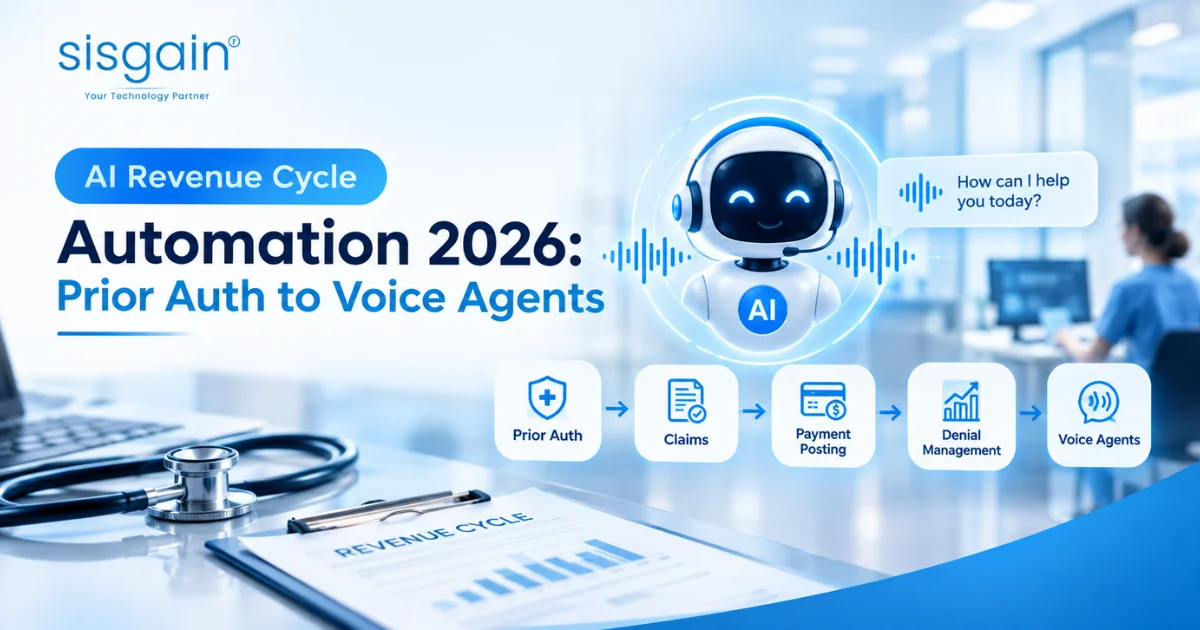
Sixty-three percent of healthcare organizations now use AI somewhere in their revenue cycle. Two years ago, the return on that investment was still a pitch-deck promise. In 2026 it is a line item on the P&L.
Regulation is accelerating the shift. The CMS Interoperability and Prior Authorization Final Rule (CMS-0057-F) requires impacted payers to return decisions within 72 hours for expedited requests and seven days for standard ones. Those payers include Medicare Advantage, Medicaid, CHIP and federal exchange plans. Providers and payers can no longer run prior authorization on fax machines, phone queues and manual portals. Automation is now the baseline for operating at scale.
My thesis is simple. The health systems pulling ahead in 2026 pair AI-driven revenue cycle automation (prior authorization, eligibility, claims and denials) with AI voice agents that handle patient outreach and scheduling. Together they lower administrative cost and improve access.
This article covers the architecture, the highest-value use cases, the compliance considerations and a practical implementation roadmap. It also covers where a custom development partner fits, because the build-versus-buy decision now shapes long-term ROI.
The 2026 Revenue Cycle Imperative
Market momentum and regulatory pressure
Adoption has moved past the pilot stage. With 63% of organizations deploying AI across revenue cycle management (RCM) functions, early adopters report 30–60% reductions in cost-to-collect. Those numbers explain why RCM leaders now treat AI as core infrastructure rather than an innovation experiment.
The regulatory clock reinforces the business case. CMS-0057-F compresses payer decision windows, and it pushes both sides toward standardized, API-based exchange. Providers who still depend on manual submission will feel the mismatch in turnaround times, staff burnout and delayed care.
The results are visible at scale. Penn Medicine projects more than $100 million in AI-driven gains, including a 30% efficiency improvement in prior authorization automation alone. Even discounting for the size of a system like that, the direction is clear: administrative work that once took days now takes minutes.
Where AI delivers measurable ROI
The returns cluster across the three phases of the revenue cycle:
- Front-end: Real-time eligibility verification with predictive risk scoring at registration, so coverage problems surface before the patient is in the chair.
- Mid-cycle: Claim scrubbing, coding assistance and clinical documentation improvement (CDI) that catch errors before submission.
- Back-end: Denial prediction, automated appeals, accounts receivable (AR) prioritization and payment variance analysis.
Each phase feeds the next. Clean registration data produces cleaner claims, and cleaner claims produce fewer denials. That compounding effect is why organizations that automate the whole chain outperform those that automate a single step. If you are mapping this out for your own organization, a structured approach to AI-driven revenue cycle automation (prior auth, denials, eligibility) is the right starting point.
AI Tools Automating Prior Authorization, Claim Scrubbing and Eligibility
The most useful way to evaluate AI in RCM is by workflow rather than by vendor. Three workflows deliver the fastest payback.
Prior authorization automation
Prior authorization is the most visible pain point for providers and patients alike. Modern automation auto-fills payer forms, monitors payer-specific requirements and pushes real-time status notifications to staff. Organizations report turnaround reductions of up to 80% when these capabilities work together.
The technical foundation is FHIR-based electronic prior authorization (ePA). Direct payer integration through standardized APIs replaces portal hopping and phone calls, and CMS-0057-F is accelerating adoption on both sides of the transaction.
Imaging and surgical authorizations are the strongest first use cases. Volume is high, payer rules are well defined, and the workflow is easy to automate end to end: order, submission, status tracking, then approval or denial. Staff handle only the exceptions.
Claim scrubbing and denial prediction
AI-based scrubbing flags at-risk claims before they leave the building. Typical catches include missing documentation, coding mismatches and gaps in medical necessity support. Traditional rules engines find some of these, but machine learning models learn from each payer's actual adjudication behavior.
Denial prediction takes the idea further. Models score claims by their likelihood of reimbursement and prioritize work queues accordingly, so experienced staff spend time on the accounts most worth their effort. When a denial does occur, AI drafts the appeal with the relevant clinical context attached.
The outcome is fewer reworks, faster cash and a lower cost-to-collect. It is the mechanism behind the 30–60% figures cited earlier.
Automated eligibility verification
Eligibility failures are among the most preventable causes of rejected claims. Real-time verification at scheduling catches inactive or mismatched coverage days before the visit. Predictive models add a second layer by assessing coverage risk before service delivery and alerting staff to high-risk registrations.
For teams evaluating technology, a deeper look at AI tools automating prior authorization, claim scrubbing, eligibility verification, denial prediction, and FHIR-based ePA submissions to payers will show how these components fit together in a single stack.
AI Voice Agents for Patient Outreach and Scheduling in 2026
Automation of payer-facing work solves half the problem. The other half is the patient-facing phone, which remains a bottleneck in most health systems.
What AI voice agents do today
Current voice agents answer inbound calls, understand natural spoken requests and complete routine tasks without a human. Those tasks include scheduling, intake, refill requests, eligibility checks and prior authorization status inquiries.
They also work outbound. They rebook missed appointments, close care gaps and send reminders by voice or SMS. Luma Health's 2026 release shows where the market is heading: agentic workflows that rebook no-shows and schedule due care without staff intervention.
High-value use cases
- Appointment scheduling and management: Voice agents offer real-time slots based on patient preferences and provider availability, and they handle reschedules and cancellations in the same call.
- Prior authorization status updates: Patients who call for a status update get an immediate answer. Complex cases route to staff with full context, so the patient never repeats themselves.
- Post-discharge follow-up: Automated check-ins help reduce readmissions and capture HCAHPS feedback while the experience is fresh.
- Recall campaigns: Overdue physicals, screenings and vaccinations are segmented by risk, and calls convert directly into bookings.
Organizations deploying these agents commonly report that they handle 40–60% of inbound calls autonomously. That frees front-desk teams for the work that actually needs a human.
A 90-day implementation roadmap
A phased rollout keeps risk low and results visible:
- Month 1: Integrate the scheduling system (Epic, Cerner or Athena) and configure reminder timing, typically 48 hours, 24 hours and 2 hours before the visit.
- Month 2: Launch recall and outreach campaigns, and track conversion rates by segment.
- Month 3 and beyond: Extend to inbound call handling, with intelligent routing so clinical and urgent matters reach a person immediately.
For a closer look at architecture and use cases, see how AI voice agents for patient outreach and scheduling in 2026 are being deployed in practice.
Building a Telemedicine Platform in 2026
Virtual care is now part of the same access story. Patients who book by voice agent often need somewhere to go for the visit, and that "somewhere" increasingly determines whether the automation gains carry through.
Why custom telemedicine development matters
Off-the-shelf telehealth products work for simple use cases. They tend to fall short when an organization needs deep EHR integration, AI triage, remote patient monitoring (RPM) connectivity and multi-role workflows for patients, providers and administrators.
Enterprise-grade telemedicine platforms typically cost $150,000 to $400,000 or more, depending on scope, integrations and AI features. Compliance drives a meaningful share of that cost: HIPAA, SOC 2, state telehealth laws, electronic prescribing of controlled substances (EPCS) and encrypted video SDKs.
Core features for 2026
- Patient app: Scheduling, video visits, e-check-in, insurance upload, payments and post-visit surveys.
- Provider app: EHR-integrated charting, e-prescribing, AI scribe support and RPM dashboards.
- Admin portal: Analytics, AI-driven usage trends, care gap identification and revenue cycle dashboards.
- AI layer: Triage chatbots, no-show prediction, automated follow-ups and prior authorization status checks.
The AI layer is what separates a 2026 platform from a 2021 one. It connects the visit to the revenue cycle, so eligibility, authorization and documentation are handled before and after the encounter instead of being chased afterward.
Tech stack considerations
- Video: WebRTC, Twilio Video, Vonage or Agora. Any provider must be HIPAA-eligible and willing to sign a Business Associate Agreement (BAA).
- Backend: FHIR APIs, HL7 interfaces and payer connectivity for ePA and eligibility.
- AI/ML: Denial prediction, voice agents and natural language processing for clinical documentation.
Organizations ready to move from evaluation to execution should look at what it takes to build a telemedicine platform that is integrated with clinical and financial systems from day one.
Choosing a Telemedicine Site Development Agency
The agency you choose determines whether the platform integrates cleanly or becomes a maintenance burden. Four criteria separate strong partners from generalists.
Evaluation criteria
- Healthcare experience: Look for HIPAA-compliant deployments, proven integrations with Epic, Cerner and Meditech, and real payer connectivity work.
- AI capabilities: Ask for evidence of shipped voice agents, RCM automation and predictive analytics, not roadmap slides.
- Compliance depth: SOC 2 Type II, HITRUST alignment, familiarity with state telehealth regulations and DEA EPCS requirements.
- Scalability: Multi-tenant architecture, multi-specialty workflows and RPM integration.
Building a shortlist
Published rankings are a reasonable starting point, but treat them as inputs rather than answers. A sound shortlist framework scores each firm on healthcare domain expertise, compliance certifications, AI and RCM integration experience, and post-launch support.
Budgets vary widely. Expect roughly $40,000 for a focused MVP and $500,000 or more for an enterprise build with AI, EHR integration and RPM. Ask each candidate to explain what drives cost at each tier, because the answers reveal how well they understand your problem.
A specialized telemedicine site development agency will typically show its work through relevant portfolio projects and reference clients. Ask to speak with those clients.
Partnering with a Healthcare Application Development Company
Telemedicine is one product category. Most health organizations eventually need a broader set of applications, and the same partner logic applies.
Custom versus off-the-shelf
Custom healthcare applications align with your workflows, payer contracts and RCM automation needs. Bespoke solutions typically range from $40,000 to $300,000 or more, depending on integrations, AI features and compliance scope.
Off-the-shelf software launches faster. The trade-off is limited customization and, for complex organizations, a higher total cost of ownership over time. Workarounds, add-on licenses and manual processes accumulate quietly.
What to look for in a partner
- End-to-end services: Discovery, design, development, QA, HIPAA audit, launch and ongoing support under one accountable team.
- Integration expertise: EHR connectivity through FHIR and HL7, payer APIs for eligibility and ePA, RPM devices and billing systems.
- AI and automation track record: Demonstrated RCM use cases, voice agents and denial prediction models in production.
A qualified healthcare application development company should be able to walk you through these areas with specifics: which standards, which payers, which EHRs and what outcomes.
Why a Custom Healthcare App Development Company Wins in 2026
The strongest argument for custom development is durability. Regulation, payer rules and patient expectations will keep changing, and your technology needs to change with them.
Future-proof architecture
- Modular design: Add AI voice agents, RCM automation or RPM modules without replatforming.
- Interoperability: A FHIR-first approach with payer connectivity, ePA submissions and real-time eligibility keeps you aligned with where CMS is heading.
- Security: HIPAA controls, SOC 2 practices, encryption at rest and in transit, audit logs and role-based access are built in rather than bolted on.
ROI beyond launch
The financial case extends past go-live. AI-driven RCM automation can reduce cost-to-collect by 30–60%. Voice agents can absorb 40–60% of inbound call volume. A scalable telemedicine platform supports multiple specialties, locations and payers without another rebuild.
Those gains compound when the pieces share data and infrastructure. Working with a custom healthcare app development company that treats RCM, patient access and virtual care as one system is how organizations capture that compounding effect.
Conclusion
Three forces are converging in 2026. Regulatory pressure from CMS prior authorization deadlines is real. AI has matured, with 63% adoption in RCM. And patients expect instant, voice-first access.
Health systems that connect AI-driven revenue cycle automation, AI voice agents and well-built telemedicine platforms will see the fastest returns: lower cost-to-collect, fewer denials, higher patient satisfaction and scalable access to care.
The question is no longer whether to automate. It is how quickly you can find the right development partner and execute. Start with one high-volume workflow, such as imaging prior authorization or appointment recall, prove the result and expand from there.
Frequently Asked Questions
What is AI-driven revenue cycle automation?
It is the use of machine learning, natural language processing and workflow automation across the financial lifecycle of patient care. That includes eligibility verification, prior authorization, claim scrubbing, denial prediction, appeals and AR prioritization.
How much can AI reduce cost-to-collect?
Early adopters report reductions of 30–60%. Results depend on baseline maturity, payer mix and how many workflows are automated together rather than in isolation.
How does CMS-0057-F affect prior authorization?
The rule requires impacted payers to decide standard requests within seven days and expedited requests within 72 hours. It also pushes the industry toward FHIR-based APIs, which makes electronic prior authorization far more practical for providers.
What can AI voice agents handle today?
They can schedule, reschedule and cancel appointments, complete intake, process refill requests, check eligibility and give prior authorization status updates. Outbound, they run reminders, recall campaigns and post-discharge follow-up. Urgent or complex issues should route to staff.
How long does it take to deploy a voice agent?
A phased 90-day rollout is realistic: scheduling integration in the first month, outreach campaigns in the second, and inbound call handling from the third month onward.
How much does a custom telemedicine platform cost?
Enterprise platforms typically run $150,000 to $400,000 or more. Focused MVPs can start near $40,000, while builds with AI, EHR integration and RPM can exceed $500,000.
Should we build custom software or buy off-the-shelf?
Off-the-shelf tools launch faster but limit customization and can carry a higher long-term cost for complex organizations. Custom development fits organizations with unique workflows, payer contracts or integration needs.
What compliance requirements apply?
HIPAA is the baseline. Most partners should also demonstrate SOC 2 Type II, alignment with HITRUST, knowledge of state telehealth laws and DEA EPCS support. Any video or AI vendor handling PHI must sign a BAA.


.webp)