Sign up with Google
 Sign in with Zoho


Businesses today have access to more data, advanced technologies, and digital tools than ever before. Yet having access to technology does not automatically mean a business knows how to use it effectively.
Many organizations understand that artificial intelligence, machine learning, data analytics, and automation can improve their operations. The challenge is figuring out where to start, what to prioritize, and how to turn an idea into a practical business solution.
This is where consulting services can make a real difference.
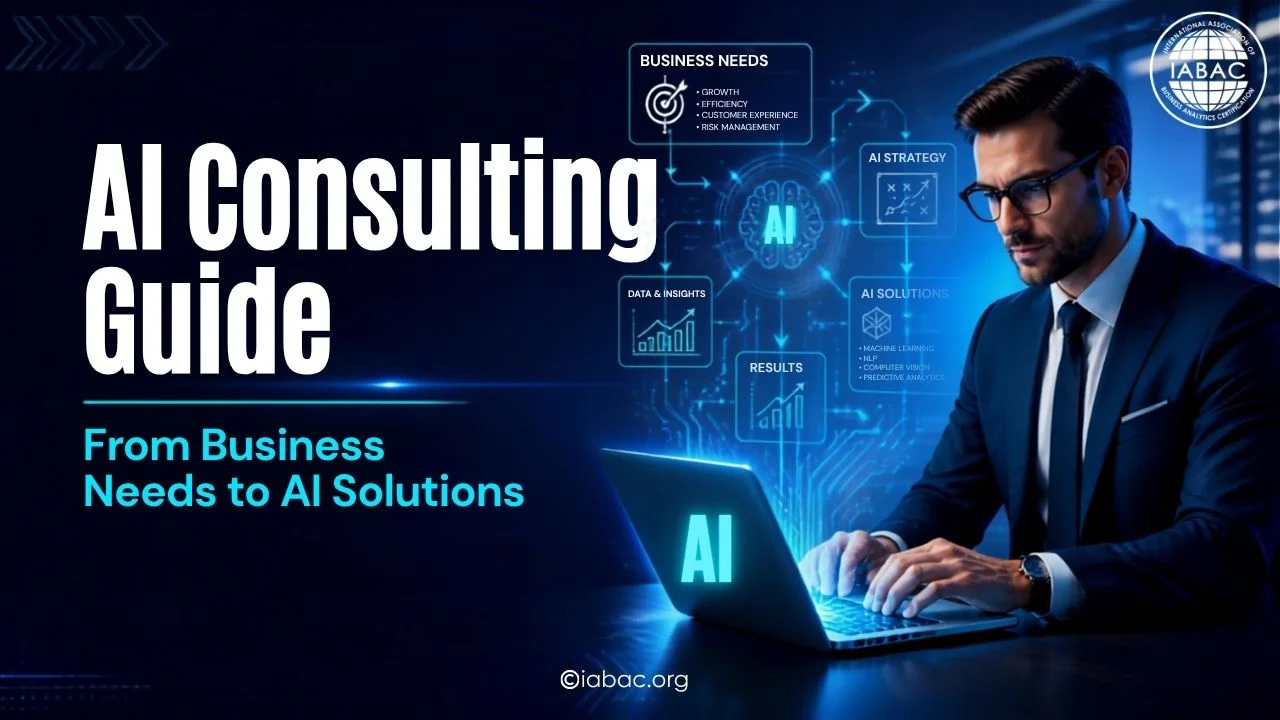
IABAC Consulting Services help businesses identify practical opportunities, understand their technology needs, and work toward solutions that support measurable business goals. Instead of adopting technology simply because it is popular, businesses can take a more structured approach based on their actual challenges.
Why Businesses Need Consulting Services
Technology projects often look simple at the beginning.
A company may want to introduce AI into customer service, use predictive analytics to improve sales forecasting, automate repetitive processes, or build dashboards for better decision-making. But once the project begins, several questions arise:
- Is this the right use case for the business?
- Does the organization have enough quality data?
- Which technology would be most suitable?
- What will the implementation cost?
- How will employees use the new system?
- How should success be measured?
Without proper planning, businesses can spend significant time and money on projects that fail to deliver the expected results.
Consulting services provide an outside perspective and a structured way to evaluate these decisions before major resources are committed.
What Are IABAC Consulting Services?
IABAC Consulting Services are designed to connect businesses with professionals who can help them explore and implement practical AI and data-driven solutions.
The focus is not simply on recommending the latest technology. It is about understanding a business problem first and then determining whether AI, analytics, automation, or another technology can provide a meaningful solution.
This approach can help organizations move from:
Business Challenge → Use Case Identification → Strategy → Implementation → Business Outcome
For companies exploring AI or analytics, this can provide greater clarity and reduce the uncertainty that often comes with technology adoption.
Identifying the Right Business Use Case
One of the biggest mistakes organizations make is starting with a technology rather than a problem.
For example, a company might decide that it needs generative AI because many competitors are using it. But that does not necessarily mean generative AI is the right solution.
A better approach is to begin with the business challenge.
Perhaps the customer support team spends several hours answering repetitive questions. Maybe the sales team struggles to forecast demand accurately. Or perhaps managers have access to large amounts of data but find it difficult to turn that data into useful insights.
A consultant can examine these challenges and determine where technology could create genuine value.
The result is a more practical question:
"What problem are we trying to solve?"
rather than:
"Which technology should we use?"
Turning Ideas Into Practical AI Solutions
Having an AI idea is very different from putting an AI solution into production.
An organization may identify an attractive use case, but implementation requires careful consideration of data, infrastructure, workflows, security, integration, and user adoption.
IABAC consulting support can help businesses move through these stages in a more organized manner.
For example, consider a retail business experiencing unpredictable demand.
A potential solution could involve predictive analytics to estimate future demand based on historical sales, seasonal trends, promotions, and other relevant factors.
But before implementing the solution, the business needs to determine:
- Which data sources should be used?
- Is the historical data reliable?
- What factors influence demand?
- How accurate does the prediction need to be?
- How will employees use the forecasts?
- What business metric will determine whether the project is successful?
Answering these questions early can prevent unnecessary development and help the organization focus on a solution that has a clear business purpose.
Supporting Data-Driven Decision-Making
Data is valuable only when businesses can use it effectively.
Many organizations collect information from websites, applications, CRM systems, sales platforms, customer interactions, and internal operations. However, having large volumes of data does not guarantee better decisions.
Data may be incomplete, duplicated, inconsistent, poorly structured, or difficult to access.
Consulting services can help businesses look at how data is collected, managed, analyzed, and used across different departments.
This can support better decisions in areas such as:
- Sales forecasting
- Customer analysis
- Marketing performance
- Financial planning
- Supply chain management
- Employee analytics
- Operational efficiency
- Risk management
The goal is not to create more reports. It is to help decision-makers understand what the data is telling them and what action they should take.
Helping Businesses Approach AI Strategically
AI adoption should not happen in isolation.
A successful AI initiative needs to fit into the organization's broader business strategy. That means considering the company's objectives, existing technology, workforce, budget, data maturity, and long-term plans.
For some organizations, the right first step may be a small pilot project.
For others, improving data quality or building a stronger analytics foundation may be more important than immediately implementing AI.
A consulting approach can help organizations determine which path makes sense for their current position.
This is particularly useful for businesses that are interested in AI but are unsure about their readiness.
From Proof of Concept to Implementation
A proof of concept can demonstrate that an idea is technically possible. However, a successful business solution needs to go beyond a demonstration.
Organizations need to consider how the solution will work in the real world.
For example, an AI model may perform well in testing but become difficult to maintain after deployment. A dashboard may provide useful information but fail to gain adoption because employees find it difficult to use. An automated process may save time but create new problems if it does not integrate properly with existing systems.
Consulting can help organizations think about these practical considerations before moving from experimentation to wider implementation.
Measuring Business Outcomes
Technology projects should have measurable objectives.
Instead of saying:
"We want to implement AI."
A business should be able to define what it expects the project to achieve.
For example:
- Reduce customer response time by 30%
- Improve forecasting accuracy
- Reduce manual data entry
- Increase lead conversion
- Identify operational inefficiencies
- Reduce processing costs
- Improve customer retention
Clear objectives make it easier to evaluate whether an initiative is actually creating value.
This also helps leadership teams make better decisions about future technology investments.
Why Expert Guidance Matters
Technology changes quickly. New AI tools, analytics platforms, and automation solutions appear regularly.
Keeping up with every new development can be difficult for an internal team that is already focused on day-to-day business operations.
An experienced consultant can bring specialized knowledge while looking at the organization's challenges from an external perspective.
This can be particularly valuable when a company:
- Is evaluating its first AI project
- Has several possible use cases but limited resources
- Needs help defining a technology strategy
- Wants to improve an existing analytics initiative
- Needs support moving from an idea to implementation
- Wants to understand the business value of AI
- Requires specialized expertise for a specific project
The consultant does not replace the organization's knowledge of its own business. Instead, the consultant combines that business understanding with technical and analytical expertise.
IABAC and the Growing Need for AI Consulting Professionals
As organizations increasingly explore AI and data-driven technologies, the demand for professionals who can connect technical possibilities with business requirements is also growing.
Technical knowledge alone is not always enough.
A good consultant needs to understand the business problem, communicate with stakeholders, evaluate potential solutions, and help translate technical concepts into practical outcomes.
IABAC supports this growing ecosystem through its professional network and consulting initiatives, helping businesses connect with professionals who have relevant AI and data expertise.
This creates an opportunity for organizations looking for guidance and professionals looking to apply their skills to real business challenges.
A Practical Approach to Consulting
Effective consulting should be collaborative.
The consultant needs to understand the organization's goals, existing processes, constraints, and expectations before recommending a solution.
A typical engagement may involve several stages.
1. Understand the Business Challenge
The first step is understanding what the organization is trying to improve.
This could involve reducing costs, improving customer experience, increasing efficiency, improving forecasting, or solving another specific business problem.
2. Evaluate the Current Situation
The next step is to examine existing data, processes, technology, and capabilities.
This helps identify gaps that may affect the success of the proposed solution.
3. Identify Suitable Use Cases
Not every problem requires AI.
Consultants can evaluate potential use cases and prioritize those that offer a realistic combination of business value, technical feasibility, and implementation practicality.
4. Develop a Strategy
Once the right opportunity is identified, the organization can develop an implementation roadmap.
This may include technology selection, data requirements, project phases, resources, timelines, and success metrics.
5. Implement and Evaluate
The final objective is to turn the strategy into a working solution and measure its results.
Performance should be monitored over time so the organization can identify what is working and where improvements are needed.
Who Can Benefit From IABAC Consulting Services?
IABAC Consulting Services can be relevant to organizations at different stages of their AI and analytics journey.
A business that is just beginning to explore AI may need help identifying its first use case.
A company that already has analytics capabilities may need support expanding them.
An organization with an existing AI project may need specialized expertise to improve implementation or move toward production.
The needs are different, but the underlying requirement is similar: make better technology decisions based on real business needs.
The Value of Making Better Technology Decisions
The biggest benefit of consulting is not simply access to technical expertise.
It is the ability to make more informed decisions.
A business does not need to implement every new technology. It needs to identify the technologies that solve meaningful problems and can produce measurable value.
That requires asking the right questions before investing resources.
What problem are we solving?
Do we have the right data?
Is the solution technically feasible?
Will employees and customers benefit from it?
How will we measure success?
What will it take to maintain the solution over time?
These questions can help businesses move beyond technology experimentation and toward practical implementation.
Final Thoughts
AI, machine learning, and data analytics can create significant opportunities for businesses, but technology alone does not guarantee success.
The difference often comes down to choosing the right problem, selecting the right approach, and executing the solution effectively.
IABAC Consulting Services provide businesses with access to professional expertise that can help them identify opportunities, evaluate use cases, develop practical strategies, and work toward measurable outcomes.
For organizations considering their next AI or analytics initiative, expert guidance can make the journey clearer and more focused.
The goal is simple: use technology where it makes business sense and turn ideas into solutions that deliver real value.
Explore IABAC Consulting Services
If your organization is exploring AI, analytics, automation, or data-driven solutions, learn more about IABAC Consulting Services and connect with professionals who can help you identify the right opportunities for your business.