Sign up with Google
 Sign in with Zoho

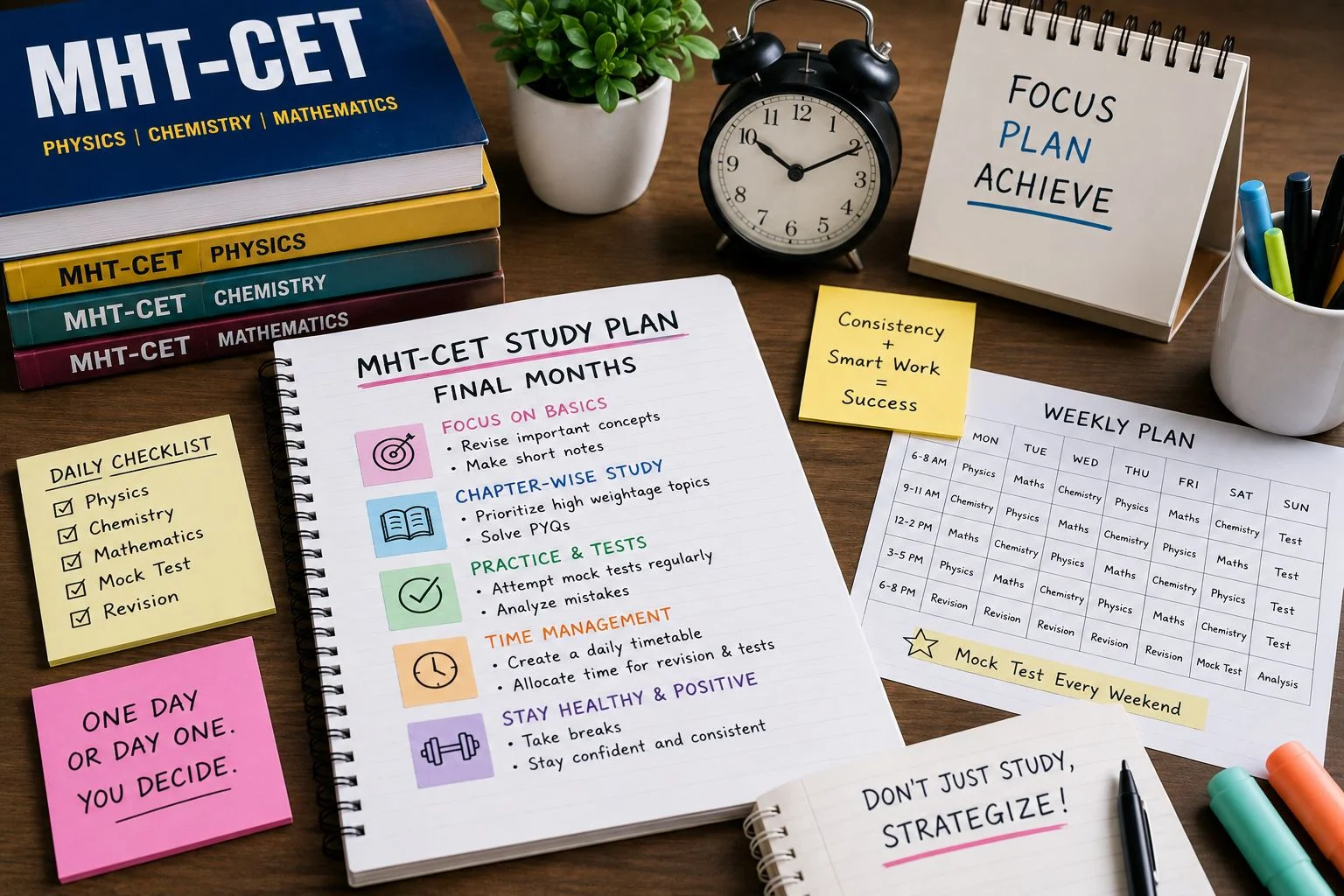
The final months before MHT-CET can feel confusing. You have already studied many chapters, but the syllabus may still look long. Some topics are strong, while others need another round of revision. Then there are mock tests, previous-year questions and the pressure of improving your score.
A good MHT-CET study plan can make this period much easier to manage.
You do not need to study every chapter from scratch. Your focus should shift towards revision, question practice, mock tests and fixing weak areas. The goal is to use your remaining time wisely instead of simply studying for longer hours.
Quick Answer
In the final months before MHT-CET, divide your preparation into three parts: syllabus revision, question practice and mock-test analysis. Give more time to important and weak topics, while regularly revising chapters you already know.
A practical routine might include daily concept revision, timed MCQ practice and weekly full-length tests. Your plan should also leave enough time for reviewing mistakes.
What Should Your MHT-CET Study Plan Include?
Your final preparation should not look exactly like your preparation at the beginning of the year.
Early preparation is mostly about learning concepts.
Final-month preparation is more about:
- Revising important concepts
- Solving MCQs
- Practising calculations
- Improving speed
- Revisiting weak chapters
- Taking mock tests
- Analysing mistakes
- Managing exam time
Think of it like preparing for a cricket match.
You do not learn how to hold the bat on match day. You practise beforehand, identify where you struggle and then work on those areas.
The same approach works for MHT-CET.
3-Month MHT-CET Study Plan
If you have around three months left, divide your preparation into three stages.
Your exact schedule can change depending on how much of the syllabus you have already completed.
Month 1: Strengthen Your Basics
The first month should focus on getting your concepts back in shape.
Do not spend an entire week on one difficult chapter if several other chapters are still untouched.
Start by dividing your syllabus into three categories:
Strong: You can solve questions comfortably.
Average: You understand the topic but make occasional mistakes.
Weak: You struggle to understand or apply the concept.
Spend more time on the second and third categories.
A simple daily structure
You could divide a study day into:
- 2 to 3 hours for concept revision
- 2 hours for MCQ practice
- 1 hour for reviewing mistakes
- 30 to 60 minutes for formulas and quick revision
You do not have to copy this schedule exactly.
If you have school, college or coaching classes, adjust it around your routine.
The important part is consistency.
Month 2: Increase Question Practice
Once you have revised most topics, start solving more questions under time pressure.
This is where many students notice a problem.
They understand the chapter when reading their notes but struggle when solving a mixed set of MCQs.
That is normal.
Reading a solution and solving a question yourself are two different skills.
Focus on:
- Chapter-wise MCQs
- Mixed-topic questions
- Previous-year questions
- Timed practice
- Formula-based questions
- Application-based questions
Try not to look at the answer immediately.
Give yourself enough time to think.
Even when you get a question wrong, ask why.
Was it a concept problem?
A calculation error?
A careless mistake?
Or did you simply run out of time?
That answer matters.
Final Month: Shift Towards Mock Tests
During the final month, full-length tests should become a regular part of your preparation.
You can start with one or two tests each week and increase the frequency if you can properly analyse them.
Do not make the mistake of taking a mock test and checking only your score.
The score is just one part of the test.
After every mock, check:
- Questions you got wrong
- Questions you guessed
- Questions that took too long
- Chapters where mistakes were repeated
- Questions you left unanswered
- Calculation mistakes
Suppose you score 115 in one test and 125 in the next.
That improvement is useful.
But it is even more useful if you know why the score improved.
How Should You Divide Time Between Physics, Chemistry and Mathematics?
Your time should depend on your individual strengths and weaknesses.
A student who struggles with Physics may need more Physics practice.
Another student may lose marks mainly in Mathematics because of calculation speed.
Do not automatically divide your study hours equally.
You can use a simple method:
Strong subject: Maintain it through regular practice.
Average subject: Give it consistent revision.
Weak subject: Give it extra focused practice.
For example:
The exact number of hours should depend on your current level.
How Can You Improve MHT-CET Speed?
MHT-CET is not only about knowing the answer.
You also need to reach that answer within the available time.
This takes practice.
Try these habits:
- Solve questions with a timer.
- Avoid spending too long on one MCQ.
- Learn common formulas properly.
- Practise mental calculations.
- Improve basic arithmetic.
- Mark difficult questions and return to them later when appropriate.
- Review questions that took too much time.
For example, if you regularly spend four minutes on one Mathematics question, ask yourself whether the question genuinely needs four minutes or whether you are missing a faster method.
Speed usually improves through familiarity.
How Important Are Previous-Year Questions?
Previous-year questions can help you understand the style and level of questions you may face.
They can also show you which concepts you need to practise more.
While solving them, do not only memorise the answer.
Ask:
- What concept was tested?
- Could the question be solved another way?
- Did I make a calculation mistake?
- How much time did I spend?
- Have I seen a similar question before?
Create a list of frequently repeated concepts and revise them regularly.
Create a Mistake Notebook
This sounds simple, but it can become one of your most useful revision tools.
Whenever you make a mistake, write it down.
For example:
Physics: Forgot the direction of force
Chemistry: Confused two reactions
Mathematics: Calculation mistake
After a few weeks, you may notice patterns.
Maybe you are not actually weak in an entire chapter. You may just be making the same two or three mistakes repeatedly.
Fix those, and your accuracy can improve.
What Should You Do If Your Syllabus Is Still Incomplete?
Don't panic.
This is where students often waste valuable time.
They look at the remaining syllabus and decide they need to study everything perfectly.
That may not be realistic.
Instead:
Step 1
List all remaining chapters.
Step 2
Divide them into easy, moderate and difficult topics.
Step 3
Prioritise topics you can learn and practise within the available time.
Step 4
Continue revising previously completed chapters.
Step 5
Start solving questions instead of waiting until the entire syllabus is finished.
A common mistake is postponing mock tests until the syllabus is 100% complete.
You can start practising tests even while some topics are still being revised.
What Should You Avoid in the Final Months?
Don't keep changing your study material.
Using five books for one chapter can create more confusion than clarity.
Choose reliable study material and use it properly.
Don't study only your favourite subject
It feels good to solve questions from a subject you already like.
But your weaker subjects need attention too.
Don't ignore sleep
Studying until 3 a.m. every night may feel productive, but poor sleep can affect concentration and memory.
A consistent sleep routine is usually a better choice.
Don't compare mock scores constantly
Your friend's score does not tell you what you need to improve.
Your own mistakes are more useful.
Don't spend the final weeks learning everything from scratch
Revision should be the priority as the exam gets closer.
How Can You Make a Weekly MHT-CET Schedule?
Here is a simple example.
You can change this according to your school or coaching schedule.
The important part is leaving time for test analysis.
A test without analysis is only half the work.
Should You Join Coaching or Tutorials During Final Preparation?
This depends on what you need.
If you are already comfortable studying independently, you may only need test practice and doubt support.
If you regularly struggle with concepts or need a fixed study routine, structured guidance can help.
Students looking for Ajinkya Tutorials Nagpur or other local coaching options should compare more than just fees.
Look at:
- Faculty experience
- Batch size
- Test frequency
- Doubt-solving support
- Study material
- Previous student feedback
- Revision sessions
- Performance tracking
You should also ask whether the teaching approach matches your current level.
If you already know the basics, you may benefit more from problem-solving and test analysis than from repeating introductory lessons.
A 7-Day Revision Routine Before the Exam
The final week should not become a race to learn every remaining chapter.
Focus on what you already know and keep your mind fresh.
7 days before
Revise important concepts and formulas.
6 days before
Practise Mathematics and Physics questions.
5 days before
Revise Chemistry and solve selected MCQs.
4 days before
Take a mock test under exam-like conditions.
3 days before
Review mistakes and weak areas.
2 days before
Light revision of formulas, reactions and important concepts.
1 day before
Avoid heavy studying.
Keep your materials ready, sleep properly and stay calm.
Frequently Asked Questions
What is the best MHT-CET study plan for the final months?
The best plan depends on how much of the syllabus you have completed. In general, use the final months for three things: revision, question practice and mock tests. Give extra time to weak topics while regularly revising strong ones. Keep a mistake notebook and use mock-test analysis to decide what you should study next.
How many hours should I study for MHT-CET?
No fixed number of hours guarantees good preparation. Your study time should fit your current syllabus, school or college schedule and preparation level. More useful than simply increasing hours is having focused study sessions, regular MCQ practice, revision and enough sleep to maintain concentration.
When should I start taking MHT-CET mock tests?
You do not need to wait until the entire syllabus is perfect before taking mock tests. Start with chapter- or subject-level tests and gradually move to full-length tests. During the final month, regular full-length practice can help you work on time management, accuracy and exam-day strategy.
How can I improve my MHT-CET score in the final months?
Focus on your mistakes rather than simply solving more questions. Revise weak concepts, practise previous-year questions, take timed tests and analyse every mock. If you repeatedly make the same type of error, spend time fixing that specific problem. Better accuracy and time management can make your preparation more effective.
Should I revise the complete syllabus before solving mock tests?
No. You can start mock or chapter-level tests while revision is still in progress. Waiting until every chapter is completed may leave you with very little time to practise under exam conditions. Use tests to find gaps in your preparation and then return to those topics for focused revision.
Are coaching classes useful for MHT-CET preparation?
Coaching can be helpful if you need structured study, regular tests or help with difficult concepts. It is not the only way to prepare. If you are comparing Ajinkya Tutorials Nagpur with other options, check teaching quality, test practice, doubt support, study material and how well the program fits your current preparation level.
Final Thoughts
The final months before MHT-CET can feel stressful, but you still have time to improve.
Don't try to become perfect in every chapter.
Focus on becoming better at the questions you are likely to face.
Revise what you know.
Work on weak areas.
Solve MCQs regularly.
Take mock tests.
And most importantly, study your mistakes.
A good MHT-CET study plan is not about sitting at your desk for the longest number of hours. It is about knowing what to study, why you are studying it and whether your practice is actually improving your performance.
Keep your plan simple enough to follow every day.
That consistency can matter more than a complicated timetable that looks good on paper but lasts only three days.