Sign up with Google
 Sign in with Zoho

The Day My Business Was Invisible Online And What Changed Everything
My cousin runs a small furniture workshop in Jaipur. Good work, fair prices, happy customers the kind of business that should thrive.
But for three years, almost nobody outside his immediate circle knew he existed. Every month he'd say the same thing: "Agar log mujhe dhundte, toh business hota." If people searched for me, I'd have business.
One day, I sat with him for two hours. We set up his Google Business Profile, posted ten photos of his actual work, and wrote three honest posts about what he makes. Nothing fancy. No ad spend.
Within 45 days, he got his first inquiry from a complete stranger someone who found him on Google Maps while searching "custom sofa Jaipur."
That one change didn't make him rich overnight. But it showed him something that changed how he thought about his business: the internet was already full of people looking for exactly what he offered. He just wasn't showing up.
That's what digital marketing actually is. Not a complicated technical system. Not something only big companies do. It's the practice of showing up consistently, clearly, usefully in the places where your customers are already looking.
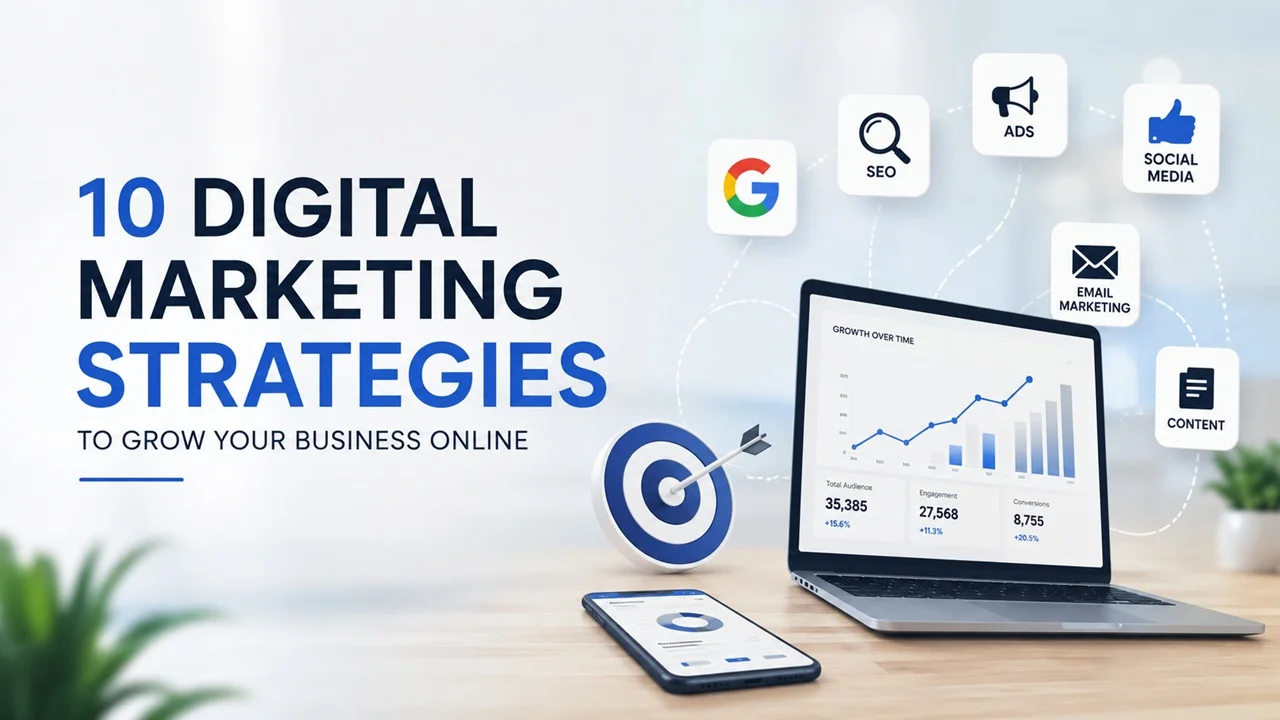
Here are 10 strategies that actually work. No jargon. No fluff. Just things you can understand, act on, and see results from.
1. Get Your Google Business Profile Right First
Before you spend a single rupee on ads, before you worry about Instagram followers, before you build a website claim and complete your Google Business Profile.
Why? Because when someone searches "[your service] near me" or "[your service] [your city]" Google shows a map with three businesses. That's the most valuable real estate in local digital marketing. And it's completely free.
What "complete" actually means:
- Your correct business name, address, and phone number
- Your actual business hours (including holiday hours)
- At least 10 real photos of your shop, your work, your team
- Your business category selected correctly
- A short, honest description of what you do and who you serve
The businesses that show up in that map section didn't pay for it. They just filled in their profile properly and kept it updated. Most of your local competitors haven't done this well. That's your opportunity.
One thing to do today: Search your own business name on Google. If the profile looks incomplete or wrong, that's the first thing to fix.
2. Build a Website That Answers Questions, Not Just Looks Good
Most business websites in India make the same mistake: they're designed for the business owner, not the customer.
They have an elaborate homepage with a big hero image and a tagline nobody understands. They have an "About Us" page talking about the founder's 25 years of experience. And they have a "Services" page that lists services without explaining why those services matter.
What your website actually needs to do is answer the questions your customer is asking before they call you:
- What exactly do you offer?
- Where are you located / do you serve my area?
- What does it cost roughly?
- What do your results look like?
- Why should I trust you over the ten other options I found?
A website that answers these questions converts visitors into leads. A website that doesn't answer them sends people back to Google to find someone else.
You don't need a ₹2 lakh custom website to do this. A clean, fast-loading WordPress site with clear service pages, real photos, and a phone number that's easy to find will outperform a beautiful but vague website every time.
One thing to do today: Open your website on your phone. Find the answer to "what does this business do and how do I contact them?" If it takes more than 10 seconds, fix that first.
3. Create Content That Answers What Your Customers Are Searching
Here's something worth understanding about how people use Google. They don't type "Company Name Pvt Ltd." They type questions.
"How to fix a leaking pipe at home." "Best fabric for summer kurta." "How much does interior design cost in India." "What to check before buying a used car."
Every one of those searches is a potential customer looking for help. If your business publishes content that genuinely answers those questions a blog post, a video, a FAQ page Google shows your business to that person.
This is content marketing, and it's not complicated. It just requires actually knowing what questions your customers ask, and answering them honestly.
A real example: A pest control company in Pune started writing blog posts answering questions like "why do cockroaches come back after treatment" and "how to know if you have termites." Those posts now bring them 400+ organic visitors a month. None of those visitors pay per click.
Start with five questions your customers ask you most often. Write an honest, helpful answer to each one. Publish them on your website. That's content marketing.
4. Use SEO to Get Found Without Paying for Every Click
SEO Search Engine Optimization sounds technical but the core idea is simple: make it easy for Google to understand what your business does and who it helps, so Google can show it to the right people.
The basics of SEO for a small or medium business:
Use the words your customers use. If your customers say "AC repair" but your website says "HVAC maintenance services," Google may not connect those dots as well as you'd like. Use the words your actual customers type.
Get other websites to mention you. When trusted websites link to yours a local newspaper article, a business directory, a partner's website Google treats that as a vote of confidence. More quality mentions = better rankings.
Make your website fast. A website that loads in 8 seconds on mobile doesn't rank well. Run your site through Google's free PageSpeed Insights tool and follow the fixes it recommends.
Keep your content fresh. Websites that publish new, useful content regularly tend to rank better than websites that haven't been updated in two years.
SEO takes 3–6 months to show meaningful results. But unlike paid ads, it keeps working after you stop actively investing in it. It's the difference between renting attention and owning it.
5. Run Google Ads for People Who Are Ready to Buy Right Now
If someone types "emergency plumber Noida" into Google, they're not browsing. They have a leaking pipe and they need help in the next hour.
Google Ads puts your business in front of people at exactly that moment. You only pay when someone clicks. And because you're reaching people who are actively searching for what you offer, the quality of that traffic is higher than almost any other paid channel.
The three things that determine whether Google Ads works for you:
First, your keyword targeting are you showing up for searches where the person is actually ready to buy, not just curious?
Second, your ad copy does your ad say something specific and compelling that makes them choose you over the other results?
Third, your landing page when they click, does the page they land on match what the ad promised and make it easy for them to contact you?
All three need to work together. Most Google Ads campaigns that "don't work" have a problem in one of these three areas usually the landing page.
Start small. ₹5,000–₹10,000 a month is enough to test whether Google Ads works for your business before committing to bigger budgets.
6. Build Your Business on WhatsApp Where Your Customers Already Are
With over 500 million users in India, WhatsApp is where most Indian consumers are most comfortable communicating. Businesses that use WhatsApp properly have a meaningful advantage over those that treat it like an email replacement.
WhatsApp for small businesses:
- Set up WhatsApp Business (the free app) with your profile, business hours, and auto-replies
- Create a catalogue of your products or services directly in the app
- Use quick replies for your most common questions
- Share your WhatsApp link or QR code everywhere your website, your visiting card, your Google profile
WhatsApp for larger businesses: WhatsApp Business API allows bulk messaging, automated conversations, and integration with your CRM. It's used by banks, ecommerce brands, and service businesses to handle thousands of customer conversations simultaneously.
The businesses that get this right treat WhatsApp as a service and relationship tool not just a broadcast channel. Customers who feel heard on WhatsApp become loyal customers.
7. Use Social Media to Build Trust, Not Just Post Content
Here's the honest truth about social media for business: most business social media accounts are boring because they only post about themselves.
"New product launch." "We're excited to announce." "Celebrating X years in business." "Check out our offer."
Nobody outside your existing customers cares about these posts. They scroll past.
What actually builds followers, trust, and eventually business on social media is content that is useful or interesting to people who don't already know you.
For a saree shop: Post about how to care for silk sarees, how to identify good quality fabric, how to style different drapes for different occasions. Useful. Specific. Not a sales pitch.
For a CA firm: Post about real tax-saving tips, common mistakes people make in ITR filing, what to keep ready before your CA appointment.
For a physiotherapy clinic: Post about exercises for back pain at a desk, how to know if you need physio or just rest, what to expect in your first physiotherapy session.
The pattern: teach something useful. Be specific. Talk like a knowledgeable friend, not a company. That's what builds following, trust, and eventually business.
Post 3–4 times a week on the platforms where your customers actually spend time not everywhere.
8. Email Marketing: The Channel Most Businesses Ignore
If you have any existing customer database phone numbers, emails, WhatsApp contacts you have a marketing asset that most businesses don't fully use.
Email marketing has a consistent ROI that outperforms most other channels. Not because email is glamorous, but because you're talking to people who already know and trust you.
A simple email marketing approach for Indian businesses:
Collect emails through your website (offer something useful in exchange a free guide, a discount, a checklist).
Send a short, useful email once or twice a month not a promotional blast, but something they'd actually want to read.
When you have something to offer a new service, a limited offer, an event your list is there, waiting.
The businesses that do this consistently build a revenue stream that doesn't depend on algorithms, ad costs, or platform changes. It's the most stable digital marketing channel there is.
9. Ask Happy Customers for Reviews Then Respond to Every One
Online reviews are the modern version of word-of-mouth. Before someone visits a new restaurant, books a service, or buys from an unfamiliar brand, they read the reviews.
Your Google reviews, specifically, affect two things: how high you rank in local search, and whether someone who finds you actually contacts you.
The simple system:
After every positive experience, ask the customer directly. "Would you mind leaving us a review on Google? It helps a lot." Most happy customers will do it if you just ask they just don't think of it on their own.
Send a WhatsApp message with the direct Google review link to make it as easy as possible.
Respond to every review positive and negative. Respond to negative reviews publicly and professionally. Potential customers read how you handle complaints as much as they read the complaints themselves.
A business with 50 reviews averaging 4.3 stars will consistently outperform a business with 8 reviews averaging 4.8 stars in local search results. Volume matters.
10. Track What's Working and Stop Guessing
The biggest waste in digital marketing isn't spending on the wrong channels. It's spending without knowing which channels are working.
Google Analytics (free) tells you how people find your website, how long they stay, and what they do. Google Search Console (also free) tells you which searches show your website and which ones lead to clicks.
If you're running ads, your ad platform shows you which ads are producing enquiries and which are burning money.
The basic questions every business should be able to answer:
- Where are my website visitors coming from?
- Which marketing channel is generating the most enquiries?
- What does it cost me to get one new customer?
You don't need to become a data analyst. You need to check these numbers once a month, notice what's working, put more into that, and cut what isn't.
Most businesses never do this. The ones that do grow faster than those that don't not because they spend more, but because they spend smarter.
The Simplest Digital Marketing Advice You'll Get
Don't try to do everything at once.
Pick two or three of these strategies that fit your business right now. Do them consistently for 90 days. Measure what happens.
The businesses that grow online aren't the ones with the most sophisticated strategy. They're the ones that pick something reasonable and actually do it week after week, without stopping when results are slow.
That's it. That's the whole secret.
FAQs
1. What is digital marketing and why does it matter for small businesses?
Digital marketing is any marketing activity that happens online search, social media, email, WhatsApp, ads. For small businesses, it matters because it puts you in front of people who are already searching for what you offer, often at a fraction of the cost of traditional advertising.
2. Which digital marketing strategy works fastest?
Google Ads and WhatsApp Business can produce results within days. SEO and content marketing take 3–6 months but produce more sustainable, long-term results. Most businesses benefit from doing both paid for quick results while building organic presence for the long term.
How much should a small business spend on digital marketing?
There's no universal answer, but a reasonable starting point is 8–12% of your target monthly revenue. More important than the number is consistency ₹5,000 a month spent consistently for 12 months will produce better results than ₹50,000 spent once and then stopped.
3. Do I need to be on every social media platform?
No. Pick one or two platforms where your specific customers spend time and do those well. A B2B company benefits most from LinkedIn. A fashion brand does better on Instagram. A local service business gets most value from Google and Facebook. Spreading thin across five platforms and doing none of them well is worse than focusing on one or two.