Sign up with Google
 Sign in with Zoho
Artificial intelligence has moved beyond experiments. Many companies now use AI in customer support, finance, HR, software development, and marketing. Yet, many teams still lack clear rules for using AI safely.
That is where an AI Governance Maturity Model becomes useful.
It helps you measure how prepared your business is for AI. It also shows where your biggest gaps exist. You can improve one step at a time instead of fixing everything at once.
Most trusted governance frameworks, including the NIST AI Risk Management Framework (AI RMF), recommend building governance throughout the AI lifecycle rather than treating it as a one-time compliance task.
If your company plans to invest in AI Governance and Consulting, this maturity model gives you a practical starting point.
What Is an AI Governance Maturity Model?
An AI Governance Maturity Model measures how well your organization manages AI risks, policies, people, and processes.
It checks whether your company can:
- Build AI responsibly
- Protect sensitive business data
- Monitor AI decisions
- Reduce legal risks
- Improve AI performance over time
Think of it as a health report for your AI program.
Instead of asking,
"Do we use AI?"
It asks,
"Can we trust the AI we use?"
Why AI Readiness Matters More Than AI Adoption
Many companies buy AI tools quickly.
Very few prepare their teams first.
This creates problems like:
- Employees using public AI tools without approval
- No record of AI models
- Missing ownership
- Poor quality data
- No monitoring after deployment
OECD research shows many organizations continue expanding AI, but governance, transparency, skills, and measurement still lag behind adoption.
Without governance, AI becomes difficult to scale.
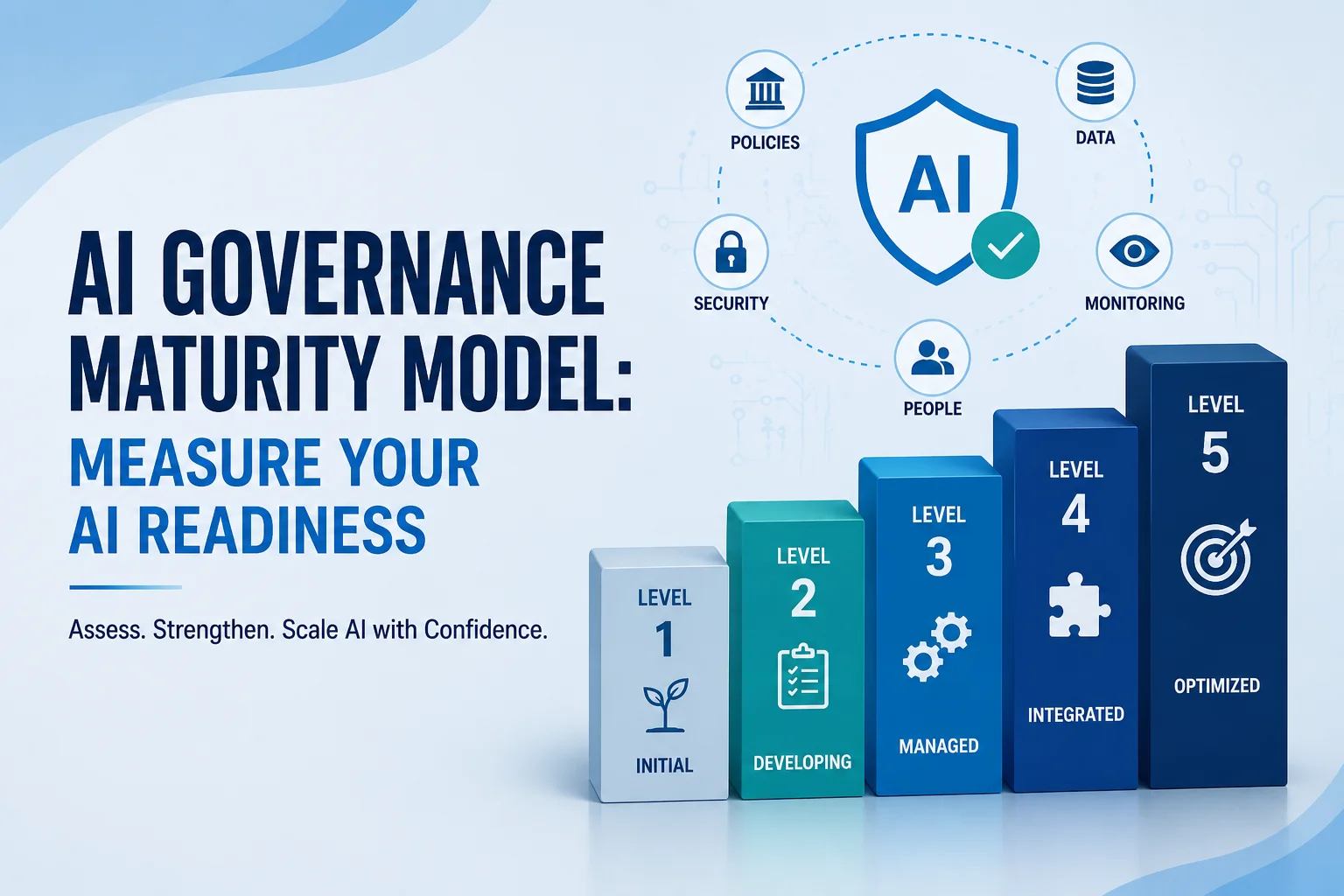
The Five Levels of AI Governance Maturity
A simple maturity model contains five stages.
Every organization starts somewhere.
The goal is steady improvement.
Level 1 – Initial
At this stage, AI grows naturally.
Employees test ChatGPT or other AI tools without guidance.
Different teams purchase different AI products.
Nobody tracks them.
Typical signs include:
- No AI policy
- No risk reviews
- No AI inventory
- No approval process
- Limited leadership involvement
Many businesses stay here longer than expected.
They often believe AI governance slows innovation.
In reality, poor governance creates larger problems later.
Level 2 – Developing
The organization realizes AI needs rules.
Basic governance starts.
Examples include:
- AI usage policy
- Approved AI tools
- Employee awareness training
- Data privacy guidance
- Initial AI committee
This stage often begins after an ai consultation with governance experts.
Companies usually discover hidden AI use across departments.
That discovery alone creates value.
Example
A retail company finds that:
- Marketing uses ChatGPT.
- HR uses AI for resume screening.
- Finance uses AI for reports.
Each team follows different rules.
The first governance project simply creates one shared AI policy.
Nothing fancy.
Just consistency.
Level 3 – Managed
Now governance becomes part of daily work.
AI projects follow standard processes.
Risk assessments become common.
Documentation improves.
Most organizations begin using:
- AI approval workflows
- Risk scoring
- Data quality reviews
- Human oversight
- Performance monitoring
This stage usually requires experienced AI Consulting Services.
External specialists often help create repeatable governance processes.
What Changes at Level 3?
Instead of asking,
"Can we use AI?"
Teams ask,
"Should we use AI for this problem?"
That small shift changes decision-making.
Level 4 – Integrated
Governance now supports business growth.
It no longer acts like a compliance checklist.
Leadership receives AI reports.
Business teams understand responsibilities.
Security, legal, compliance, and technology work together.
Common practices include:
- Central AI inventory
- Model lifecycle management
- Third-party AI reviews
- Bias testing
- Regular audits
- Executive dashboards
NIST recommends governing AI across design, development, deployment, and ongoing monitoring instead of focusing only on deployment.
Level 5 – Optimized
Very few organizations reach this stage.
Governance becomes continuous.
AI improves through regular measurement.
The organization monitors:
- Model accuracy
- Business value
- Security risks
- User feedback
- Compliance status
- AI incidents
Teams update policies whenever risks change.
Governance evolves with technology.
AI Governance Maturity Checklist
Answer these questions honestly.
More "No" answers usually mean lower maturity.
Six Areas Every Organization Should Measure
1. Leadership
Leadership should own AI strategy.
Questions include:
- Who approves AI?
- Who manages risks?
- Who reports progress?
Without ownership, governance usually fails.
2. Policies
Policies should explain:
- Acceptable AI use
- Sensitive data rules
- Human review
- Vendor selection
- Incident reporting
Policies should stay simple.
Nobody reads a 100-page manual.
3. Data Governance
AI depends on data quality.
Check whether:
- Data stays accurate
- Personal data remains protected
- Data sources remain trusted
- Permissions stay updated
Bad data creates poor AI results.
4. Technology Controls
Technology should support governance.
Examples include:
- Access controls
- Logging
- Model monitoring
- Security testing
- Version tracking
These controls reduce operational risks.
5. People and Skills
Employees need training.
Otherwise they create risks without realizing it.
Training should explain:
- Safe prompting
- Data protection
- AI limitations
- Human review
- Responsible usage
6. Continuous Monitoring
Governance never ends.
Monitor:
- Model drift
- False outputs
- Business impact
- User complaints
- Security events
Many organizations build AI.
Few monitor it properly.
Common Mistakes During AI Governance
Companies often repeat the same mistakes.
Some examples include:
- Writing policies nobody follows
- Ignoring third-party AI vendors
- Skipping employee training
- Treating governance as legal work only
- Measuring compliance instead of business value
Good governance balances innovation and control.
How AI Governance and Consulting Helps
Many organizations know they need governance.
They simply do not know where to begin.
Professional AI Governance and Consulting helps businesses:
- Measure maturity
- Find governance gaps
- Prioritize improvements
- Build practical policies
- Define ownership
- Reduce AI risks
Consultants also prevent companies from copying governance models that do not match their business.
Choosing the Right AI Governance Solutions
Not every organization needs complex software.
Small companies may only need:
- AI policy
- Training
- Risk register
- Governance committee
Larger enterprises often need complete ai governance solutions that include:
- AI lifecycle management
- Model documentation
- Audit reporting
- Risk management
- Vendor governance
- Compliance workflows
The solution should match business size.
Not marketing promises.
When Should You Consider AI Governance Services?
Many companies wait too long.
You should explore ai governance services if:
- Multiple teams use AI
- Customer data enters AI systems
- AI supports business decisions
- Regulators ask AI questions
- AI projects continue growing
Governance becomes easier before problems appear.
Real-World Example
Imagine a healthcare company introducing an AI assistant.
Without governance:
- Doctors receive different answers.
- Nobody checks accuracy.
- Patient data enters public AI tools.
- Audit records disappear.
With governance:
- Approved AI models get selected.
- Sensitive data stays protected.
- Human review remains mandatory.
- Performance gets monitored every month.
The technology stays the same.
The management changes completely.
Final Thoughts
AI success depends on more than powerful models.
It depends on trust.
An AI Governance Maturity Model helps organizations understand where they stand today and what they should improve next. Small improvements often create bigger long-term results than large one-time projects.
Whether your business is starting its AI journey or expanding enterprise-wide, investing in AI Governance and Consulting, AI Consulting Services, ai consultation, and practical artificial intelligence consulting helps build a safer and more scalable AI program. Frameworks such as the NIST AI RMF and guidance from the OECD both stress that governance, measurement, and continuous oversight are essential for responsible AI adoption.