Sign up with Google
 Sign in with Zoho

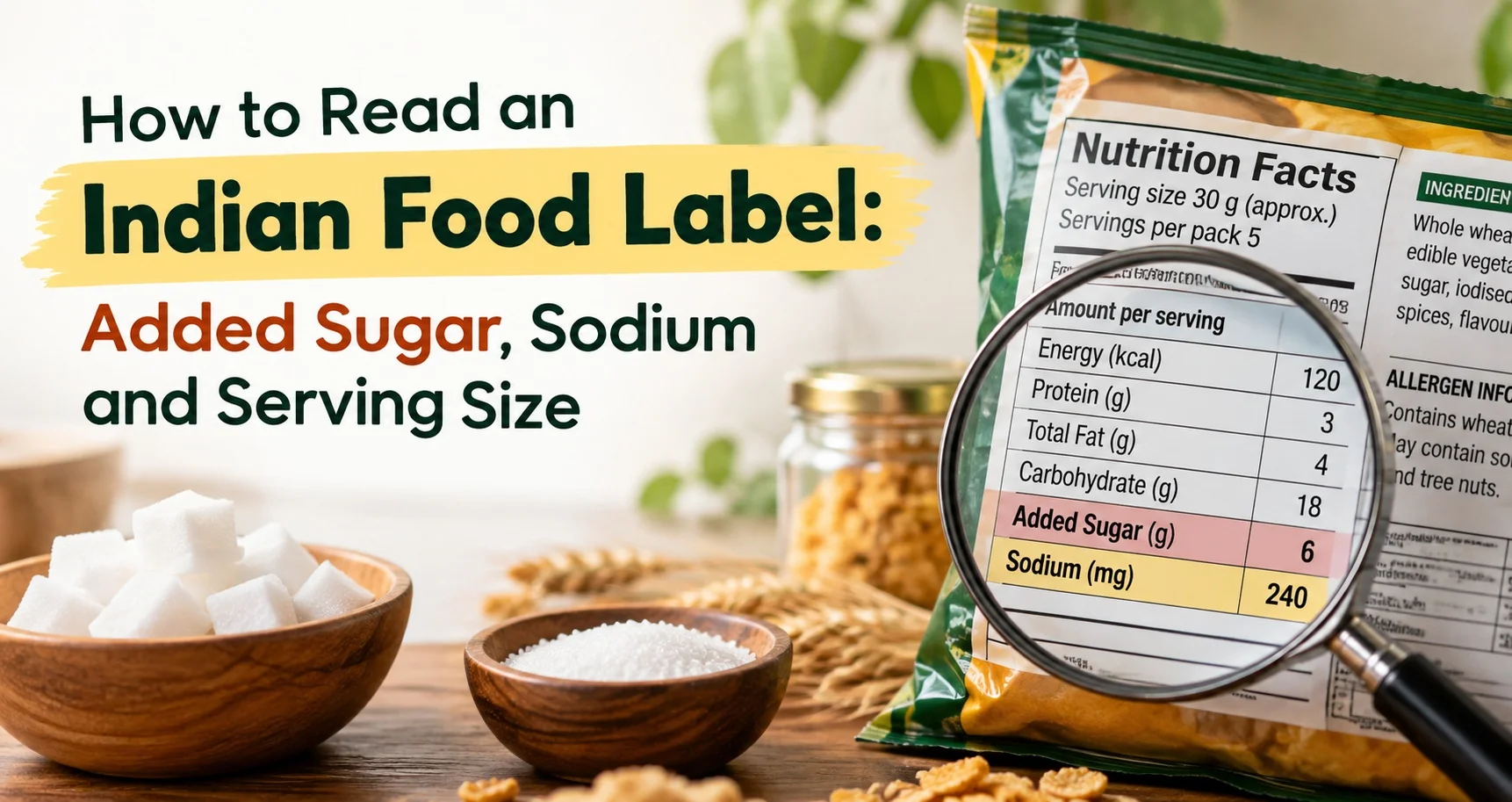
Have you ever picked up a packet of biscuits, breakfast cereal or flavoured yoghurt because it looked healthy? You check the front of the pack, see words like “multigrain” or “no added preservatives,” and assume you are making a good choice.
But what does the nutrition label actually say?
The back of a food packet can tell you a lot about what you are eating. It lists calories, carbohydrates, protein, fats, sugar, sodium and other details. The challenge is knowing which numbers matter and how to interpret them.
If you shop for packaged foods regularly, learning to read food labels can help you compare products and make choices that suit your health goals. You do not need to avoid every packaged food. You just need to know what is inside the packet.
In this guide, we will look at how to read an Indian food label, understand added sugar and sodium, check serving sizes and spot claims that may be confusing.
What Is a Food Nutrition Label?
A nutrition label provides information about the nutrients and energy in a packaged food. In India, packaged foods generally carry nutrition information under the Food Safety and Standards Authority of India (FSSAI) regulations, subject to the rules and exemptions that apply to specific products.
You will usually find a nutrition information panel on the back or side of the packet. It may include:
- Energy, measured in kilocalories (kcal)
- Protein
- Carbohydrates
- Total sugars
- Added sugars, where declared
- Total fat
- Saturated fat and trans fat
- Sodium
- Serving size or nutritional values per 100 g or 100 ml
The exact information can vary by product and applicable labelling requirements.
Start by checking the nutrition panel rather than relying only on the claims printed on the front. Words such as “natural,” “multigrain” and “made with real fruit” do not tell you the full nutritional story.
1. Understand Serving Size Before Checking Anything Else
Serving size is one of the most useful details on a food label. It tells you the quantity used to calculate the listed nutrition values when the panel provides information per serving.
Let's say a packet of namkeen contains 200 g, and its label provides nutrition information for a 30 g serving.
If you eat 60 g, you have eaten two listed servings. You will need to multiply the per-serving values by two to estimate your intake.
For example, if one 30 g serving contains 150 kcal, eating 60 g provides approximately 300 kcal.
The same calculation applies to sugar, sodium, fat and other listed nutrients.
Serving Size vs Package Size
These are not the same thing.
- Serving size: The quantity used for the nutrition calculation.
- Package size: The total amount of food in the packet.
A packet may contain several servings, even if you tend to finish it in one sitting.
When comparing products, check whether the serving sizes are similar. One cereal may list values for 30 g, while another lists values for 40 g. Comparing the numbers without adjusting for quantity can give you the wrong impression.
How to Calculate Nutrition for Your Portion
Use this simple formula:
Nutrition in your portion = nutrition per serving × (your portion size ÷ serving size)
For instance, if a 25 g serving of a snack contains 5 g of sugar and you eat 50 g, you consume about 10 g of sugar from that snack.
This small calculation can make food labels much easier to understand.
2. How to Identify Added Sugar on an Indian Food Label
Sugar is not always obvious. It can appear in biscuits, sauces, breakfast cereals, flavoured milk, packaged drinks and foods that do not taste particularly sweet.
The first thing to understand is the difference between total sugars and added sugars.
Total Sugar vs Added Sugar
Total sugars include sugars naturally present in foods, as well as added sugars where applicable.
For example, plain milk contains lactose, a naturally occurring sugar. Whole fruit contains naturally occurring sugars too.
Added sugars are sugars added during food processing or preparation. They may be used to improve sweetness, flavour or texture.
If a product declares both total sugars and added sugars, check both values. A flavoured dairy product, for example, may contain natural lactose as well as added sugar.
Which Ingredients Can Indicate Added Sugar?
Read the ingredient list and look for terms such as:
- Sugar
- Glucose syrup
- Dextrose
- Fructose syrup
- Invert sugar
- Malt syrup
- Honey
- Jaggery
These ingredients don't all behave the same way in every food, but they can help you identify ingredients used to sweeten a product.
Honey and jaggery are often seen as healthier alternatives to white sugar. They may differ in flavour and contain small amounts of other nutrients, but they still contribute sugars. You should not treat them as unlimited options.
How Much Added Sugar Is Too Much?
The World Health Organization recommends keeping free sugars below 10% of total daily energy intake, with a further reduction to below 5% suggested for additional health benefits.
For someone consuming 2,000 kcal daily, these levels correspond to less than 50 g and around 25 g of free sugars per day, respectively.
Free sugars include sugars added to foods and drinks, plus sugars naturally present in honey, syrups, fruit juices, and fruit juice concentrates. This is not the same as the total sugars figure on a food label.
These figures are general guidance, not an individual prescription. Your energy needs and health circumstances may differ.
A practical step is to compare similar products and choose the one with less added sugar when the other nutritional qualities are comparable.
3. How to Check Sodium on Food Labels
Sodium is another number worth checking, especially if packaged foods are a regular part of your diet.
Your body needs sodium for normal nerve function, fluid balance and muscle function. The problem is getting more than you need over time.
High sodium intake can contribute to raised blood pressure, which increases the risk of heart disease and stroke.
Sodium vs Salt: What Is the Difference?
People often use these terms interchangeably, but they are not identical.
Salt contains sodium and chloride. Sodium is the component listed on many nutrition panels.
The WHO recommends that adults consume less than 2,000 mg of sodium per day, equivalent to less than 5 g of salt from all sources.
Remember that this is the total for your day, not just the packaged foods you eat.
Which Packaged Foods May Contain More Sodium?
Check labels on products such as:
- Instant noodles and soup mixes
- Namkeen and salted chips
- Pickles and packaged chutneys
- Ready-to-eat meals
- Processed cheese
- Packaged sauces and seasoning mixes
Some foods may contain considerable sodium even when they do not taste extremely salty.
How to Compare Sodium Between Two Products
Suppose two packets of crackers have these values per 100 g:
Product B contains less sodium, while Product A contains slightly less added sugar. Which is better?
It depends on your needs and how much you eat. If sodium reduction is your main priority, Product B may be the more suitable option. You should still compare serving sizes, saturated fat and the rest of the ingredient list.
Also check the units. A label showing sodium in milligrams cannot be compared directly with one showing salt in grams without conversion.
4. Read the Ingredient List, Not Just the Nutrition Table
The nutrition table gives you quantities. The ingredient list tells you what the product contains.
Ingredients are generally listed in descending order by weight at the time of manufacture, subject to applicable labelling rules. This means the first few ingredients can offer a useful idea of what makes up most of the product.
For example, if refined flour and sugar appear near the beginning of a biscuit's ingredient list, they make up a substantial part of the formulation.
For a breakfast cereal, look at whether whole grains appear prominently and check the added sugar content.
You can also look for allergens, such as milk, peanuts, soy, wheat and other ingredients identified on the label.
An ingredient list is not a complete measure of a food's health value. Still, it adds context that the nutrition panel alone cannot provide.
5. Do Not Be Misled by Front-of-Pack Claims
Food packaging often uses words that sound reassuring. Some are meaningful under specific rules, while others may tell you very little about the overall nutritional quality of a product.
Here are a few examples.
“Multigrain”
This indicates the use of more than one grain, but it does not automatically mean the product is rich in whole grains or fibre. Check the ingredient list and nutrition panel.
“Sugar-Free”
This claim does not mean the product contains no calories or is suitable for every health condition. Check the applicable claim requirements, ingredients and other nutrients.
“Low Fat”
A low-fat product may still contain considerable added sugar or sodium. Compare the full nutrition panel instead of focusing on fat alone.
“Made With Real Fruit”
This wording does not tell you how much fruit the product contains or how much fibre it provides. Check the ingredient list and the declared nutrition values.
The simplest rule is to treat front-of-pack claims as a starting point, not the final decision.
6. Check Fibre, Protein and Saturated Fat Too
Sugar and sodium deserve attention, but they are not the only numbers that matter.
When comparing packaged foods, look at the nutrients that fit your needs.
Fibre
Fibre supports bowel regularity and digestive health. Foods containing whole grains, pulses, nuts and seeds can contribute to your daily intake.
When choosing bread or breakfast cereal, compare the fibre content per 100 g and check the ingredient list for whole grains.
Protein
Protein helps maintain muscles and supports tissue repair. If you are choosing a snack to keep you satisfied between meals, compare its protein content along with fibre and calories.
Roasted chana, for example, can provide protein and fibre. But a product labelled “high protein” still needs to be checked for added sugar, sodium and portion size.
Saturated and Trans Fat
Saturated fat is found in foods such as butter, ghee, fatty meats and some packaged products. Excessive intake can raise LDL cholesterol in some people.
Trans fat is another nutrient to check. Industrially produced trans fats are associated with an increased risk of heart disease.
Look at the declared saturated fat and trans fat values, and compare similar products before choosing one.
7. A Simple Checklist for Your Next Grocery Shopping Trip
You do not need to spend several minutes studying every packet. Start with these steps.
- Check the serving size. Find out how much food the nutrition values cover.
- Compare added sugar. Look at the number per 100 g or 100 ml, where available.
- Check sodium. This is especially useful for instant foods, snacks and sauces.
- Read the ingredients. See which ingredients appear near the beginning of the list.
- Look at fibre and protein. These can help you compare products within the same category.
- Check saturated fat and trans fat. Consider the overall nutritional profile.
- Compare similar products. Choose based on the nutrients that matter to you, not just the packaging.
For example, if you are buying breakfast cereal, compare two products using the same quantity. If one has less added sugar and more fibre, it may be a better fit for your everyday breakfast.
You do not have to get every choice right. Even learning to compare one or two nutrients can help you shop with more confidence.
When Can a Dietitian Help You Understand Food Labels?
Sometimes, choosing a packaged food is more complicated than checking its sugar content.
You may need to consider your blood glucose levels, blood pressure, digestive symptoms, weight management goals or other dietary needs.
A Best Dietitian in Bangalore can help you understand nutrition labels in the context of your usual meals and health goals. For example, someone managing diabetes may need to consider total carbohydrates and portion size, while someone with high blood pressure may need to pay closer attention to sodium.
At Mitha Aahara, personalised nutrition guidance can help you make practical food choices without unnecessarily eliminating familiar foods.
The aim is not to make grocery shopping stressful. It is to help you understand what you are buying and how it fits into your overall diet.
Frequently Asked Questions
1. How do I read a food nutrition label in India?
Start with the serving size, calories, carbohydrates, total and added sugars, sodium, fats and protein. Then read the ingredient list and compare similar products using the same quantity.
2. What is the difference between total sugar and added sugar?
Total sugars include naturally occurring sugars and added sugars. Added sugars are introduced during processing or preparation. Both figures can help you understand the sugar content of a product.
3. How much sodium should I consume daily?
The WHO recommends less than 2,000 mg of sodium per day for adults, equivalent to less than 5 g of salt. Your individual needs may differ based on your health and medical advice.
4. Is a product with a “low fat” label always healthy?
No. A low-fat product may still contain substantial added sugar or sodium. Check the full nutrition panel and ingredient list before comparing it with alternatives.
5. Why is serving size important on a food label?
Serving size helps you calculate how much energy and how many nutrients you consume. If you eat twice the listed serving, you generally consume twice the listed quantities of those nutrients.
Final Thoughts
Reading a food label becomes easier once you know where to look.
Start with three things: serving size, added sugar and sodium. Then check the ingredient list, fibre, protein and fats when you compare products.
You can still enjoy biscuits, snacks, breakfast cereals and other packaged foods. The point is to understand their nutritional content and make choices that suit your needs.
The next time you shop, turn the packet around before putting it in your cart. A quick look at the label may tell you more than the claims on the front.
But what does the nutrition label actually say?
The back of a food packet can tell you a lot about what you are eating. It lists calories, carbohydrates, protein, fats, sugar, sodium and other details. The challenge is knowing which numbers matter and how to interpret them.
If you shop for packaged foods regularly, learning to read food labels can help you compare products and make choices that suit your health goals. You do not need to avoid every packaged food. You just need to know what is inside the packet.
In this guide, we will look at how to read an Indian food label, understand added sugar and sodium, check serving sizes and spot claims that may be confusing.
What Is a Food Nutrition Label?
A nutrition label provides information about the nutrients and energy in a packaged food. In India, packaged foods generally carry nutrition information under the Food Safety and Standards Authority of India (FSSAI) regulations, subject to the rules and exemptions that apply to specific products.
You will usually find a nutrition information panel on the back or side of the packet. It may include:
- Energy, measured in kilocalories (kcal)
- Protein
- Carbohydrates
- Total sugars
- Added sugars, where declared
- Total fat
- Saturated fat and trans fat
- Sodium
- Serving size or nutritional values per 100 g or 100 ml
The exact information can vary by product and applicable labelling requirements.
Start by checking the nutrition panel rather than relying only on the claims printed on the front. Words such as “natural,” “multigrain” and “made with real fruit” do not tell you the full nutritional story.
1. Understand Serving Size Before Checking Anything Else
Serving size is one of the most useful details on a food label. It tells you the quantity used to calculate the listed nutrition values when the panel provides information per serving.
Let's say a packet of namkeen contains 200 g, and its label provides nutrition information for a 30 g serving.
If you eat 60 g, you have eaten two listed servings. You will need to multiply the per-serving values by two to estimate your intake.
For example, if one 30 g serving contains 150 kcal, eating 60 g provides approximately 300 kcal.
The same calculation applies to sugar, sodium, fat and other listed nutrients.
Serving Size vs Package Size
These are not the same thing.
- Serving size: The quantity used for the nutrition calculation.
- Package size: The total amount of food in the packet.
A packet may contain several servings, even if you tend to finish it in one sitting.
When comparing products, check whether the serving sizes are similar. One cereal may list values for 30 g, while another lists values for 40 g. Comparing the numbers without adjusting for quantity can give you the wrong impression.
How to Calculate Nutrition for Your Portion
Use this simple formula:
Nutrition in your portion = nutrition per serving × (your portion size ÷ serving size)
For instance, if a 25 g serving of a snack contains 5 g of sugar and you eat 50 g, you consume about 10 g of sugar from that snack.
This small calculation can make food labels much easier to understand.
2. How to Identify Added Sugar on an Indian Food Label
Sugar is not always obvious. It can appear in biscuits, sauces, breakfast cereals, flavoured milk, packaged drinks and foods that do not taste particularly sweet.
The first thing to understand is the difference between total sugars and added sugars.
Total Sugar vs Added Sugar
Total sugars include sugars naturally present in foods, as well as added sugars where applicable.
For example, plain milk contains lactose, a naturally occurring sugar. Whole fruit contains naturally occurring sugars too.
Added sugars are sugars added during food processing or preparation. They may be used to improve sweetness, flavour or texture.
If a product declares both total sugars and added sugars, check both values. A flavoured dairy product, for example, may contain natural lactose as well as added sugar.
Which Ingredients Can Indicate Added Sugar?
Read the ingredient list and look for terms such as:
- Sugar
- Glucose syrup
- Dextrose
- Fructose syrup
- Invert sugar
- Malt syrup
- Honey
- Jaggery
These ingredients don't all behave the same way in every food, but they can help you identify ingredients used to sweeten a product.
Honey and jaggery are often seen as healthier alternatives to white sugar. They may differ in flavour and contain small amounts of other nutrients, but they still contribute sugars. You should not treat them as unlimited options.
How Much Added Sugar Is Too Much?
The World Health Organization recommends keeping free sugars below 10% of total daily energy intake, with a further reduction to below 5% suggested for additional health benefits.
For someone consuming 2,000 kcal daily, these levels correspond to less than 50 g and around 25 g of free sugars per day, respectively.
Free sugars include sugars added to foods and drinks, plus sugars naturally present in honey, syrups, fruit juices, and fruit juice concentrates. This is not the same as the total sugars figure on a food label.
These figures are general guidance, not an individual prescription. Your energy needs and health circumstances may differ.
A practical step is to compare similar products and choose the one with less added sugar when the other nutritional qualities are comparable.
3. How to Check Sodium on Food Labels
Sodium is another number worth checking, especially if packaged foods are a regular part of your diet.
Your body needs sodium for normal nerve function, fluid balance and muscle function. The problem is getting more than you need over time.
High sodium intake can contribute to raised blood pressure, which increases the risk of heart disease and stroke.
Sodium vs Salt: What Is the Difference?
People often use these terms interchangeably, but they are not identical.
Salt contains sodium and chloride. Sodium is the component listed on many nutrition panels.
The WHO recommends that adults consume less than 2,000 mg of sodium per day, equivalent to less than 5 g of salt from all sources.
Remember that this is the total for your day, not just the packaged foods you eat.
Which Packaged Foods May Contain More Sodium?
Check labels on products such as:
- Instant noodles and soup mixes
- Namkeen and salted chips
- Pickles and packaged chutneys
- Ready-to-eat meals
- Processed cheese
- Packaged sauces and seasoning mixes
Some foods may contain considerable sodium even when they do not taste extremely salty.
How to Compare Sodium Between Two Products
Suppose two packets of crackers have these values per 100 g:
Product B contains less sodium, while Product A contains slightly less added sugar. Which is better?
It depends on your needs and how much you eat. If sodium reduction is your main priority, Product B may be the more suitable option. You should still compare serving sizes, saturated fat and the rest of the ingredient list.
Also check the units. A label showing sodium in milligrams cannot be compared directly with one showing salt in grams without conversion.
4. Read the Ingredient List, Not Just the Nutrition Table
The nutrition table gives you quantities. The ingredient list tells you what the product contains.
Ingredients are generally listed in descending order by weight at the time of manufacture, subject to applicable labelling rules. This means the first few ingredients can offer a useful idea of what makes up most of the product.
For example, if refined flour and sugar appear near the beginning of a biscuit's ingredient list, they make up a substantial part of the formulation.
For a breakfast cereal, look at whether whole grains appear prominently and check the added sugar content.
You can also look for allergens, such as milk, peanuts, soy, wheat and other ingredients identified on the label.
An ingredient list is not a complete measure of a food's health value. Still, it adds context that the nutrition panel alone cannot provide.
5. Do Not Be Misled by Front-of-Pack Claims
Food packaging often uses words that sound reassuring. Some are meaningful under specific rules, while others may tell you very little about the overall nutritional quality of a product.
Here are a few examples.
“Multigrain”
This indicates the use of more than one grain, but it does not automatically mean the product is rich in whole grains or fibre. Check the ingredient list and nutrition panel.
“Sugar-Free”
This claim does not mean the product contains no calories or is suitable for every health condition. Check the applicable claim requirements, ingredients and other nutrients.
“Low Fat”
A low-fat product may still contain considerable added sugar or sodium. Compare the full nutrition panel instead of focusing on fat alone.
“Made With Real Fruit”
This wording does not tell you how much fruit the product contains or how much fibre it provides. Check the ingredient list and the declared nutrition values.
The simplest rule is to treat front-of-pack claims as a starting point, not the final decision.
6. Check Fibre, Protein and Saturated Fat Too
Sugar and sodium deserve attention, but they are not the only numbers that matter.
When comparing packaged foods, look at the nutrients that fit your needs.
Fibre
Fibre supports bowel regularity and digestive health. Foods containing whole grains, pulses, nuts and seeds can contribute to your daily intake.
When choosing bread or breakfast cereal, compare the fibre content per 100 g and check the ingredient list for whole grains.
Protein
Protein helps maintain muscles and supports tissue repair. If you are choosing a snack to keep you satisfied between meals, compare its protein content along with fibre and calories.
Roasted chana, for example, can provide protein and fibre. But a product labelled “high protein” still needs to be checked for added sugar, sodium and portion size.
Saturated and Trans Fat
Saturated fat is found in foods such as butter, ghee, fatty meats and some packaged products. Excessive intake can raise LDL cholesterol in some people.
Trans fat is another nutrient to check. Industrially produced trans fats are associated with an increased risk of heart disease.
Look at the declared saturated fat and trans fat values, and compare similar products before choosing one.
7. A Simple Checklist for Your Next Grocery Shopping Trip
You do not need to spend several minutes studying every packet. Start with these steps.
- Check the serving size. Find out how much food the nutrition values cover.
- Compare added sugar. Look at the number per 100 g or 100 ml, where available.
- Check sodium. This is especially useful for instant foods, snacks and sauces.
- Read the ingredients. See which ingredients appear near the beginning of the list.
- Look at fibre and protein. These can help you compare products within the same category.
- Check saturated fat and trans fat. Consider the overall nutritional profile.
- Compare similar products. Choose based on the nutrients that matter to you, not just the packaging.
For example, if you are buying breakfast cereal, compare two products using the same quantity. If one has less added sugar and more fibre, it may be a better fit for your everyday breakfast.
You do not have to get every choice right. Even learning to compare one or two nutrients can help you shop with more confidence.
When Can a Dietitian Help You Understand Food Labels?
Sometimes, choosing a packaged food is more complicated than checking its sugar content.
You may need to consider your blood glucose levels, blood pressure, digestive symptoms, weight management goals or other dietary needs.
A Best Dietitian in Bangalore can help you understand nutrition labels in the context of your usual meals and health goals. For example, someone managing diabetes may need to consider total carbohydrates and portion size, while someone with high blood pressure may need to pay closer attention to sodium.
At Mitha Aahara, personalised nutrition guidance can help you make practical food choices without unnecessarily eliminating familiar foods.
The aim is not to make grocery shopping stressful. It is to help you understand what you are buying and how it fits into your overall diet.
Frequently Asked Questions
1. How do I read a food nutrition label in India?
Start with the serving size, calories, carbohydrates, total and added sugars, sodium, fats and protein. Then read the ingredient list and compare similar products using the same quantity.
2. What is the difference between total sugar and added sugar?
Total sugars include naturally occurring sugars and added sugars. Added sugars are introduced during processing or preparation. Both figures can help you understand the sugar content of a product.
3. How much sodium should I consume daily?
The WHO recommends less than 2,000 mg of sodium per day for adults, equivalent to less than 5 g of salt. Your individual needs may differ based on your health and medical advice.
4. Is a product with a “low fat” label always healthy?
No. A low-fat product may still contain substantial added sugar or sodium. Check the full nutrition panel and ingredient list before comparing it with alternatives.
5. Why is serving size important on a food label?
Serving size helps you calculate how much energy and how many nutrients you consume. If you eat twice the listed serving, you generally consume twice the listed quantities of those nutrients.
Final Thoughts
Reading a food label becomes easier once you know where to look.
Start with three things: serving size, added sugar and sodium. Then check the ingredient list, fibre, protein and fats when you compare products.
You can still enjoy biscuits, snacks, breakfast cereals and other packaged foods. The point is to understand their nutritional content and make choices that suit your needs.
The next time you shop, turn the packet around before putting it in your cart. A quick look at the label may tell you more than the claims on the front.