Sign up with Google
 Sign in with Zoho

Last December my grandmother was in a care home after a fall. She'd broken her hip in October, and by Christmas she could sit in a chair by the window but not much more. We visited on the first Sunday of the month, all six of us, and took one photo. When I looked at it on the train home, the first thing I noticed was the oxygen tank behind her left shoulder. The second was the fluorescent tube, which had turned everyone slightly green.
Plan the visit with the staff first
The carers know her day better than you do. About ten days before that second visit I rang and asked one question: when is she at her best? For my grandmother it was late morning, after breakfast and tablets, before lunch. Afternoons she's tired. Ask, because everyone's different.
The staff added a few things I wouldn't have thought of:
- Avoid mealtimes. The dining room is busy and she gets distracted.
- Avoid the big Christmas party day. It's loud and every family turns up at once.
- Keep the group small. Two or three people, not six. You can take turns.
Bring December to her
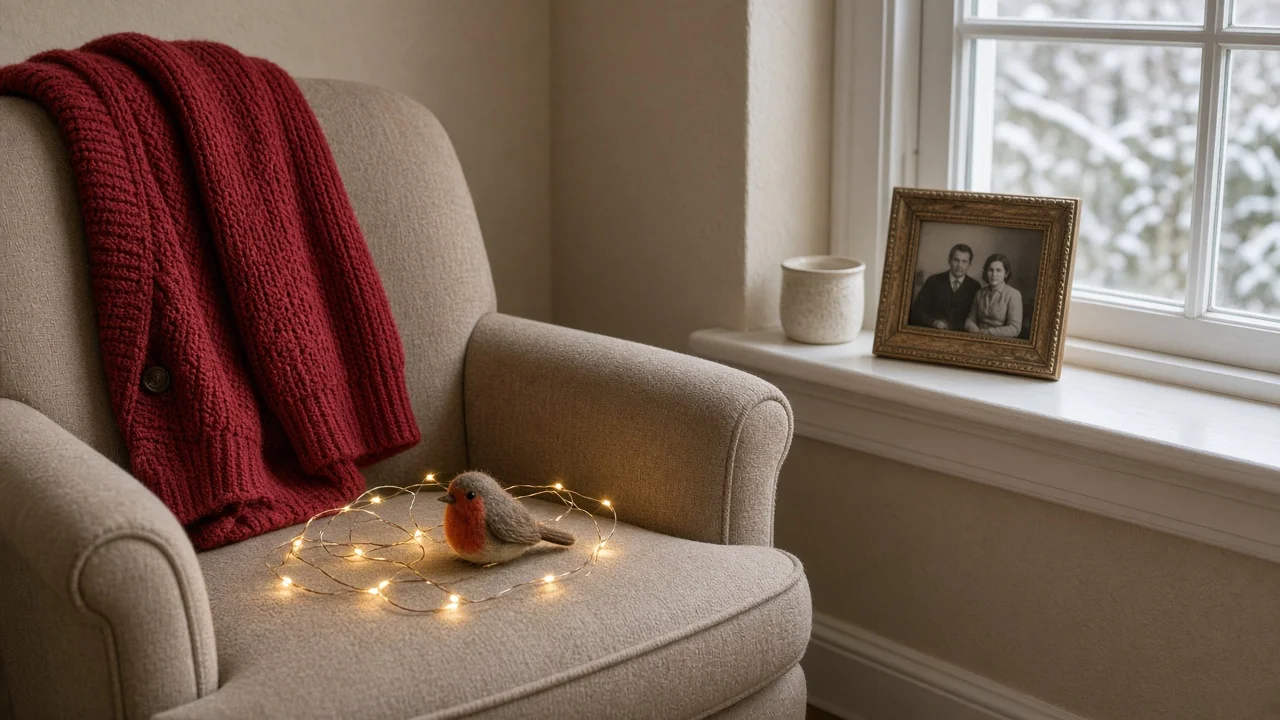
Instead of trying to get her somewhere festive, I brought the festive bits to her chair. None of this needs any tech:
- Her own red cardigan, the one she's worn every Christmas since I was small.
- A short string of battery fairy lights (no plugs, no cables to trip over).
- A familiar ornament to hold. Ours was a slightly bald felt robin that has been on her tree since the 1970s.
- A song she knows, on my phone. For her it's Bing Crosby, every time.
She held the robin and told me, for the fourth time in my life, where it came from. Best ten minutes of the visit.
Taking the photo
The rule I gave myself: she doesn't move. Not to a nicer room, not to the lounge, not even to a different chair. The photo happens where she already sits.
- Use the window. Side light is kinder than ceiling lights. Switch the overheads off if you can.
- Get down to her level. Crouch so the camera is at her eye height. Shooting down at someone in a chair makes them look smaller.
- Frame tight. Head, shoulders, the cardigan, the lights in her lap. Most of the equipment simply disappears outside the frame.
- Ten minutes, then stop. Take a burst, then put the phone away. She'll tire before you notice.
Making it look like December
A few small ways to make it feel like a Christmas photo rather than a care-home photo:
You don't need to do all of these. A plain print of a good, warm photo beats an over-edited one every time.
Who should see it
Ask her before you post anything publicly. Some older people love seeing themselves online; some really don't. Ask the care home too, especially if any staff or other residents might be in the background. Most homes have a photo policy, and the staff will appreciate you checking.
Think about the other residents as well. If someone else's relative is in the corner of the frame, crop them out or don't use that shot. They haven't agreed to be in your Christmas card, and their family might not want them shown.
We kept ours to the family chat and a few prints. Honestly, the copy that matters is the one by her bed. That's the one she sees every morning, and the one the carers point at when they say good morning.
What she said when she saw it
I brought the framed print on my next visit, in early January. She held it at arm's length (she refuses to wear her glasses for anything) and looked at it for a long time.
Then she said, "That robin's lost more feathers than I have." And then, "Put it where I can see it from the bed."
One of the carers, a lovely man called Joseph who does her mornings, told me later that she shows it to everyone who comes in, and always mentions the robin first.
It's still there. The oxygen tank isn't in it. The robin is, a little balder every year. And I didn't have to move her an inch.
If you're planning your own visit this December, my short version is this: ring the
staff, bring her own things, shoot where she sits, stop after ten minutes, and print one for the bedside. The rest is extra.