Sign up with Google
 Sign in with Zoho

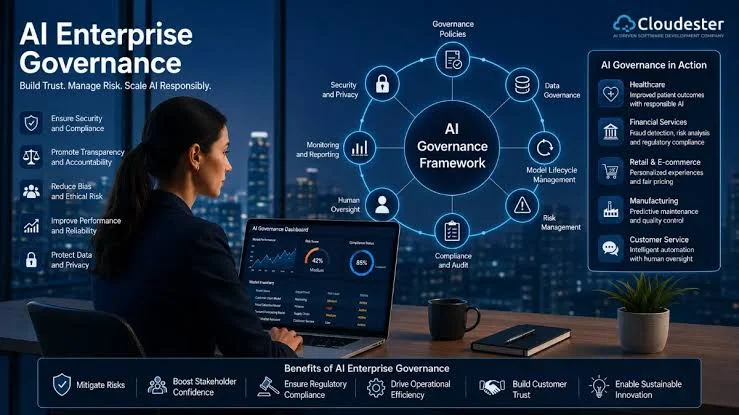
AI agents can interact with business applications, retrieve information, and execute multi-step tasks. Enterprise AI agent governance establishes who is accountable for these actions, which activities agents may perform, and how organizations monitor their impact. Effective governance combines technical controls with clear ownership, approval processes, and ongoing oversight.
Why AI Agents Need Defined Governance
Traditional software generally follows predefined workflows. AI agents can select tools, interpret instructions, and determine subsequent steps based on context. This flexibility introduces governance questions that extend beyond model accuracy.
An agent might access sensitive documents, update a customer record, or initiate a financial workflow. Even when each action appears reasonable individually, the combined sequence may create unexpected consequences.
Organizations therefore need an agreed framework defining acceptable use, decision authority, escalation requirements, and responsibility for outcomes. Governance should cover the complete lifecycle, from development and testing to deployment, monitoring, and retirement.
1. Establish Clear Ownership and Accountability
Every production AI agent should have a designated business owner and a technical owner. The business owner defines its purpose, acceptable outcomes, and operational limits. The technical owner manages its configuration, integrations, access controls, and reliability.
Security, legal, compliance, and risk teams should contribute according to the agent’s purpose and potential impact.
A practical accountability framework should identify:
- Who approves the agent for production use.
- Who authorizes access to enterprise systems.
- Who reviews incidents and exceptions.
- Who can suspend or retire the agent.
- Who accepts residual risks and approves significant changes.
Accountability must remain with designated people and teams. An AI agent should not become an excuse for unclear decision-making or unassigned responsibility.
2. Apply Least-Privilege Access and Tool Permissions
AI agents should receive only the permissions necessary for their approved tasks. Access should be restricted by role, resource, action, and business context rather than granted broadly for convenience.
For example, an IT support agent may need to retrieve device status and create service tickets. It should not automatically receive permission to delete accounts or change security configurations.
Useful safeguards include separate read and write permissions, scoped credentials, time-limited access where appropriate, and periodic permission reviews. Sensitive actions should require additional authorization.
These controls should be enforced by the systems executing the actions, not merely described in the agent’s prompt. This distinction helps prevent an instruction-following failure from becoming an unrestricted operational action.
3. Define Action Restrictions and Human Approval
Not every agent action carries the same level of risk. Organizations should classify actions by potential impact and establish approval thresholds accordingly.
Consider a finance agent that reconciles invoices. It may be permitted to identify discrepancies and prepare payment recommendations automatically. Releasing funds, changing supplier bank details, or approving unusually large transactions may require independent human authorization.
A useful policy framework distinguishes between:
- Allowed actions: Routine, low-risk activities within approved permissions.
- Restricted actions: Activities requiring additional checks or specific authorization.
- Prohibited actions: Actions outside the agent’s approved purpose or authority.
Approval workflows should specify who can authorize an action, what information they need, and how approval is recorded. High-impact workflows should also include cancellation, rollback, or recovery procedures where technically feasible.
4. Maintain Monitoring, Auditability, and Accountability
Governance continues after deployment. Organizations need enough operational evidence to understand what an agent attempted, which tools it used, what decisions were made, and whether controls were followed.
Depending on the system and privacy requirements, audit records may include the agent’s identity, relevant inputs, tool calls, permission checks, approvals, outputs, and execution results.
Monitoring should look for unusual access patterns, repeated policy violations, unexpected tool use, and failures requiring intervention. Teams should define escalation procedures and preserve appropriate records for incident investigations.
Observability also supports periodic governance reviews. If an agent’s purpose, connected systems, or permissions change, its risk assessment should be reconsidered rather than relying indefinitely on its original approval.
5. Apply Governance Across Business Functions
Enterprise AI agent governance should be consistent across departments while accounting for different operational risks.
- IT operations: An agent can diagnose common incidents and prepare remediation steps, while infrastructure changes remain subject to defined permissions and approval thresholds.
- Finance: An agent can compare invoices and flag anomalies, while payment authorization follows established financial controls.
- Customer support: An agent can retrieve approved knowledge and draft responses, while account closures, sensitive disclosures, or exceptional refunds follow appropriate authorization rules.
These examples demonstrate why governance needs both organization-wide standards and workflow-specific controls.
A Phased Implementation Checklist
Enterprises can introduce governance incrementally:
- Inventory agents: Document their owners, purposes, connected systems, data access, and permitted actions.
- Assess risk: Evaluate data sensitivity, autonomy, business impact, and the consequences of unauthorized actions.
- Define policies: Establish permission boundaries, approval thresholds, prohibited activities, and escalation routes.
- Enforce controls: Implement access restrictions, action-level checks, and approval workflows in the relevant technical systems.
- Test before deployment: Validate expected behavior, denied actions, exception handling, and recovery procedures.
- Monitor and review: Track incidents, review permissions, reassess material changes, and retire agents that no longer meet requirements.
A governance control plane can help centralize policy enforcement and oversight across AI workflows. For example, THQ.digital’s Ritvam is positioned around AI governance and observability. Enterprises evaluating this architectural approach can explore its AI governance capabilities as one reference point when assessing their own requirements.
Conclusion
Responsible AI agent deployment requires more than technical safeguards. Enterprises need clear ownership, proportionate permissions, risk-based approvals, reliable auditability, and continuous review. By combining these organizational practices with enforceable technical controls, businesses can expand AI agent use while maintaining meaningful oversight and accountability.
Frequently Asked Questions
Q.1 What is enterprise AI agent governance?
Enterprise AI agent governance is the framework of policies, technical controls, responsibilities, and monitoring practices used to manage AI agents across business operations.
Q.2 Why is accountability important for AI agents?
Clear accountability ensures that people and teams remain responsible for approving agent use, managing risks, investigating incidents, and reviewing operational outcomes.
Q.3 How does least-privilege access improve AI agent security?
It limits agents to the resources and actions necessary for their assigned tasks, reducing the potential impact of errors, misuse, or compromised workflows.
Q.4 When should an AI agent require human approval?
Human approval is appropriate when actions carry significant financial, security, legal, privacy, or operational consequences, particularly when they are difficult to reverse.
Q.5 How can enterprises evaluate an AI governance platform?
Evaluate policy enforcement, identity and permission controls, monitoring, audit records, approval workflows, integration requirements, deployment constraints, and the ability to support organization-wide governance.