Sign up with Google
 Sign in with Zoho

If you are planning a new website, you have probably heard a lot of advice. Everyone has an opinion on how a site should look, function, and perform. Some of that advice is helpful. A lot of it is outdated or just plain wrong.
The internet moves fast. Design trends change, and technology evolves. Unfortunately, old assumptions tend to stick around long after they stop being true. These myths can lead to poor decisions, wasted budgets, and frustrated users.
Let us clear the air. Here are five common web design myths debunked by the people who build websites every day.
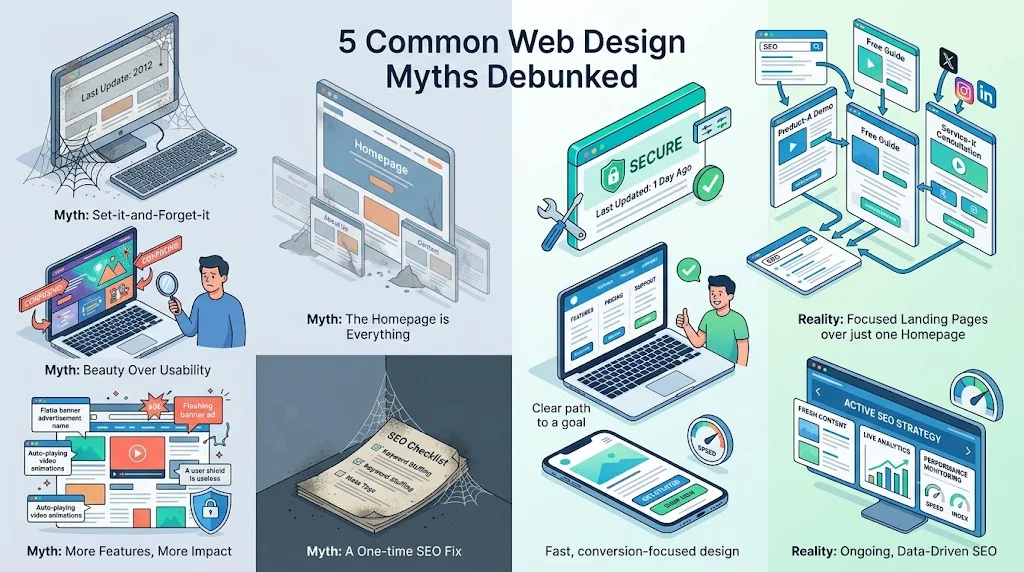
Myth 1: Once It Is Built, It Is Done
Many people treat a website like a printed brochure. You write the copy, design the layout, launch the site, and cross it off your to-do list. In reality, a website is more like a living machine. It requires ongoing care to keep running smoothly.
When your site goes live, the work is just beginning. Code gets outdated. Security threats evolve. Browsers update their standards. If you launch a site and ignore it for two years, it will eventually break. Links will die, forms will stop working, and your site will become vulnerable to hackers.
A professional website designer will tell you that maintenance is non-negotiable. You need regular updates, security patches, and backups. Think of your website as a car. You cannot drive it for years without changing the oil or checking the brakes. It needs routine attention to stay reliable.
Myth 2: The Homepage Is All That Matters
For a long time, the homepage was the front door to a website. Users would type in your main URL, land on the homepage, and navigate from there. That is rarely how people browse today.
Most traffic comes from search engines or social media links. These links drop users directly onto specific articles, product pages, or blog posts. They might never see your homepage at all.
If you spend your entire budget making the homepage look amazing but ignore the rest of the site, you are making a big mistake. Every page needs to be treated like a potential entry point. That means clear navigation, strong calls to action, and fast load times across the board. A good web design company focuses on the entire user journey, not just the front door.
Myth 3: Good Design Is Just About Looking Nice
Visuals matter. A modern, professional layout builds trust instantly. But design is not just about making things look pretty. If a site looks beautiful but users cannot find the contact page or complete a purchase, the design has failed.
Design is really about problem-solving. It is about guiding the user to the right information as quickly as possible. This involves layout, typography, color theory, and psychology. A button needs to stand out. Text needs to be readable. Forms need to be easy to fill out.
Industry professionals focus heavily on user experience, often called UX. A site must be intuitive. If a visitor has to think too hard about where to click next, they will likely leave. Form should always follow function. A website needs to work flawlessly first, and look great second.
Myth 4: More Features Make a Better Site
It is tempting to pack a website with flashy features. You might want rotating banners, video backgrounds, complex animations, and pop-up offers. More features seem like they would impress visitors and keep them engaged. Usually, they do the exact opposite.
Every feature you add increases the complexity of your site. More code means slower load times. Research shows that users abandon sites that take more than a few seconds to load. If a video background causes your site to lag on a mobile phone, that feature is costing you customers.
Extra features also create distractions. If a user is trying to buy a product but an animation keeps pulling their eye away, they might get frustrated and leave. A skilled website designer will often push back on adding unnecessary elements. They know that simplicity usually wins. Every feature on a page needs to serve a clear purpose. If it does not help the user achieve their goal, remove it.
Myth 5: You Can Set It and Forget It with SEO
Search engine optimization is not a one-time task you check off during launch. Some people believe that if you stuff the right keywords into your code and meta tags, your site will rank forever. That is not how search engines work.
Search algorithms change constantly. They reward sites that are active, fast, and secure. They also look at user behavior. If people click on your site and immediately leave, search engines notice. They assume your content is not helpful, and your rankings drop.
SEO requires ongoing effort. You need to publish fresh content, update old pages, and monitor your technical health. Broken links, slow load times, and outdated security certificates all hurt your search rankings. If you want your site to perform well in search results, you need to treat it as an ongoing project.
Make Smart Choices for Your Website
Building a website is a significant investment. You deserve to get the most out of it. By letting go of these common myths, you can make smarter decisions for your business.
Avoid the temptation to treat your site like a static brochure. Focus on the entire user experience, keep your features simple, and plan for ongoing maintenance. When you are ready to build or redesign your site, partner with a web design company that understands these principles. Listen to the professionals. They know what it takes to build a site that actually works.