Sign up with Google
 Sign in with Zoho

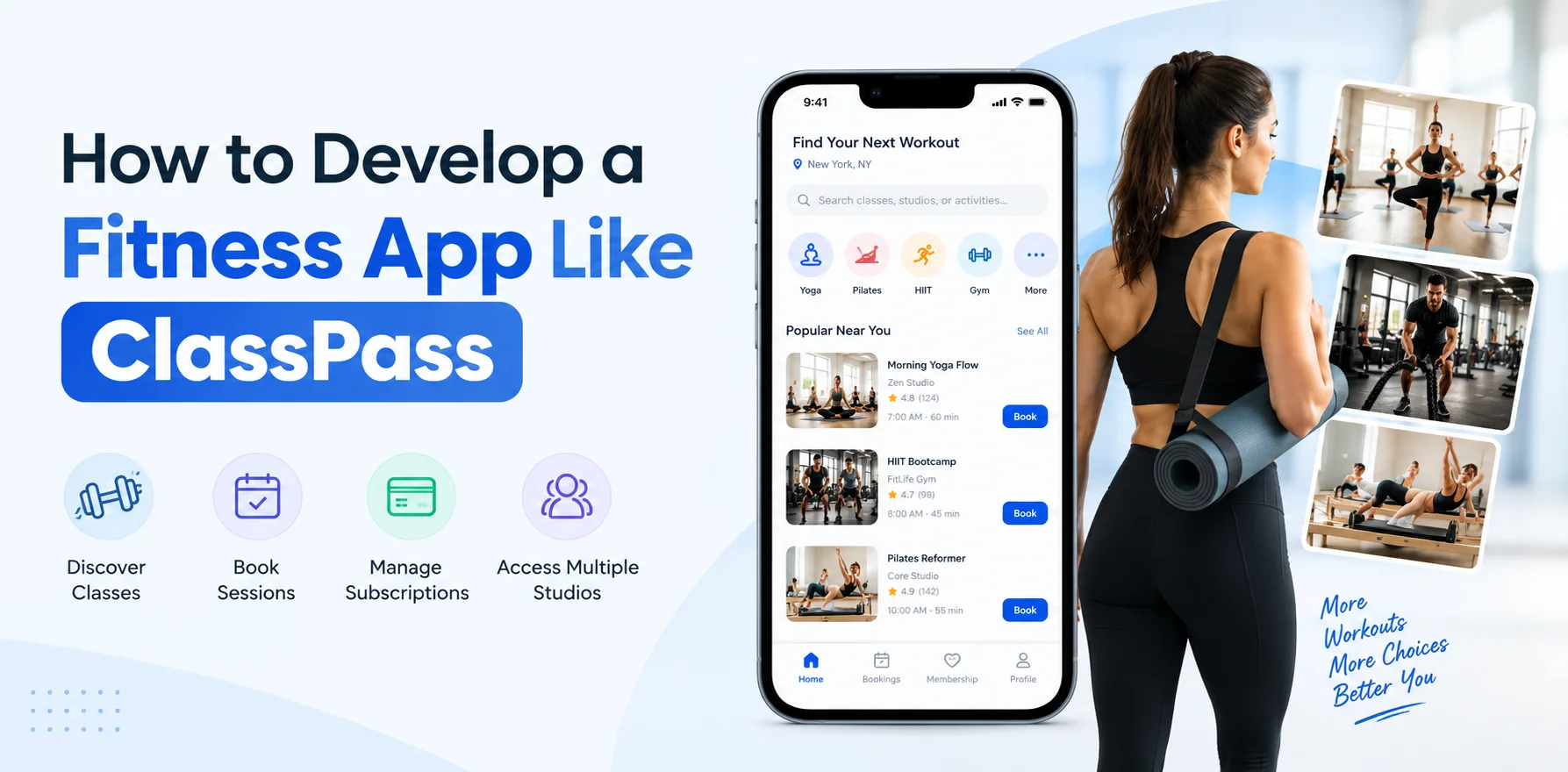
The conventional gym membership systems can no longer satisfy modern users' needs for booking and managing their memberships and classes at different places. As such, there is a need for fitness marketplaces that give users the freedom to join multiple fitness studios and manage their memberships using one platform.
It should not come as a surprise, therefore, that nowadays there is an increased interest among business owners in the development of a fitness app like ClassPass. Such applications bring together users who get the chance to use various gyms, yoga studios, Pilates centers, etc., by booking their classes within a unified subscription system.
Today's users prefer convenience and variety, whether they want to attend a HIIT class, do yoga, or visit the nearest gym. Thus, fitness marketplace apps have become a popular direction to go in today's world.
This guide explains the essential features, development process, monetization strategies, and other important considerations for building an app similar to ClassPass.
What Is the ClassPass App?
ClassPass is a fitness and wellness booking platform that allows users to discover and book activities at participating gyms, fitness studios, and wellness businesses. Depending on availability and membership terms, users can explore activities such as yoga, Pilates, strength training, cycling, dance, and other fitness experiences.
It is a fitness and wellness activity booking system where users get an opportunity to discover and book activities from different gyms, fitness studios, and wellness companies. Subject to availability and depending on the terms of their subscription, users may get the chance to discover activities like yoga, Pilates, strength training, spinning, dance, and other forms of physical fitness.
As opposed to locking users to one fitness center, this platform helps in connecting users to various fitness providers within the same platform.
Must-Have Features: A Fitness App Like ClassPass
Features play a significant role in the usability and commercial success of a fitness platform. The goal is to help users discover suitable workouts, enable providers to manage their offerings, and give administrators the tools to operate the business efficiently.
Here are the essential features to consider.
1. User Registration and Profile Management
Registration should be easy enough for users to register using their email IDs, phone numbers, or their social accounts. Their profiles can have data about their fitness interests, their preference of workouts, their experience level, their location, and even their booking preferences.
Such data makes it possible to customize the user experience and also helps them find more relevant classes. Protection of their account security and privacy is essential.
2. Fitness Class Discovery and Search
A fitness class discovery application, like ClassPass, should have a searchable directory for the users to find information on different fitness classes, gyms, wellness centers, or studios that suit their needs. This feature would enable the users to filter their results on the basis of location, activity, schedule, pricing, and other criteria.
For example, someone looking for a Pilates class after work should be able to find nearby studios with suitable timings. Location-based search and clear class descriptions make the discovery process more convenient.
3. Class Booking and Cancellation
The booking system must ensure that users can book their desired classes and get instant confirmation. Availability of slots, times of sessions, deadlines for cancellation and booking limitations should be visible in it.
It must update the availability in case of a booking or cancellation. Automated wait lists can also help users take their slots in previously booked classes.
4. Membership and Subscription Management
Member management will be very important for subscription-based fitness platforms. Users must be able to compare plans, make payments for memberships, check renewal dates and manage their subscriptions.
Based on the business model, there can be various forms of membership, including monthly credits, per-class price, restricted bookings, and access levels. Providing clear details about the usage of credits, expiration period, and renewal policy builds customers' trust.
5. Online Payments and Digital Wallet
Integration of payments ensures that users can subscribe to subscriptions, buy tickets for particular classes, and enjoy additional services. The types of payments supported might include cards, digital wallets, and payments from specific regions.
Receipts need to be provided by the app, along with the payment history and refunds when necessary.
6. Real-Time Notifications and Reminders
Reminders are used to notify users of upcoming classes, booking confirmations, canceled bookings, changes in the waiting list, and renewal of subscriptions.
Sending reminders several hours before a particular class would help to increase the number of classes attended and decrease the number of booked classes that are skipped by the user. It is also important to give users the ability to choose their preferences of notifications.
7. Fitness Studio and Gym Management
An application like ClassPass also requires a special interface for fitness providers. The studio owners should have the possibility to make listings, upload images, schedule classes, limit their capacities, and track reservations.
The dashboard of a provider may also show data about attendance, booking statistics, activity of customers, and finances. These tools will enable participating businesses to manage their activities and make them available for a larger number of people.
8. Ratings and Reviews
Ratings and reviews are used by users for providing feedback concerning teachers, studios, class quality, and overall experience. These reviews can be helpful for other members when choosing which class to attend.
It is necessary to provide tools for moderating reviews in order to avoid any inappropriate or fake ones. The feedback based on real bookings may increase credibility and motivate the service providers.
How to Develop an App Like ClassPass?
Developing a fitness marketplace requires a structured approach that combines business planning, product design, technology selection, and ongoing optimization. The following steps can help entrepreneurs turn their idea into a market-ready application.
Step 1: Conduct Market Research and Competitor Analysis
Begin by defining who the users are, their geographical location, and the kind of fitness facilities that you would like to cater to. Find out what your competitors are offering in terms of membership options, booking process, service providers, and user experience from such sites as ClassPass Alternatives.
Determine what people like about such platforms and what they lack. This could be an opportunity to build your business plan in terms of providing unique features, for example, catering to boutique studios, affordable memberships, specialized workouts, or local niche markets.
Step 2: Define the Business Model and Requirements
Determine how you will allow your members to interface with the fitness providers and monetize your platform. This can be through a monthly credit-based subscription plan, a pay-per-class model, bundle plans, or any other combination thereof.
Afterwards, list down the requirements that will go into developing the customer’s app, studio’s dashboard, and administration’s panel. Booking policy, payment process, cancellation policy, commission to the providers, and restrictions for membership should be clearly listed.
Step 3: Choose the Right Technology Stack
The technology stack should support a smooth user experience, secure transactions, and future business growth. Your selection will depend on the expected number of users, platform requirements, integrations, and development budget.
An experienced mobile app development team can evaluate these options and recommend an architecture that balances performance, cost, maintainability, and scalability.
Step 4: Design the UI/UX
UI/UX design should be simple enough for class discovery, booking, and membership management. Start by creating wireframes of major user flows, then develop interactive prototypes that show how users navigate through screens.
Design simplicity in the home screen, easy-to-use search filters, clear information about classes, simple booking process, and clarity on membership details should be the key focus areas. The studio owners need an easy way to manage their schedules and bookings as well.
Step 5: Develop the Core Application
After the design and requirements have been finalized, development may proceed. The customer application is supposed to offer functionalities related to registration, class discovery, booking, payment, and membership management. The provider dashboard is supposed to allow studios to manage their listings, scheduling, and bookings.
The backend integrates all this functionality and is responsible for managing booking availability, subscription policies, notifications, payment information, and user permissions.
Special attention must be paid to booking clashes. If several customers try to book the last free space at the same time, the system is supposed to prevent overbooking.
Step 6: Integrate Payments and Subscription Billing
Implement the payment gateway and the subscription system based on the chosen business model. Payments must be processed through the platform safely and efficiently, and all transactions should be accounted for.
In case of a membership that uses credits, the system needs to deduct the appropriate amount per each booking as well as address any cancellations or refund situations based on the established criteria.
Check the processes of successful payment, failed transaction, duplicate payment, renewal, cancellation, and refund. The system must adhere to all payment integration security standards, and no payment card information must be stored unless explicitly stated.
Step 7: Test the Application Thoroughly
The testing process is an essential phase to uncover bugs before the users start booking and paying for classes. The functional testing process needs to be performed to test registration, search filters, booking, membership modifications, payment process, notification process, and account management.
Performance testing is just as important since class availability and booking pressure may vary at certain time periods. Security testing needs to be conducted to test authentication, access control, data protection, and vulnerabilities within the application.
Step 8: Launch and Continuously Improve
The starting point will be an easy-to-manage launch location with a well-curated selection of fitness centers. Providers should have correct information, updated schedules, and clear processes for managing bookings.
Key performance indicators will include user sign-ups, bookings made, subscriptions acquired, cancellations, re-bookings, and cost per customer acquisition. Such KPIs may assist in recognizing areas requiring improvement in the experience or the model itself.
Following the launch, customer feedback and insights from analytics will direct future feature development. Recommendations for personalization, loyalty initiatives, corporate memberships, and more wellness categories may be introduced later on.
Monetization Strategies for a Fitness App Like ClassPass
A sustainable revenue model is essential for balancing customer value, provider earnings, and platform operating costs. Entrepreneurs can combine several monetization approaches depending on their target market and customer preferences.
1. Subscription-Based Memberships
Monthly or annual memberships can provide recurring revenue. Customers pay a fixed fee in exchange for access to selected classes, a defined number of credits, or other membership benefits.
Membership services on either a monthly or yearly basis may result in ongoing income. The client pays an equal amount of money in exchange for certain classes, certain credits, and many other benefits from the membership program.
2. Commission on Bookings
This system can earn money from the gyms and fitness clubs through commissions paid per completed booking. This rate could depend on the terms of the agreement, service type, promotional offers, or even booking frequency.
This system is more consistent with real-life activity in the market. Nevertheless, commission percentages need to ensure profitability for both the service providers and the operators of the site.
3. Pay-Per-Class Bookings.
It could be that some consumers would like to make single session bookings than paying monthly memberships. The fitness app development company can get paid via service fees or a margin on bookings.
The company can get revenue from the service fee or margin on each booking. This strategy may be used to turn new customers into subscribers after using the platform.
4. Premium Features and Upgrades
A premium membership could add extra advantages like preferred booking, exclusive classes, better recommendations, loyalty bonuses, or access to select partner facilities.
It should be clear what the advantages of such an upgrade would be. Do not limit basic capabilities merely to make people upgrade to the premium level – give them reasons why to do so.
Conclusion
Building an application for fitness, such as ClassPass, provides startups with the ability to link fitness lovers with fitness facilities, studios, instructors, and health care providers via a mobile-friendly platform.
The process of building the platform goes beyond copying what other applications already have. This is because a number of factors need to be taken into consideration, such as value proposition, bookings, partnerships with providers, user interface, and a sustainable business model.
It is important to conduct thorough market research and come up with a well-defined minimum viable product that will incorporate class discovery, bookings, payments, membership, and provider management. Conduct beta testing and evaluate feedback from customers and studios to enhance the product.