Sign up with Google
 Sign in with Zoho

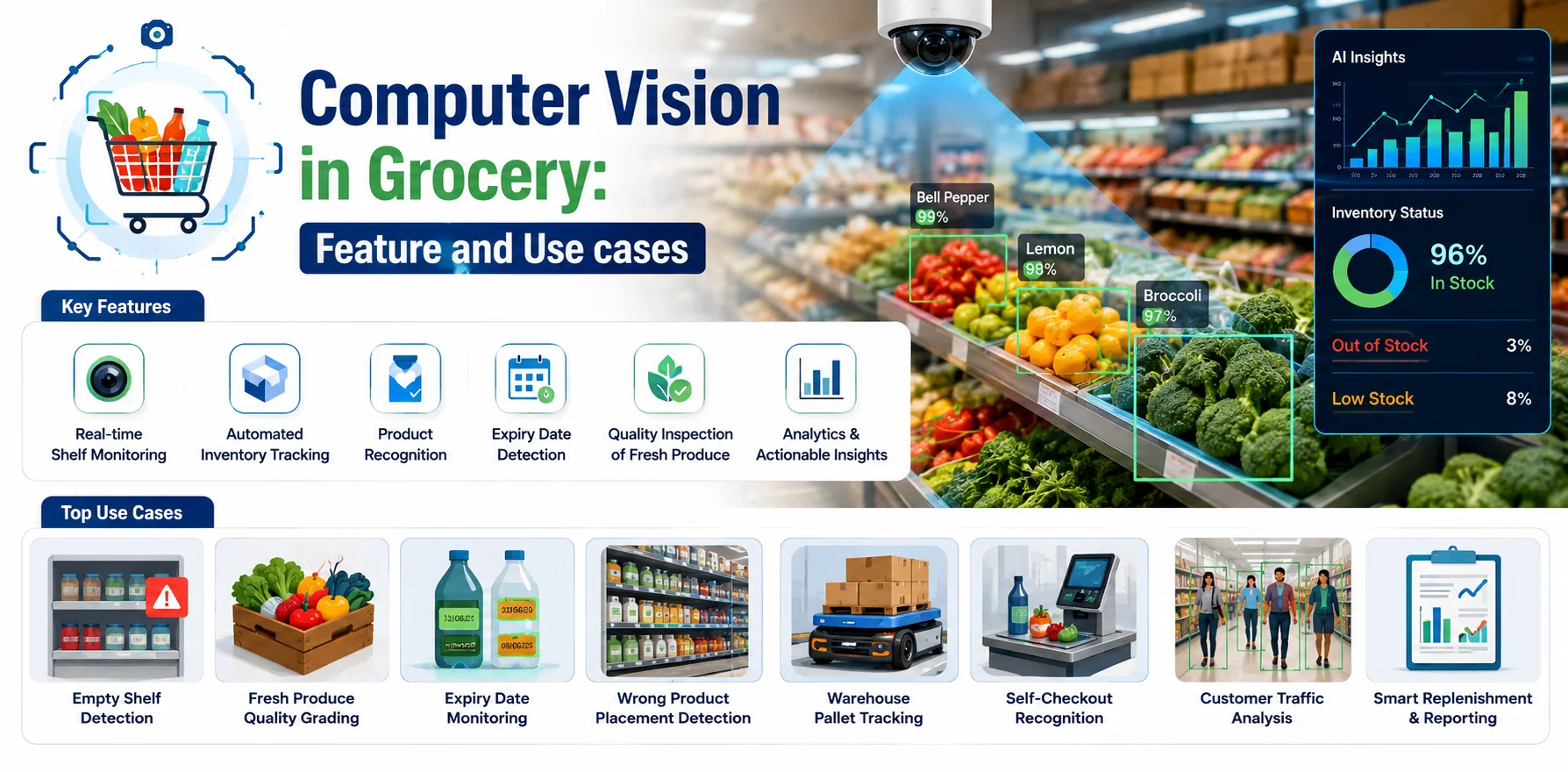
Technology evolution is currently occurring in the field of groceries as advanced technologies are being implemented by various companies to increase the efficiency of their operation and raise the level of customer satisfaction. Even though technologies like online shopping, payments, and automation of warehouses are becoming common practice, there is one technology revolutionizing the operation of grocery businesses in an even more spectacular way—computer vision in grocery.
Computer vision is the ability of computers to perceive and interpret the visual information received via cameras and images, thus making it possible to automate inventory, shelf, and quality control processes and other warehousing activities. In contrast to conventional inventory management techniques that involve laborious procedures and use barcodes, computer vision gives companies 24/7 visibility of all inventories in their retail stores and warehouses.
With the rising customer demand for quick delivery of goods and exact information on their availability, modern grocery businesses employ intelligent visual systems to reduce costs, waste, etc. It does not matter whether it is a physical store or an online grocery service; computer vision helps create a more efficient retail environment.
What Is Computer Vision in Grocery?
Computer vision is one of the advanced forms of artificial intelligence that makes possible for the software to identify objects, products, empty shelves, individuals, and activities via images and video feeds.
In the grocery retail industry, use of intelligent cameras coupled with AI helps monitor the inventory, identify products, detect empty shelves, check fresh produce, and monitor warehouse activities independently.
Unlike other methods such as barcode scanning and manual inventory tracking, computer vision provides businesses with continuous information about their operations.
Key Features of Computer Vision in Grocery
1. AI-Powered Shelf Monitoring
The smart camera constantly scans for gaps in the store’s inventory that include empty spaces, low-stock items, and misplaced products. In real-time alerts allow workers to fill inventory even before the customer comes across any out-of-stock product.
2. Automated Inventory Tracking
Using computer vision technology, automatic monitoring of stock movements within the store or warehouse is achieved without fully depending on manual counting or bar code scanning processes.
3. Product Recognition
Image recognition uses the image, packaging, and labeling of products to recognize them. This is beneficial because it helps organizations confirm the products, enhance accuracy of checkout process, and eliminate identification errors.
4. Real-Time Object Detection
Artificial intelligence detects objects including products, shelves, pallets, shopping carts, and equipment used in the warehouse on-the-fly.
5. Fresh Produce Quality Inspection
The computer vision is used to examine fruits and vegetables for any bruising, discoloration, difference in size, and other defects.
6. Expiry Date Recognition
Optical Character Recognition (OCR) scans the manufacturing date and expiry date printed on the packaging. The businesses get timely alerts on near-expiry products.
Practical Use Cases of Computer Vision in Grocery
1. Automatic Empty Shelf Detection
Intelligent cameras are constantly scanning the shelves and detecting empty or low stock parts. Instant notifications are sent to the store staff who can restock the products before the customer faces any shortages.
2. Fresh Produce Grading
The AI analyzes fruits and vegetables based on their color, size, texture, and surface quality. The automated grading process ensures uniform quality and reduces manual labor.
3. Expiry Date Monitoring
The computer vision technology scans the labels and detects the products which are near their expiry date. The businesses will be able to offer discounts and minimize food wastage.
4. Incorrect Product Placement Detection
The visual recognition system uses shelf layout comparison with pre-defined planograms for identifying incorrectly placed products.
5. Warehouse Pallet Tracking
With the help of computer vision, the location of the pallet is tracked constantly with the movement and condition of the inventory. This enables warehouse employees to find the product easily.
6. Automated Stock Counting
Rather than performing manual inventory counting, which takes considerable time, the automatic camera counts the inventory in the store without interfering with any operations.
7. Intelligent Replenishment Alerts
When inventories hit pre-set levels, restock notifications are automatically sent via computer vision systems. Replenishment avoids shortages but keeps products in stock at all times.
8. Order Picking Verification
Computer vision is used to check whether the picked products match order specifications prior to their dispatch from the warehouse.
Business Benefits of Computer Vision for Grocery Retailers
1. Higher Inventory Accuracy
Real-time visual monitoring removes most of the possible mistakes that may occur in the case of manual stock counting. Proper inventory management allows companies to purchase more efficiently, plan replenishment, and avoid mistakes with inventory.
2. Reduced Food Waste
Constant computer vision analysis of the product condition and the time until expiration helps detect the products that need to be managed immediately. This helps prevent food waste, manage the stock, and not lose money on unnecessary waste.
3. Faster Shelf Replenishment
The smart shelf monitoring system gives instant notifications to store personnel if the inventory levels fall below set thresholds. Quick restocking of goods prevents companies from losing sales due to an inventory shortage.
4. Lower Operational Costs
Automation of manual tasks like inventory inspection, shelf monitoring, and quality inspection will minimize the workforce while increasing operational efficiency. Personnel can devote themselves to customers and other core business activities.
5. Improved Warehouse Efficiency
Visual monitoring allows full transparency in warehouse operations like pallet tracking, storage space use, and inventory management. It increases picking accuracy and order fulfillment speed.
6. Better Customer Satisfaction
The customers will come back when there is consistency in the availability and freshness of products. The computer vision technology will help achieve consistency of inventory, well-organized shelves, and operational efficiency.
7. Better Business Intelligence
Computer vision produces valuable operational data that will assist in making informed decisions. Retailers will be able to analyze the performance of inventory, shelf utilization, customer behavior, and product movement.
Conclusion
Many retailers invest in comprehensive grocery delivery app development services to combine computer vision with inventory management, warehouse automation, analytics dashboards, and real-time monitoring capabilities. These integrated solutions improve operational efficiency and customer satisfaction.
Computer vision is revolutionizing grocery retail by injecting smartness, automation, and real-time visibility into operations. Be it shelf analytics, inventory management, quality control, or warehouse optimization—these are some of the ways that computer vision technology can be used to optimize the business and ensure high ROI.
The competition among grocery retailers has never been fiercer; hence, the adoption of computer vision is not an innovative step but an essential investment for businesses that want to keep up with the trends and succeed.
From optimizing a legacy grocery retail platform to developing a new one, incorporating computer vision into operations is what makes the difference.