Sign up with Google
 Sign in with Zoho

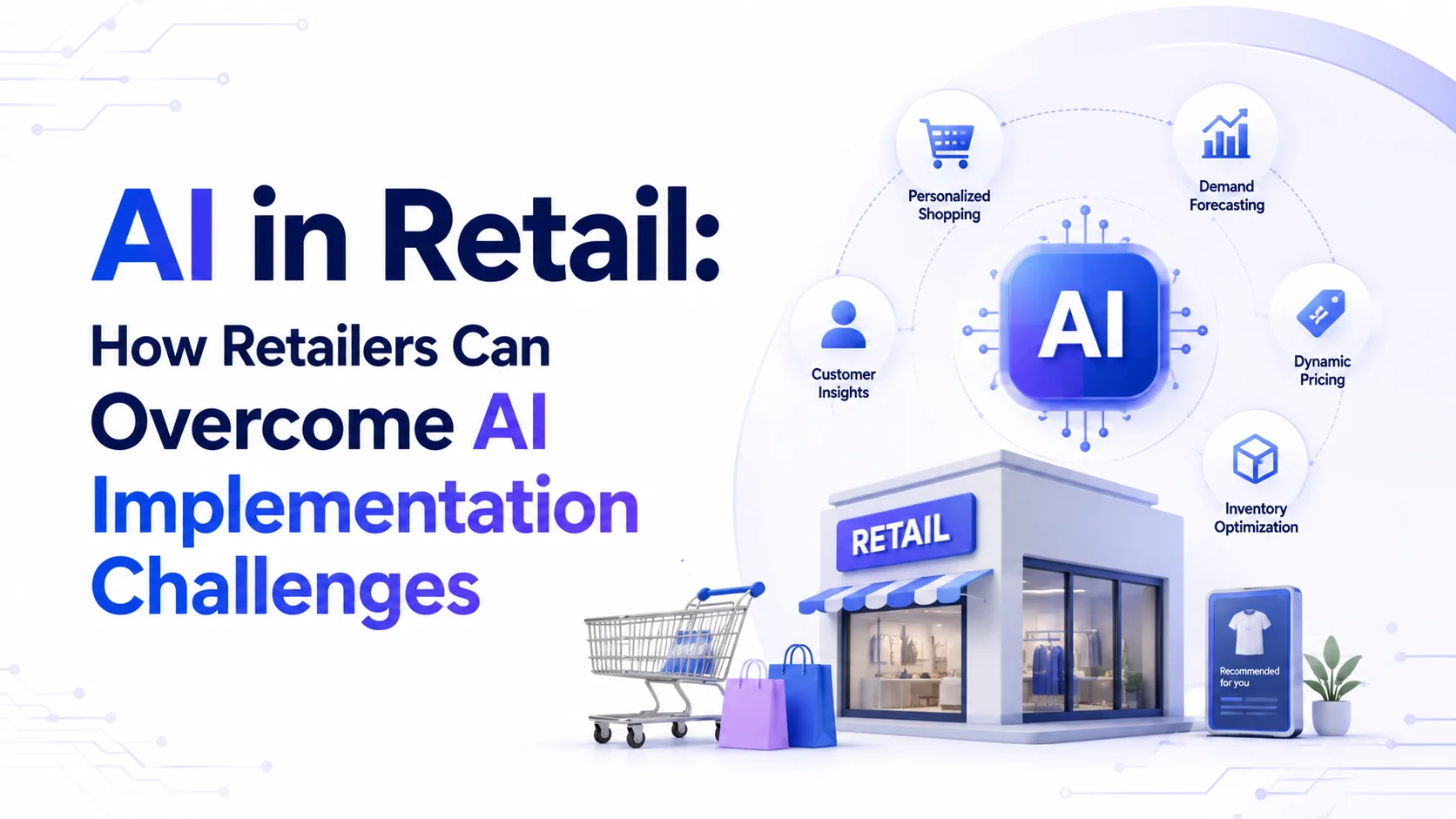
The retail industry is experiencing rapid change thanks to AI, which helps retailers improve their customer experience, streamline their inventory, automate processes, and make data-driven decisions. AI in Retail is bringing about changes in how retailers operate, ranging from personalized recommendations to demand forecasting and advanced chatbots. Thus, AI in Retail becomes an inevitable choice for any retailer wishing to succeed.
However, the adoption of AI is not always an easy journey, even despite its growing popularity. Inability to gather and process data, difficulties with its integration, limited budget, resistance of employees, and lack of necessary skills are some of the most frequent obstacles that retailers need to overcome. All these factors can lead to project delays and a reduction in ROI.
All mentioned obstacles can be dealt with properly and help retailers to introduce AI technologies successfully and gain significant business benefits through having a good understanding of those obstacles and a proper strategy. Collaborating with experts in AI development services will also be helpful in the process of AI implementation.
Why AI Adoption in Retail Is Growing
Retail businesses collect customer, sales, inventory, and operational data at a vast scale every single day. AI can turn that information into valuable insights that inform decision-making at an organizational level.
Here are a few of the most useful retail AI applications:
- Personalized shopping recommendations
- Analyzing data to optimize stock and warehouses
- Demand forecasting
- Dynamic pricing
- Customer service automation
- Fraud detection
- Visual product search
- Supply chain optimization
While these advantages sound appealing, retailers may find that investing in new software alone is not enough to make AI a success.
Common AI Implementation Challenges in Retail
1. Poor Data Quality
AI systems need precise, comprehensive, and structured data. The information many retailers have is spread across a number of systems, making it hard to build a single, reliable data set.
Common issues include:
- Duplicate customer records
- Missing inventory information
- Outdated pricing data
- Inconsistent product catalogs
AI models rely on clean data for reliable predictions and recommendations.
2. Legacy System Integration
Many retailers continue using legacy ERP, POS, and inventory management systems. The task of integrating advanced AI systems into the legacy systems poses both technological difficulties and a significant amount of time investment.
The organization needs to create an architecture that will facilitate the seamless integration of legacy systems and new AI systems.
3. Building the Right AI Strategy
Don't use AI just because your competitors are using it. Every AI project needs to address a specific business need.
The first step is asking yourself what you want to see change:
- Reducing inventory waste
- Improving online conversion rates
- Improving customer retention
- Automating repetitive tasks
- Enhancing demand forecasting
By collaborating with AI development services providers, businesses can better pinpoint impactful use cases and develop a realistic plan to implement them.
4. Identifying and Addressing Skills and Talent Gaps
The greatest difficulty in adopting AI technology is the lack of AI specialists. The engagement of data scientists, AI specialists, and machine learning specialists can pose great problems for retailers.
In order not to develop an entire team devoted to AI, businesses usually employ specialized teams of developers who already have an understanding of AI technologies, cloud computing, data engineering, and machine learning.
5. Managing Employee Resistance
One fear employees often have is that AI will take their jobs. In reality, AI is meant to handle repetitive tasks so employees can focus on higher-value work.
Retailers should:
- Provide AI training programs
- Communicate business goals effectively
- Show the benefits of using AI in the workplace
- Foster collaboration between technical and business teams
Rolling out the technology is only half the battle — the other half is organizational change management.
6. Choosing Scalable AI Technologies
A lot of companies have invested in stand-alone AI software that is capable of doing just a small part of the things required and does not scale along with the company's growth. This is one of the primary reasons why AI in Retail projects fail to deliver results beyond the pilot phase.
The organization must rather invest in an AI development platform which is scalable for the future, can integrate with other business systems, and can manage the exponentially growing amount of data about their customers and operations. It could also include the use of generative AI development services for tasks such as content generation and personalization.
7. Enhancing Data Security and Compliance
Retail companies gather sensitive customer information, such as payment history and purchasing patterns. Ensuring compliance with data privacy laws and maintaining robust cybersecurity measures are crucial for AI systems.
Some of the main security practices include:
- Data encryption
- Role-based access control
- Secure cloud infrastructure
- Regular security audits
- Adherence to regional privacy laws
Security should be a primary concern from the outset through to deployment, ideally with reliable AI development partners guiding the process.
8. Starting Small and Scaling Up
Retailers should start with smaller pilot programs rather than rushing into enterprise-wide AI initiatives.
Examples include:
- AI-powered product recommendations
- Customer support chatbots
- Inventory forecasting
- Sales prediction models
Pilot projects help companies test and measure ROI, as well as fine-tune their AI strategy before rolling it out across departments.
9. Measuring AI Performance
AI implementation should always come with measurable performance indicators.
Important KPIs include:
- Customer satisfaction
- Conversion rates
- Inventory turnover
- Revenue growth
- Cart abandonment reduction
- Operational efficiency
- Forecast accuracy
These metrics will help the retailer recognize areas where improvements can be made in order to get the best possible value from the AI investment in the long run.
10. Partnering with the Right Technology Experts
The selection of the right implementation partner is one of the most important decisions that have to be made when it comes to AI projects.
When selecting a partner, retailers should look for:
- Retail industry expertise
- End-to-end implementation
- Scalable architecture
- Ongoing maintenance
- AI model optimization
- Staff training and support
By collaborating with experienced AI providers, businesses can ensure their solutions are not generic, but specifically designed to meet their unique business needs.
Conclusion
There is no doubt that the retail industry is currently experiencing some radical changes as far as AI is concerned since it leads to enhanced decision-making processes, improved operations, and a more personalized customer experience. Data quality problems, outdated technologies, lack of skills, security challenges, and unwillingness to change the current state of affairs are some of the obstacles on the way – however, all of them can be easily overcome through proper planning and the choice of technologies.
For sure, those organizations that have clear goals and sufficient infrastructure to implement innovative projects and work with reliable AI development partners will be more successful in the future.