Sign up with Google
 Sign in with Zoho



Your daughter’s engineering degree costs ₹45 lakh today. In 15 years, it will cost ₹1.88 crore, at 10% education inflation. That number is not at all reassuring, but with the right strategy it is achievable.
Ritesh and his wife now need to put this large future expense into a practical investment plan. Recurring deposits are a popular safe choice in India. But Ritesh worries that the outrageous inflation rates observed in the education sector will always outpace growth in a bank Term Deposit. The inflation assumption used is a conservative rate commonly used in education planning.
So his challenge is choosing the right mutual fund investment approach that can outgrow inflation and manage the risks of market volatility. He wants to build his daughter’s education fund without any surprises later when his daughter starts college.
How Much Should Ritesh Invest for his College Education Goal using SIPs?
Ritesh uses the NIFTY 500’s 5-year historical return of 11.76%, which is the standard benchmark for Equity funds, to base his own return assumption at 12%.

Ritesh currently earns ₹2 lakh per month. Even if the required SIP of ₹37,260 is 18.6% of his salary, he feels that the monthly contribution is higher than he wants to manage.
Ritesh learns that step-up SIPs can reduce the starting monthly contribution by increasing the SIP amount every year. He assumes his salary will grow 10% each year, and he can increase his SIP by the same rate.

Under the new assumptions, Ritesh’s starting SIP falls to ₹21,870, which is just 10.94% of his current salary.
Following the step-up plan, if both his salary and SIP increase 10% every year, the SIP will continue the same proportion of his salary throughout the 15-year investment period. This is 7.7 percentage points lower than the 18.6% contribution required using the flat-SIP approach.
This step-up approach makes the initial investment manageable, although it does not decrease the total monthly investment during his 15-year goal.
How Should Ritesh Balance Growth and Risk for His College Education Fund?
For Ritesh’s 15-year goal and his moderate risk tolerance, an illustrative portfolio could allocate 50% to Flexi-cap, 30% to Aggressive Hybrid, and 20% to Debt funds. The exact equity exposure would depend on the aggressive hybrid fund’s equity allocation. This personalized fund mix will not necessarily deliver the assumed 12% of a pure-equity portfolio.
Ritesh’s investment advisor can help him find the correct fund allocation that will preferably match or exceed his 12% return assumption. If Ritesh is open to higher growth and equity exposure, to beat the high education inflation.
As Ritesh approaches his goal date, he can systematically reduce the equity exposure with debt mutual funds in increments, following a determined glide path, to protect his assets near the goal date.
Ritesh’s advisor can help him through all these for his blended portfolio.
What Does Delaying the SIP Cost Ritesh?
By now, Ritesh was convinced of using mutual funds for his goal, and he knew how much to invest and where, but he did not know if he should start now or in a few years. He felt that a 13-year goal and a 15-year goal would probably cost almost the same amount.
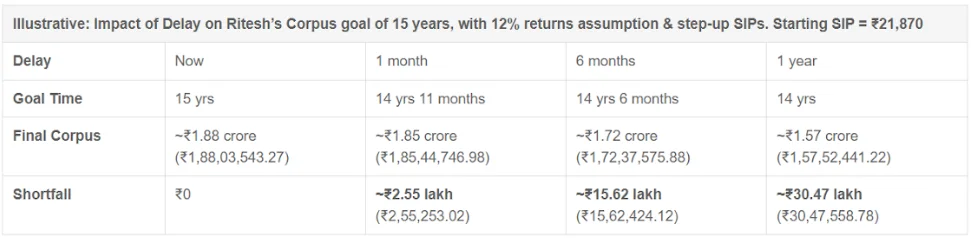
Waiting another year would create a deficit of ~₹30.4 lakh in the goal target of his daughter’s college fund. Waiting just a month would cost him ~₹2.55 lakh from his goal amount. Even if he covers these shortfalls using a loan, he will still have to pay that back later, causing an additional monetary burden.
Why SIPfund?
With an acceptable SIP estimate and appropriate fund allocation strategy, Ritesh now needs guidance to implement and oversee his chosen plan strategy. The SIPfund platform and the advisory support team can help him with that.
- Though SIPfund’s education goal planner can help Ritesh arrive at the flat SIP estimates, an advisor can help him arrive at the numbers for step-up SIPs.
- Using the SIPfund platform, Ritesh can avail SIPfund’s curated list of mutual funds for each suggested category, with details on the 3-year historical returns and the Assets Under Management (AUM). The advisors can help fine-tune the actual funds for the portfolio and their allocations.
- The SIPfund platform can show progress for Ritesh’s Higher Education Goal, which can track its growth and help him plan periodic adjustments. The advisory team can support him with correct estimations and tracking numbers throughout the goal.
- The SIPfund advisory team can also help Ritesh understand and navigate market downturns that are generally scary to many investors. A 15-year goal will invariably go through these, and that requires expert guidance to overcome.
Ritesh’s goal achievement is crucial for his daughter’s higher education, especially in a highly inflated sector like higher education. With mutual funds, constant gains are never guaranteed, but navigating losses and eventually reaching the goal amount target can be made much easier with the SIPfund platform and the supporting advisors.
What Next?
Ritesh did not know what to expect from mutual funds and if they would be able to meet his steep goal of his child’s education. But with guidance from an advisor he was able to settle on a decision and also come up with estimates to start an investment.
If you want to start investing for the college fund now, follow these 3 steps:
Step 1 — Define your goal. Your daughter’s ₹45 lakh education will cost ₹1.8 crore in 15 years at 10% inflation. Based on this, the SIPfund platform and the app (iOS or Android) will suggest funds and the allocation. A SIPfund advisor will confirm your exact SIP, which can be ₹21,870 using step-ups, based on your portfolio. They will also show you your cost of delay.
Step 2 — Set up automatic SIP. Fill out investor KYC and your bank information. Choose a nominee. Verify your NSE Unique Client Code (UCC). Complete E-Mandate on the app. Choose your funds and start SIP.
Step 3 — Track your goal progress. The SIPfund platform will show the corpus growth monthly. An advisor will help you stay on track with your goal.
Don't delay anymore.
A one-year delay was costing Ritesh ₹30.4 lakh from his daughter’s college fund. Schedule a free college fund planning session at 95133 55661 /62 /63 /64 today. A SIPfund advisor will help confirm your goal target of ₹1.8 crore and SIP amount of ₹21,870, based on your chosen fund mix and tolerance.
Disclaimer: The information provided in this article is for educational purposes only and does not constitute investment advice or a recommendation to buy or sell any mutual fund. Mutual Fund investments are subject to market risks; read all scheme-related documents carefully.