Sign up with Google
 Sign in with Zoho



Ankush needs to invest ₹18,500 monthly, which is only ~10.2% of his monthly income.
For his goal time and moderate risk tolerance (illustrative), Ankush could consider a portfolio of Large-cap, Aggressive Hybrid, and Flexicap funds. The allocation between his funds should match his risk tolerance, as these funds together have significant risk exposure. The actual returns from his personalized fund mix might be different from the assumed 12% returns for equity funds. As his goal approaches, he would also benefit from a gradual decrease of portfolio risk by increasing his debt exposure.
What Happens If Ankush Delays His Home Purchase?
Ankush was still on the fence about when to start. Based on popular knowhow he feels the need to wait to start in good market conditions. But he still calculated his cost of delay by half or one year to see the effect.
Ankush needs to invest ₹18,500 monthly, which is only ~10.2% of his monthly income.
For his goal time and moderate risk tolerance (illustrative), Ankush could consider a portfolio of Large-cap, Aggressive Hybrid, and Flexicap funds. The allocation between his funds should match his risk tolerance, as these funds together have significant risk exposure. The actual returns from his personalized fund mix might be different from the assumed 12% returns for equity funds. As his goal approaches, he would also benefit from a gradual decrease of portfolio risk by increasing his debt exposure.
What Happens If Ankush Delays His Home Purchase?
Ankush was still on the fence about when to start. Based on popular knowhow he feels the need to wait to start in good market conditions. But he still calculated his cost of delay by half or one year to see the effect.
Ankush wants to buy a home in 10 years for his family in Bangalore. He is targeting luxurious 2BHK apartments in areas like Whitefield or the ORR belt. For affording a home in these localities, he is assuming a target total cost of ₹2 crore. He needs a down payment of ₹40 lakh, in today’s value.
He needs to estimate his goal amount in the future. The Housing Price Index (HPI) data published in the press releases by National Housing Bank, reports the property price inflation rates for multiple years. In Bangalore, property prices saw a 13.1% YoY rise for 2025-2026, the same the year before, and a 8.1% YoY rise for 2023-2024. Based on these values, Ankush assumes a conservative 8% average property inflation for his estimations.
Ankush’s future home would need a down payment of ₹42.74 lakh (~₹42.8 lakh) after 10 years, after adjusting for 8% property inflation.
He is considering the type of mutual fund that will meet his goal within 10 years.
Can Ankush Build a ₹42 Lakh Home Down Payment With SIPs?
Ankush wants to find out which growth option would be best for his home ownership goal. He is currently 30, and earns ₹1.8 lakh per month.He assumes 6% return from debt mutual funds, based on NIFTY Composite G-sec Index’s 5-year historical return of 6.26%. Similarly, a 8% return is assumed from a hybrid fund, based on NIFTY 50 Hybrid Composite Debt 65:35 Index’s 3-year historical returns of 7.95%. And, a 12% return is assumed from equity funds, based on NIFTY 500’s 5-year historical return of 11.76%. These return assumptions are illustrative. Actual mutual fund returns can be higher or lower.

Ankush needs to invest ₹18,500 monthly, which is only ~10.2% of his monthly income.
For his goal time and moderate risk tolerance (illustrative), Ankush could consider a portfolio of Large-cap, Aggressive Hybrid, and Flexicap funds. The allocation between his funds should match his risk tolerance, as these funds together have significant risk exposure. The actual returns from his personalized fund mix might be different from the assumed 12% returns for equity funds. As his goal approaches, he would also benefit from a gradual decrease of portfolio risk by increasing his debt exposure.
What Happens If Ankush Delays His Home Purchase?
Ankush was still on the fence about when to start. Based on popular knowhow he feels the need to wait to start in good market conditions. But he still calculated his cost of delay by half or one year to see the effect.
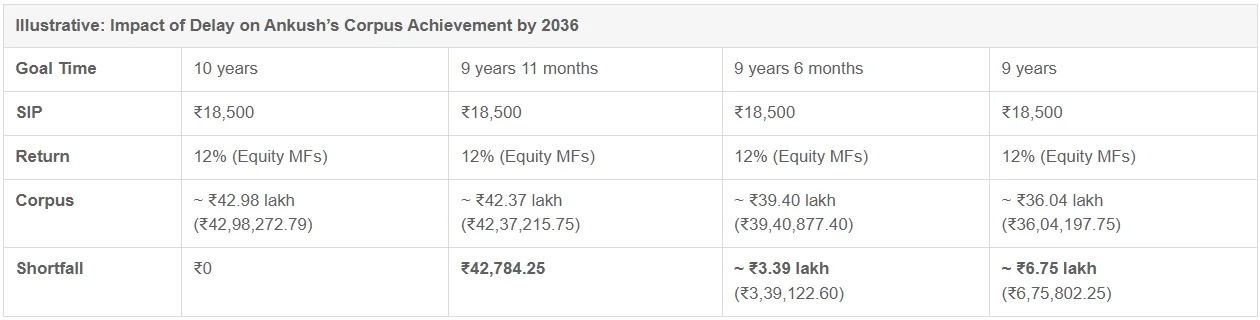
By delaying 6 months, he falls short of his goal amount of ₹42.8 lakh by ~₹3.39 lakh. By delaying a full year, his goal deficit increases to ~₹6.75 lakh. Delaying by a month, he loses ~₹42,800 from his goal amount.
Why SIPfund?
Ankush knows he needs to invest ₹18,500 every month. But that is just the first step of the process.
He still needs to know what funds to choose, will his fund choices work to reach his goal amount in time, and how should he divide his investments between the funds. After starting his SIP, he would need to know if he is on track towards his goal, throughout the 10 years, and should he be taking the same level of risk as he approaches his goal date.
- The SIPfund platform presents a combination of funds for your goal timeline. So, for Ankush’s 10-year home purchase goal, the platform would likely recommend a mix of Large-cap and Flexicap mutual funds for his portfolio. The actual portfolio mix would be personalized based on his risk tolerance.
- The SIPfund platform also provides a dashboard for viewing the goal progress with the total corpus value and the growth of each of the funds. Ankush can easily follow if he is on track of his corpus goal.
- The SIPfund’s advisory team would be available to maintain the corpus growth on track, by supporting the investor with calculations if the portfolio growth goes off track or if too much risk gets accumulated. Ankush can readily avail a second opinion on his corpus growth and to control the level of risk. This support is especially useful in avoiding emotional selling during market crashes.
Instead of treating SIP as a ‘start and forget’ tool, Ankush can easily use the SIPfund platform to keep an eye on his portfolio growth, fund performance, and market fluctuations that may affect his portfolio.
What Next?
Just like Ankush you can set up your Home purchase investments in these 3 steps:
Step 1: Define your goal. What is the down-payment you need in 10 years? ₹42.8 lakh (₹40 lakh + 8% inflation). With these inputs, use the home goal planning calculator to get your SIP amount.
Step 2: Choose your fund type. The SIPfund platform or App (iOS or Android) will recommend a mix of funds based on your total SIP. They can be chosen or replaced with other funds of your choice.
Step 3: Set up automatic SIP. Input your investor KYC and your bank information. Select a nominee. Then verify the email from the National Stock Exchange (NSE), containing the Unique Client Code (UCC). On the app, set up the E-Mandate for automatic monthly withdrawals. You can now choose your funds and start your SIP.
Don’t guess your SIP amount. Confirm it now. Every month of delay is a loss of ~₹42,800.
Schedule a free home goal planning consultation at 95133 55661 /62 /63 /64. A SIPfund advisor will confirm if ₹18,500 per month will reach your ₹42.8 lakh down payment goal in 10 years, or if you need adjustment to your timeline and goal.
Disclaimer: The information provided in this article is for educational purposes only and does not constitute investment advice or a recommendation to buy or sell any mutual fund. Mutual Fund investments are subject to market risks; read all scheme-related documents carefully.