Sign up with Google
 Sign in with Zoho
Millions of people open a yoga video each morning, roll out a mat, and press play. It's free, convenient, and easy to fit around a busy schedule. For many beginners, it's the first step toward a healthier routine, and there is nothing wrong with wanting to start that way.
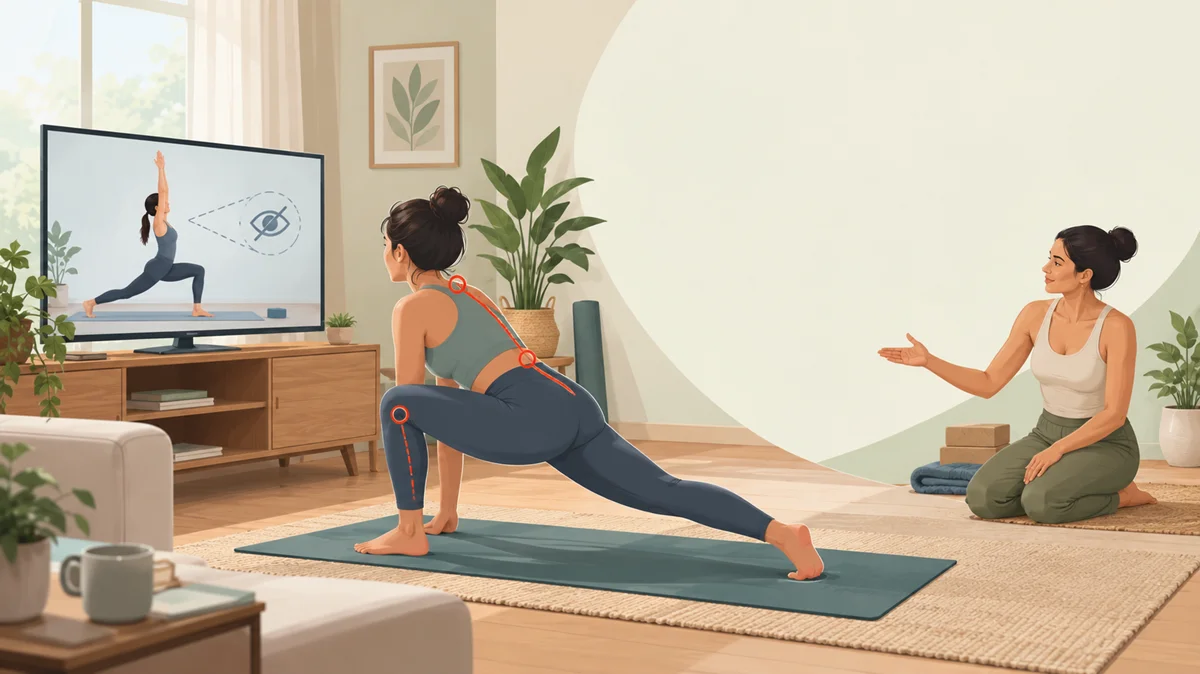
But there is a problem most video instructors never mention: a recording cannot see you.
The instructor on screen has no idea whether your knee is collapsing inward, your lower back is overarching, or your shoulders are creeping toward your ears. They keep demonstrating, you keep practicing, and small errors quietly repeat themselves day after day. Over time, what began as a well-intentioned wellness habit can become a source of discomfort, strain, and frustration.
The Problem with "Blind" Practice
Yoga postures are precise. A pose like Downward-Facing Dog or Triangle depends on the alignment of the spine, pelvis, shoulders, and joints working together. When that alignment is slightly off, the body compensates by recruiting the wrong muscles or loading the wrong joints. Compensation is where trouble begins.
With a pre-recorded video, you rely entirely on self-perception, and self-perception is notoriously unreliable. Most of us don't have an accurate sense of how our bodies look in space. A pose that feels straight often isn't. A shoulder that feels level may be several centimeters lower than the other. Without an outside eye, it is very hard to tell the difference between a productive stretch and a joint under strain.
Mirrors help a little, but they come with their own limits. Turning your head to check your reflection changes your neck and spine position, which defeats the purpose in many poses. And even if you spot something that looks off, you may not know how to fix it.
Common Alignment Mistakes Videos Can't Catch
Here are some of the errors that regularly go unnoticed in self-guided practice:
- Rounded spine in forward folds. Many beginners fold from the lower back rather than hinging at the hips. This puts stress on the lumbar spine instead of stretching the hamstrings as intended.
- Collapsed knees in lunges and Warrior poses. When the front knee drifts inward or travels far past the ankle, the knee joint takes load it was never designed to carry.
- Overarching the lower back in backbends. Cobra and Upward Dog are often performed by crunching the lumbar spine rather than lengthening and lifting through the chest.
- Hyperextended elbows and knees. Flexible practitioners often lock their joints and lean on ligaments instead of engaging muscles for support.
- Shoulder tension in Plank and Chaturanga. Sagging shoulders or flared elbows can overload the wrists and shoulder joints over time.
- Uneven weight distribution. Favoring one foot, hip, or hand is extremely common, and it quietly reinforces existing imbalances.
- Holding the breath. Breath restriction is easy to miss on your own, yet it changes how the body moves and how deeply you can release.
None of these feels dramatic in the moment. That is exactly what makes them risky. They build up gradually, and the first sign is often a nagging ache in the knee, back, or wrist that appears weeks or months later, by which point the habit is already well established.
Why Repetition Makes It Worse
Repetition is one of yoga's greatest strengths. It builds strength, flexibility, and muscle memory. But repetition amplifies whatever you are doing, good or bad. Practice a pose incorrectly for months and you aren't simply failing to improve; you are training your body to move the wrong way.
The nervous system learns movement patterns through repetition, and once a pattern feels "normal," it becomes difficult to question. Unlearning a deeply set habit usually takes far longer than learning the correct version from the start. Many experienced teachers will tell you that they spend more time helping students undo old habits than teaching new ones.
This is why yoga teachers are trained to observe, adjust, and cue individual students rather than simply demonstrate poses.
One Size Does Not Fit All Bodies
Another limitation of recorded videos is that they are made for an imaginary average viewer. Real bodies are not average. Differences in bone structure, limb length, flexibility, previous injuries, and daily movement habits all affect how a pose should look and feel in your body.
For example, a person with long femurs may never achieve the same squat depth as someone with shorter ones, no matter how much they practice. Someone with tight hips from long hours at a desk may need to bend their knees in a forward fold. A person with sensitive wrists may need to practice Plank on their forearms.
A video can offer a few general modifications, but it cannot assess which one you actually need. Only a teacher who can see you can make that call.
What a Real-Time Teacher Does Differently
A qualified instructor who can observe you in the moment notices things you simply cannot:
- Spots misalignment immediately and corrects it before it becomes a habit.
- Offers personalized modifications for tight hips, a sensitive back, limited wrist mobility, or any other concern.
- Adjusts the pace if you or the group need more time to settle into a posture.
- Answers questions on the spot, so confusion doesn't turn into guesswork.
- Teaches body awareness, helping you learn what correct alignment feels like from the inside so you can eventually self-correct.
- Builds accountability, which keeps your practice consistent and mindful.
The good news is that you no longer need to travel to a studio to get this kind of attention. Technology has made real-time guidance accessible from your living room. Joining live interactive online yoga classes lets you practice from your own space while a trained teacher watches your form, gives verbal cues, and corrects you as you move. It combines the convenience of home practice with the safety of personal feedback, and for many students it is the missing piece that finally makes their practice feel safe and sustainable.
Getting the Most from a Live Online Class
If you decide to move beyond recorded videos, a few simple habits will help you benefit more:
- Position your camera well. Place your device where the teacher can see your full body, ideally from the side or at an angle that clearly shows your alignment.
- Tell the teacher about injuries. Mention any past or current issues before class so they can offer safe variations from the start.
- Ask questions freely. The interactive format works best when you speak up about what you feel, see, or don't understand.
- Prioritize alignment over depth. A smaller, correct version of a pose is safer and more effective than a deep, compromised one.
- Prepare your space. A non-slip mat, a clear area, and a few props such as blocks, a strap, or a folded blanket make adjustments much easier.
- Stay consistent. Regular guided practice builds awareness faster than occasional sessions.
Videos Still Have a Place
This isn't an argument against recorded content altogether. Videos can be useful for reviewing sequences you already know, exploring a new style, or practicing when a live session isn't possible. The key is understanding their limits.
They work best as a supplement to guided learning, not a replacement for it, especially if you are new to yoga, returning after an injury, or working on a specific posture-related concern such as back pain, stiff shoulders, or tight hips. Think of videos as a reference book and a live teacher as a conversation. Both are useful, but only one can respond to you.
Listen to What Your Body Is Telling You
Whatever format you choose, pay attention to warning signs. Sharp pain, tingling, numbness, joint pressure, or discomfort that lingers after practice are all signals to stop and reassess. Yoga should leave you feeling steadier and more at ease, not strained or depleted. If you experience persistent pain, it is wise to consult a healthcare professional alongside your yoga teacher.
The Takeaway
Yoga is meant to make your body stronger, more balanced, and more aware. But awareness needs feedback, and a screen that can't see you can't provide it. Free videos are a great way to get curious about yoga, but they are a poor substitute for a teacher who can watch, correct, and adapt to your body.
If you want your practice to heal rather than harm, invest in guidance that responds to you, not a generic demonstration. Your spine, joints, and future self will thank you.