Sign up with Google
 Sign in with Zoho
Picture two students. The first has watched hundreds of hours of tutorial videos, can name every pose in the Sanskrit alphabet, and still feels a pinch in the lower back every time she folds forward. The second has attended a weekly studio class for years, moves beautifully when someone else is leading, and goes quiet when asked to build a class of his own.
Neither of them is doing yoga wrong. They are each missing half of a learning loop, and that gap is exactly what hybrid learning is designed to close.
The old assumption was that online yoga education meant compromise: convenient, but thinner than being in the room. That assumption has aged badly. Well-designed certified online yoga courses now separate what is best learned alone, at your own speed, from what needs a teacher's eyes on your body, and they schedule each where it belongs. The result is less like watching television and more like an apprenticeship that happens to run on a laptop.
Understanding why this works starts with noticing that "learning yoga" is really two different jobs.
The Knowledge That Lives in Your Notes, and the Knowledge That Lives in Your Hips
Some of yoga can be studied the way you would study anatomy or music theory. Which muscles lengthen in a standing forward fold. Why the breath shortens when the ribs are compressed. What the traditional texts say about the purpose of posture. This is cognitive knowledge, and it improves with repetition, pausing, rewinding and rereading.
The rest is felt. The exact moment a hamstring stops stretching and starts straining. The small rotation of the shin that turns a wobbling Tree Pose into a steady one. No paragraph can hand that over; it has to be discovered in a body, ideally with someone watching who knows what to look for.
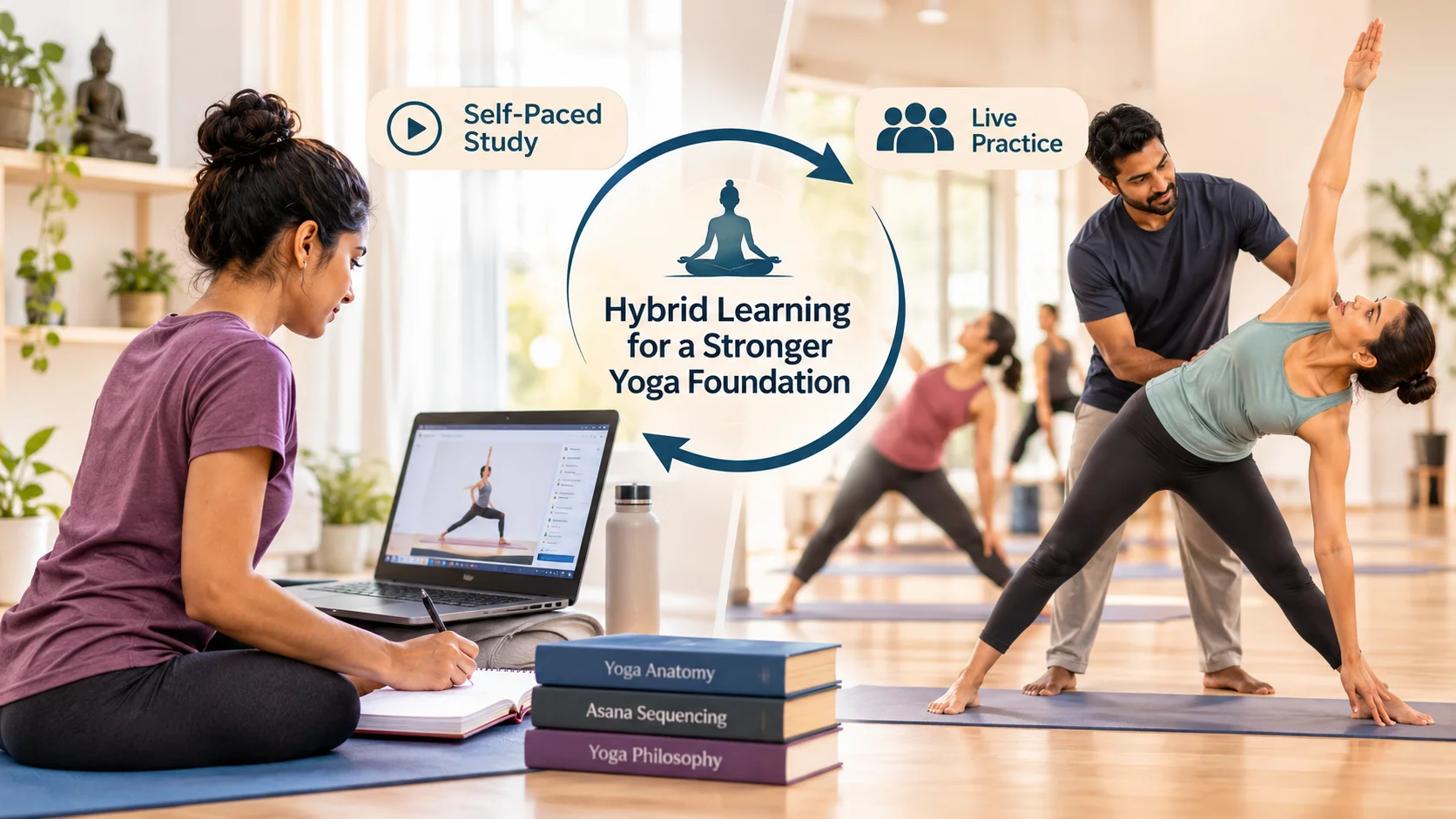
Self-paced study excels at the first kind. Live practice excels at the second. Trouble starts when a program insists one format can do both jobs.
Why a Recording Can Teach You What a Studio Class Rarely Does
A live class moves at the speed of the room. If you did not follow the cue for the transition between Warrior and Triangle, the group is already three breaths ahead. A recorded lesson gives you the opposite experience: you can stop at the exact second that confuses you, replay the alignment explanation four times, and sit with a concept until it clicks.
This matters most for the dense, detail-heavy parts of the subject, such as anatomy of the major joints, contraindications, or the logic behind how poses are grouped. Learners who process slowly, who are working in a second language, or who are fitting study around a job and family often discover that they retain far more when they control the pace.
There is a quieter benefit too. Studying alone removes the social pressure to look like you understand. You can be confused in private, which is usually the fastest route to actually understanding.
What a Live Teacher Catches That You Cannot Feel
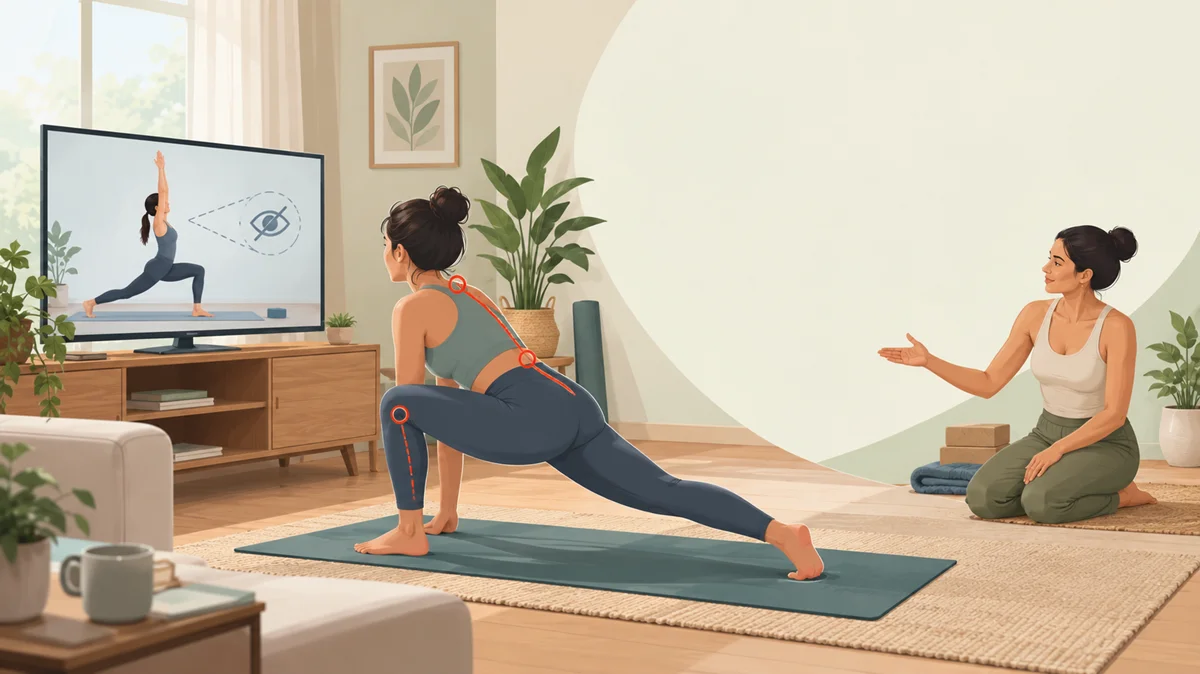
Now the reverse. You can watch a perfect demonstration of Downward-Facing Dog and still round your upper back without knowing it, because your own sense of "straight" is calibrated by your habits, not by reality. A teacher watching you in real time sees the collapsed shoulder, the locked knee, the held breath, and offers a correction small enough to change everything.
Live sessions also train something recorded content cannot: responsiveness. Teaching yoga means adjusting on the fly when a student cannot get into a pose, when someone mentions an injury, or when the energy in the room drops. Practising in front of real people and receiving live feedback is where that skill is built.
And there is accountability. A scheduled session with a teacher expecting you is a different commitment from a video you promise yourself you will watch on Sunday.
A Weekly Rhythm That Makes Both Modes Pay Off
Hybrid learning is not simply "some videos plus some Zoom calls." The version that builds real skill follows a rhythm: learn the idea alone, try it with guidance, then reflect.
In practice that might look like studying a module on spinal extension early in the week, practising the related postures on your own while the explanation is fresh, bringing your questions and your struggles to a live session, and then returning to your notes with a sharper understanding of what you were missing. Each format feeds the other. The recorded material makes live time more productive because you arrive with specific questions instead of blank confusion. The live time makes the recorded material more meaningful because you now know what it feels like in your own body.
Sequencing Is Where the Two Modes Meet
Nowhere does this combination matter more than in building a class. Sequencing looks simple from the student's side of the mat: one pose flows into the next. From the teacher's side it is a layered puzzle. You are managing the order of warming and cooling, the balance of forward and backward bends, the build toward a peak posture, the preparation of vulnerable joints, and the timing of the breath, all while keeping the class safe and coherent.
The theory of that puzzle is ideal for self-paced study. You can analyse sample sequences, ask why a counter-pose follows a particular backbend, and draft your own plans without anyone waiting on you. But the test of a sequence is how it feels when real people move through it, and only live practice and feedback reveal that. A structured yogasana and sequencing course that combines independent study with guided practice lets you design a flow on paper, run it, notice where it stumbles, and refine it, which is the actual process experienced teachers use throughout their careers.
Questions Worth Asking Before You Enrol
Not every program that calls itself hybrid delivers the benefits above, so it is worth looking carefully before committing. A few questions separate a thoughtful design from a repackaged video library:
- Is the live component interactive? Watching a teacher through a screen is not the same as being observed and corrected.
- Is the self-paced material structured? Look for a clear progression, not a pile of unrelated videos.
- Do the two parts reference each other? The best programs connect the recorded lesson to the live practice built around it.
- Is there a way to receive feedback on your own teaching or sequencing? Skill grows through correction, not exposure.
- Will you finish with something you can actually use? A sequence you have designed and tested is worth far more than a certificate that sits in a drawer.
The Foundation Is Built From Both Sides
The debate between studying alone and practising together was always a little false. Yoga has traditionally been passed from teacher to student, but students have always also gone away and worked quietly on what they were shown. Hybrid learning simply gives that old pattern a modern structure.
If you have been leaning on videos alone, add a teacher who can see you. If you have been relying on classes alone, make room for slow, deliberate study. A strong foundation rarely comes from one mode winning. It comes from knowing which kind of learning each moment calls for.

 (1).webp)