Sign up with Google
 Sign in with Zoho

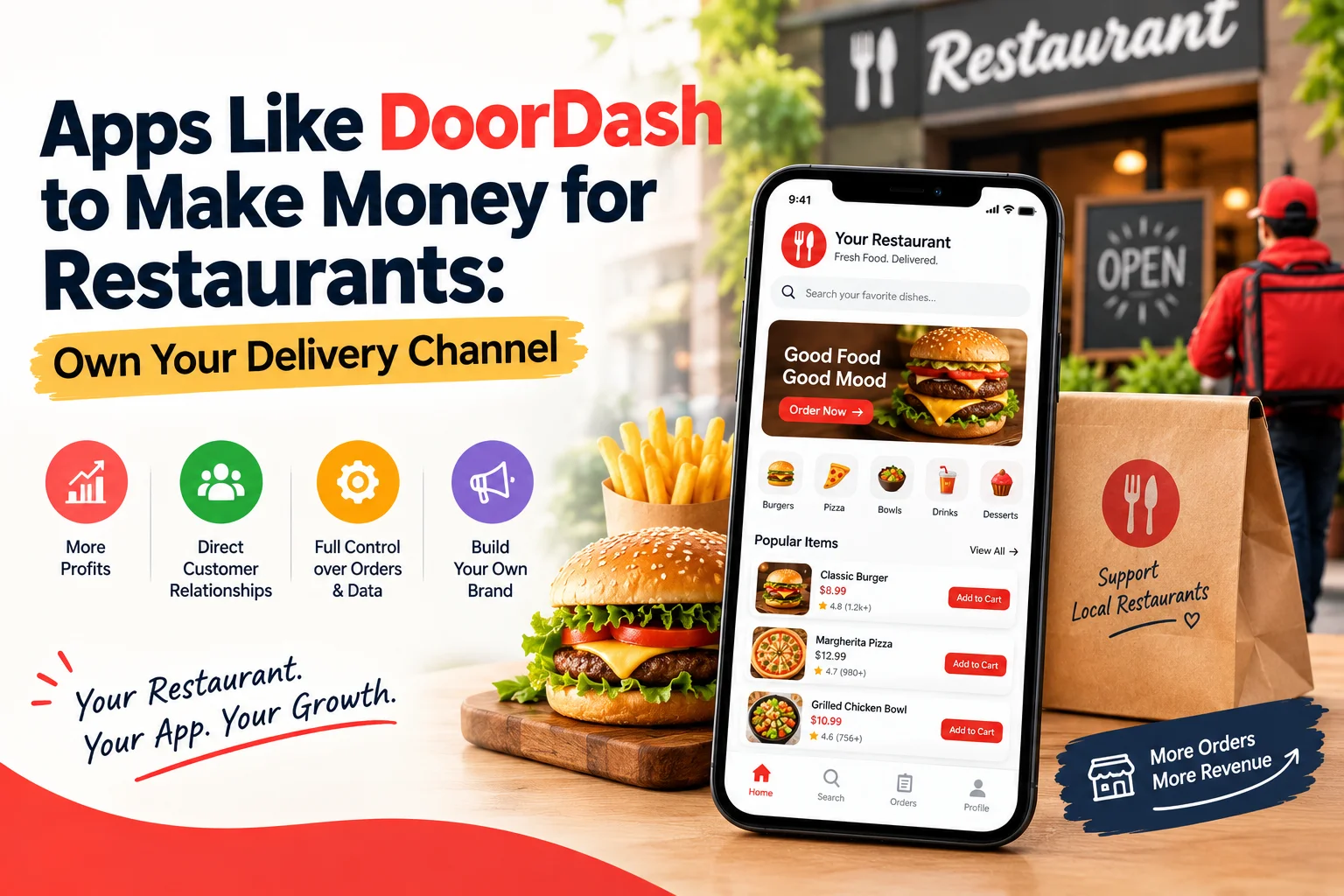
A customer finds your restaurant on a delivery app, places an order, and waits for food to arrive. From the restaurant’s side, the order may look simple.
Behind it, the platform handles discovery, payment processing, driver assignment, customer communication, and sometimes customer support. In return, the restaurant usually pays a commission on each marketplace order. DoorDash describes its marketplace commission as a percentage of the order subtotal, with published plans ranging from 15% to 30% for delivery orders.
That does not mean third-party platforms are bad. They can bring discovery and new customers. But when every order comes through someone else’s app, the restaurant has limited control over the customer relationship, branding, order data, and long-term repeat business.
This is why many restaurants now look at apps like DoorDash not to replace marketplaces immediately, but to build a direct ordering channel alongside them.
What “apps like DoorDash” means
“Apps like DoorDash” can mean different things depending on who is building them.
For a customer, it may mean an app where they browse restaurants, place an order, pay, and track delivery. For a restaurant, it may mean a branded ordering app where customers order directly and the restaurant controls the menu, prices, offers, and customer communication.
A DoorDash-like app is not only a food-delivery app. It is a connected ordering system involving customers, restaurants, drivers or delivery partners, payments, notifications, and operational dashboards.
A direct ordering app may include pickup, delivery, or both. The restaurant can decide whether to use its own drivers, a third-party delivery network, or a combination of both.
Why restaurants want their own channel
Third-party marketplaces can bring new customers, especially when a restaurant is new or does not have a strong online presence. But they are not the only channel a restaurant should rely on.
DoorDash itself explains that direct ordering gives restaurants more control over prices, customer data, order history, loyalty programs, and exclusive offers. It also states that direct orders through a restaurant’s own online-ordering platform are commission-free, though standard payment-processing costs still apply.merchants.
That does not mean a direct app has no cost. The restaurant still pays for development, hosting, payment processing, maintenance, and sometimes delivery fulfillment. The difference is that the restaurant owns the channel rather than paying a marketplace commission on every order.
A direct channel is not a reason to abandon marketplaces. It is a way to reduce dependence on them over time.
The real opportunity: repeat orders
A new customer may discover a restaurant through a delivery marketplace. But the restaurant’s long-term opportunity is turning that customer into a repeat direct customer.
For example, a customer orders once through a marketplace. The restaurant can include a card in the delivery bag inviting the customer to order directly next time for a small discount or loyalty reward. If the customer orders directly the next time, the restaurant keeps more control over the relationship and can send relevant offers later.
This is not about forcing customers to leave a marketplace. It is about giving them a reason to order directly when they already know the restaurant.
A direct channel can support:
- Exclusive app-only offers.
- Loyalty points or rewards.
- Birthday or anniversary offers.
- Email and SMS marketing, where permitted.
- Order history and personalised recommendations.
- Pickup, delivery, and catering options in one place.
The value grows when customers return. One direct order may save a commission, but repeat direct orders can change the economics of the business.
What a DoorDash-like restaurant app needs
A restaurant app should not copy every feature of a large delivery marketplace. It should solve the restaurant’s actual workflow.
For a single restaurant, the priority may be a simple menu, easy checkout, pickup and delivery options, and reliable order updates. For a restaurant group, the priority may include multiple locations, central menu management, reporting, and role-based access.
A useful first version usually includes:
- Menu browsing and item customization.
- Cart, checkout, and payment.
- Pickup and delivery options.
- Order confirmation and status updates.
- Customer accounts and order history.
- Offers, discounts, or loyalty features.
- Restaurant dashboard for orders and menu management.
- Driver or delivery-partner workflow, if the restaurant manages delivery.
The exact scope depends on the business. A cloud kitchen, a single restaurant, and a multi-branch chain do not need identical systems.
Start with the ordering workflow
Before requesting a quote, map the order journey from beginning to end.
A customer opens the app, selects items, customizes an order, pays, and waits for food. What happens if an item becomes unavailable? What happens if the customer wants a refund? What happens if the driver cannot find the address?
These questions matter more than asking for “all DoorDash features.”
A practical exercise is to describe one complete order:
“A customer orders two meals, pays online, chooses delivery, and needs one item replaced because it is unavailable.”
Then ask the developer to explain:
- Who can change the order?
- How the customer approves the replacement.
- How the payment difference is handled.
- What the kitchen sees.
- What the driver sees.
- What appears in the restaurant’s reports.
The answers reveal whether the developer understands the operational workflow, not just the customer interface.
Choose the right development route
Restaurants generally have three options: use a third-party marketplace, use a ready-made ordering platform, or build a custom application.
A marketplace can bring discovery quickly. A ready-made platform can reduce development time. Custom development gives the restaurant more control over workflows, branding, and integrations.
There is no universally correct choice. A small restaurant may begin with a simple direct-ordering website. A multi-branch restaurant may need a custom platform connected to its POS, kitchen operations, and loyalty programme.
When custom development makes sense
Custom development makes sense when the restaurant’s workflow does not fit a standard template.
For example, a restaurant may need separate menus for dine-in, pickup, catering, and delivery. It may need different prices by location, kitchen-level order routing, or integration with an existing loyalty system.
A doordash clone app development company can help translate those requirements into a product brief. But the restaurant should still define its own workflow first. A familiar app model is a starting point, not a complete specification.
Ask the developer to explain:
- Which features would be included in the first release.
- Which integrations are required.
- What would need to be built specifically for the restaurant.
- What could increase the cost?
- What support is included after launch.
A good developer should explain assumptions and exclusions, not only return a price.
Build for the restaurant team
A customer app receives most of the attention, but the restaurant team needs tools too.
Kitchen staff may need a clear order queue. Managers may need to update menu availability. Owners may need reports on sales, popular items, delivery performance, and customer repeat rates.
A useful restaurant dashboard should answer practical questions:
- Which orders are waiting for preparation?
- Which items are unavailable today?
- Which orders are assigned to drivers?
- Which promotions are performing well?
- Which customers are ordering repeatedly?
- Which locations are generating the most revenue?
If the restaurant uses a POS system, ask how the app will connect with it. A disconnected ordering system can create manual work, errors, and delays during busy hours.
Delivery: own drivers or a partner?
A restaurant does not always need to hire its own drivers. It can choose between in-house delivery, a third-party delivery network, or a hybrid approach.
DoorDash Drive On-Demand, for example, allows restaurants to offer delivery through their own app, website, or ordering system while using DoorDash’s Dasher network. DoorDash describes this as a flat per-order fee rather than a marketplace commission percentage.merchants.
That can be useful for a restaurant that wants a branded ordering experience but does not want to manage drivers.
The right choice depends on order volume, delivery area, staffing, and customer expectations. A restaurant should not build an in-house delivery operation before it understands its demand.
Make the direct channel easy to find
Building an app does not automatically bring orders. The restaurant must give customers a reason to use it.
A practical approach is to use marketplaces for discovery while directing existing customers toward the restaurant’s own channel. For example, include a QR code on packaging, promote direct ordering through social media, offer a first direct-order discount, or give loyalty points for app orders.
The goal is not to force customers away from marketplaces. It is to give them a better reason to order directly next time.
A direct channel becomes more valuable when customers can easily find it, place an order without confusion, and receive a consistent experience from browsing to delivery.
Avoid common mistakes
Many restaurant app projects fail because they begin with too many features or too little operational planning.
Avoid these common mistakes:
- Copying every feature from a large delivery marketplace.
- Launching before the menu, pricing, and fulfilment process are ready.
- Ignoring the kitchen and driver workflow.
- Treating the app as a one-time project rather than an ongoing product.
- Not clarifying who owns the code, accounts, and customer data.
- Comparing proposals that include completely different deliverables.
A restaurant should begin with the order journey it can reliably fulfil. Additional features can be added once the basic service is working.
Budget beyond the first release
The cost of a DoorDash-like restaurant app depends on the number of platforms, features, integrations, design complexity, and support requirements. A single-restaurant ordering app may cost less than a multi-restaurant marketplace with driver management and advanced reporting.
Use a budget breakdown rather than comparing only the final number.
A useful budget discussion also separates one-time development costs from recurring costs. Hosting, payment processing, SMS services, maps, cloud storage, and maintenance may continue after launch.
Frequently asked questions
Q1. Should a restaurant stop using DoorDash and other marketplaces?
Not necessarily. Marketplaces can help restaurants reach new customers. A direct ordering channel gives the restaurant more control over branding, customer data, offers, and repeat-order marketing. Many restaurants use both: marketplaces for discovery and a direct channel for regular customers.merchants.
Q2. What features should a restaurant app include at launch?
A practical first version usually includes menu browsing, item customization, cart and checkout, payment, pickup or delivery options, order updates, customer accounts, and a restaurant dashboard. Advanced features such as loyalty programmes, driver management, analytics, and multi-location support can be added once the basic workflow is working.
Q3. How much does it cost to build a DoorDash-like restaurant app?
There is no single price because the cost depends on the number of platforms, features, integrations, design complexity, and support requirements. A single-restaurant ordering app may cost less than a multi-restaurant marketplace with driver management and advanced reporting. Request a project-specific quotation rather than relying on a generic estimate.
A DoorDash-like app can help a restaurant build a direct relationship with its customers. The goal is not simply to copy a large delivery platform. It is to create a reliable ordering channel that the restaurant owns, improves, and uses to bring customers back.

.webp)