Sign up with Google
 Sign in with Zoho

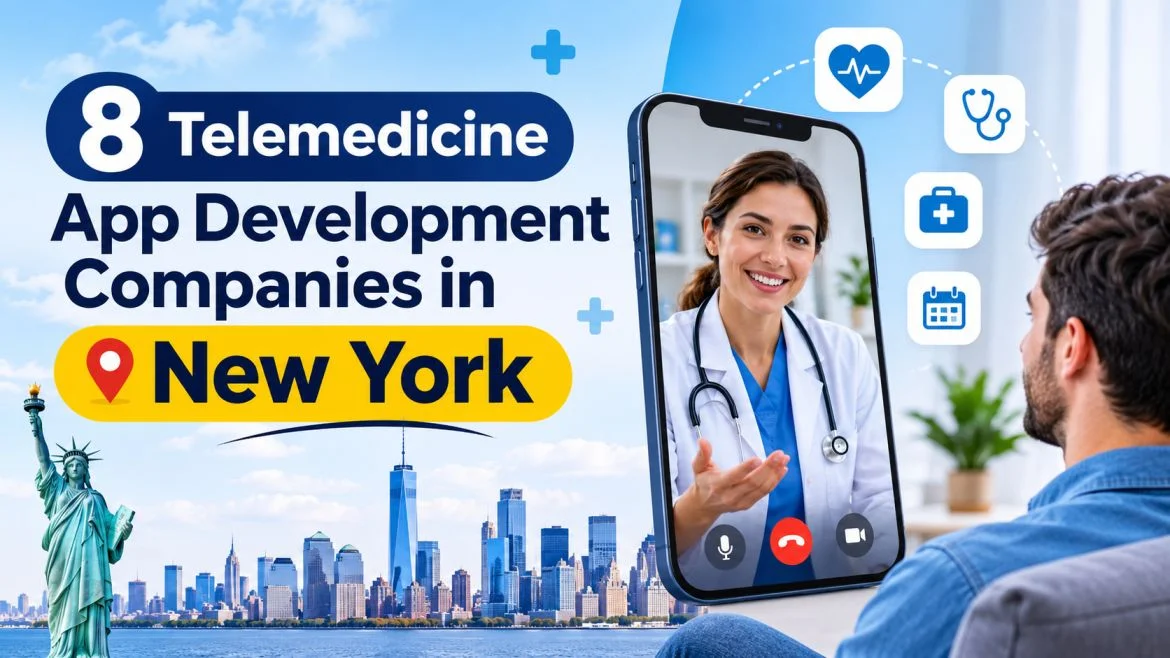
Picture a busy clinic in Manhattan: the front desk is handling walk-ins, a physician is running behind schedule, and three patients are waiting for follow-up consultations that could easily happen over video. This is the gap telemedicine fills but only when the technology actually fits clinical routines.
New York has no shortage of software agencies. What is harder to find is a team that understands what happens after the video call ends: clinical notes, prescriptions, EHR updates, billing, follow-ups, and data privacy. This guide takes a different angle. Instead of listing generic capabilities, it matches eight New York-connected telemedicine development companies to the type of healthcare organization they suit best.
8+ Telemedicine App Development Companies in New York
Each profile below answers one question: who is this company best suited for? Read it as a shortlist exercise, not a ranking of every healthcare software agency in the state.
1. Developer Bazaar Technologies — Best for clinics launching a complete virtual care system
Who it fits: Single clinics, diagnostic centres, and multi-specialty groups that want patient, doctor, and admin tools built as one connected system rather than separate apps stitched together later.
What stands out:
- Video consultations paired with scheduling, secure chat, e-prescriptions, and follow-up reminders in one workflow.
- Options for both single-clinic deployments and multi-specialty virtual care networks.
- Integration paths for EHR systems, payments, notifications, and third-party healthcare tools.
- A customizable build approach, so clinical workflow drives the product instead of the other way around.
Worth noting: For physician groups that want a guided build rather than a generic template, partnering with a dedicated Telemedicine App Development Company early in planning can prevent workflow gaps from appearing after launch.
2. Vention — Best for organizations that want multi-channel patient access
Who it fits: Healthcare providers whose patients need more than one way to reach a care mobile app, web portal, or even voice-based consultation.
What stands out:
- Builds telemedicine across web, mobile, and voice channels from its New York office at 575 Lexington Avenue.
- Designs with staff workload reduction in mind, not only patient-facing features.
- Creates caregiver-inclusive experiences for families managing care on behalf of patients.
- Positions telemedicine as a cost and convenience improvement across the care journey.
3. Arkenea — Best for providers that want healthcare-only expertise
Who it fits: Hospitals, clinics, and healthtech startups that prefer a partner working exclusively in healthcare rather than a generalist app agency.
What stands out:
- More than 14 years spent building exclusively healthcare software.
- HIPAA-compliant telemedicine and patient engagement platforms as a core offering.
- Virtual care systems that connect patients with local specialists and cut wait times.
- Design decisions shaped around New York State telehealth regulations and diverse patient populations.
4. Taction Software — Best for hospitals with existing EHR systems
Who it fits: Established hospitals and clinic networks in New York City that already run EHR/EMR systems and need telehealth to plug into them, not replace them.
What stands out:
- Over 20 years of healthcare IT experience serving NYC providers and research institutions.
- Telehealth platforms covering video visits, scheduling, e-prescriptions, and billing.
- EHR and EMR integrations, with FHIR-based interoperability for data exchange.
- Clinical workflow automation that reduces manual coordination for care teams.
5. Agnotic — Best for compliance-first virtual care launches
Who it fits: New York providers launching virtual care where data privacy and regulatory readiness are non-negotiable from day one.
What stands out:
- Telemedicine platforms with video visits, scheduling, and e-prescribing built in.
- EHR integration is treated as a core part of care continuity, not an add-on.
- Compliance planning around both HIPAA and New York's SHIELD Act.
- A reliability-first approach for providers offering virtual care at scale.
6. Progression Agency — Best for practices and digital health startups
Who it fits: Smaller practices, clinics, and health-adjacent startups that need a practical telehealth product without enterprise-level complexity.
What stands out:
- NYC-headquartered team building telehealth, scheduling, and secure messaging apps.
- Remote patient monitoring and wellness tools offered alongside virtual care.
- Internal clinical tools for teams managing daily operations.
- A client base spanning U.S. and international healthcare organizations.
7. Clarion Tech — Best for providers needing flexible deployment models
Who it fits: Healthcare providers that have specific infrastructure need cloud, on-premise, or hybrid and want a telehealth product built around them.
What stands out:
- Custom telehealth apps across web, Android, iOS, cloud, and hybrid environments.
- U.S. office in White Plains, New York, serving providers domestically and internationally.
- AI specialists available for advanced telemedicine functionality.
- A custom-development model rather than a fixed product template.
8. TechMagic — Best for remote monitoring and chronic care programs
Who it fits: Care teams running chronic disease management, post-surgery recovery, or senior care programs where health data between visits matters as much as the consultation itself.
What stands out:
- Telehealth software built for virtual appointments and remote patient monitoring.
- Real-time health data access for patients through digital platforms.
- Custom telemedicine development instead of standardized off-the-shelf products.
- A New York office at 27 Whitehall Street serving regional healthcare clients.
- Budget is often the first question founders ask, and rightly so.
Comparing the White Label Telemedicine Platform Cost against a custom build helps clinics decide whether to launch fast on a proven base or invest in a platform shaped entirely around their clinical model.
A Different Way to Decide: Match the Company to Your Care Model
Rather than comparing all eight companies on the same features, match them to your care model. This shortcut saves weeks of evaluation.
- Running a single clinic and need everything connected?
- Start with Developer Bazaar Technologies.Patients need phone, web, and app access?
- Vention fits that multi-channel need.Healthcare-only expertise is a must?
- Arkenea is built for that.Already running EHR systems in a hospital?
- Taction Software handles integration-heavy work.Compliance is the top concern?
- Agnotic leads with HIPAA and SHIELD Act readiness.A small practice or startup is launching?
- Progression Agency keeps things practical.Cloud or on-premise deployment flexibility matters?
- Clarion Tech offers that range.Remote monitoring drives your care model?
TechMagic is aligned with that use case.
The Questions Most Founders Forget to Ask
Most telemedicine projects stall not because of missing features, but because of questions nobody asked before development started. Add these to your vendor calls.
- How will a doctor's clinical note reach the EHR after a video visit ends?
- What happens when a patient needs a prescription but the pharmacy system is down?
- How does the platform handle a patient joining from a different state?
- Who owns the audit trail if a data breach investigation happens?
- Can the platform support asynchronous care like photo-based dermatology reviews or video only?
- What does post-launch compliance monitoring look like, not just launch-day compliance?
Real FAQs
Q1.How much should a New York clinic budget for telemedicine development?
Budgets vary widely by scope. A basic video consultation app sits at the lower end, while a full platform with EHR integration, e-prescribing, remote monitoring, billing, and analytics requires a larger investment. White-label options reduce upfront time; custom builds cost more but fit unique clinical workflows better.
Q2.Is HIPAA compliance enough for a New York telemedicine app?
HIPAA is necessary but not always sufficient in New York. The state's SHIELD Act adds data security and breach-notification expectations. A compliant platform should address both, along with secure storage, encrypted communication, access controls, and audit trails.
Q3.Can telemedicine apps integrate with EHR systems like Epic or Cerner?
Yes, through standards like FHIR and HL7. Integration lets providers pull patient history, push clinical notes, and keep virtual and in-person care connected. The complexity depends on the EHR vendor and the provider's existing setup.
Q4.What should a doctor-facing telemedicine app include?
Doctors need more than a video button. Appointment management, patient history access, clinical notes, e-prescribing, follow-up scheduling, secure messaging, and billing support are the practical baseline. Teams planning to develop telemedicine app for doctors should also consider referral management and remote monitoring data views.
Q5.How long does a telemedicine platform take to build?
A simple video-and-scheduling app may take a few months. A complete platform with EHR integration, e-prescriptions, remote monitoring, billing, and multi-role dashboards takes longer, driven mainly by compliance review and integration complexity.