Sign up with Google
 Sign in with Zoho

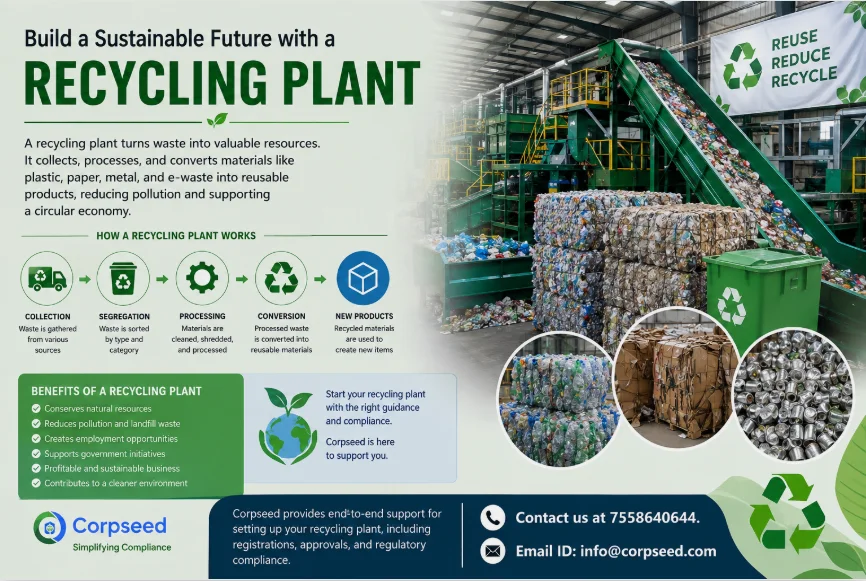
Short on time? Here's the answer: Setting up a plastic recycling plant in India costs between ₹50 lakh and ₹2.5 crore+, depending on your scale of operation. You'll need a Consent to Establish (CTE) and Consent to Operate (CTO) from your State Pollution Control Board, along with CPCB Plastic Waste Processor registration. Most units reach break-even in 18 to 36 months. The biggest shift for 2026 is the Plastic Waste Management (Amendment) Rules, 2026 (notified 31 March 2026), which introduced mandatory recycled-content targets, a shortfall carry-forward system, and stricter EPR certificate audits — changing how recyclers need to plan compliance compared to even last year.
This guide breaks down exactly what changed in 2026, what the plastic recycling business cost in India really looks like, and how the revenue model works — built for people seriously evaluating this as a business, not casually browsing.
What Makes 2026 a Turning Point for Plastic Recyclers
If you set up your recycling unit even a year or two ago, you're now operating under a noticeably different regulatory framework. Three developments matter most:
- The PWM (Amendment) Rules, 2026 (G.S.R. 237(E), notified 31 March 2026) brought in mandatory minimum recycled-content targets for plastic packaging, a formal carry-forward mechanism for producers who fall short, and stricter Registered Environment Auditor review of EPR certificates. This raises demand for legitimate, certificate-issuing recyclers, since producers can no longer paper over compliance gaps as easily.
- Recycled-content mandates are climbing fast. Rigid Category I packaging must hit roughly 40% recycled content for FY 2026–27, rising toward 60–70% in the years ahead, with flexible and multilayered packaging following a slightly gentler but still steep trajectory. This is a structural tailwind for recyclers producing food-grade or near-food-grade resin.
- Mandatory QR/barcode traceability on plastic packaging (via Rule 11 amendments) means the entire supply chain — producer to recycler to certificate — is now far more traceable. That cuts both ways: harder to fake compliance, but easier for genuine recyclers to prove volumes and win business from producers needing a clean audit trail.
Bottom line: demand for EPR certificates isn't softening — the compliance net is tightening, which favors recyclers who register properly from day one over anyone hoping to operate informally.
The Real Money-Maker: What EPR Certificates Are Worth in 2026
This is the number most guides skip — and it's what actually determines your second revenue stream. EPR certificate prices currently trade between roughly ₹4,000 and ₹20,000 per metric tonne, depending on packaging category (rigid, flexible, multilayer) and how tight supply is within that category for the year. Categories facing the steepest target increases tend to command the higher end of the range, as producers scramble to cover shortfalls ahead of the 30 June filing deadline.
On the output side:
- Recycled PET in India traded around US$715–763/MT (roughly ₹60,000–64,000/MT) through the first half of 2026, trending upward on stronger domestic packaging and consumer-goods demand.
- Reprocessed HDPE, PP, and PVC granules sold through B2B marketplaces typically range from ₹38–100 per kg, depending on grade, color, and application — food-contact or near-virgin-quality output commands a significant premium over scrap-grade material.
That spread between low-grade and high-grade output is where most of the real margin in plastic recycling lives. A plant that invests properly in washing and drying (removing contamination) earns considerably more per tonne than one that doesn't — often the difference between selling to a low-value molder versus a packaging producer needing IS 14534:2023-compliant recycled content.
How to Set Up a Plastic Recycling Plant: Step-by-Step
Step 1: Register Your Business and Choose the Right Legal Structure
A Private Limited Company or LLP is generally the smarter choice over a sole proprietorship if you intend to raise institutional financing or scale beyond a single unit — liability separation matters once pollution-control compliance risk enters the picture. You'll need:
- PAN and GST registration
- Municipal trade license
- Factory registration (thresholds vary by state)
- Udyam/MSME registration — unlocks collateral-free loans and priority-sector lending, even though it isn't mandatory
Step 2: Secure Environmental Clearances — Plan for Months, Not Weeks
This is where most first-time operators lose the most time, and 2026's stricter audit environment makes clean paperwork more valuable than ever.
Practical tip: File your CTE before finalizing machinery orders, not after — this sequencing mistake remains the single most common cause of avoidable delay. Both CTE and CTO carry roughly five-year validity and require renewal; missing one doesn't just risk a fine, it can suspend operations entirely while paperwork clears.
Step 3: Design the Plant Around Feedstock Flow, Not Just Machinery
Space for receiving, sorting, washing, shredding, drying, and finished-goods storage matters just as much as the equipment itself. Core machinery includes:
- Sorting conveyors
- Shredders
- Washing/drying systems
- Granulators and extruders
Underpowered or inconsistent equipment shows up later as downgraded, harder-to-sell output. Cutting costs here tends to cost far more over the plant's lifetime than it saves upfront.
Step 4: Build Feedstock Relationships — This Is the Business
This principle held true before 2026 and matters even more now: a plant with mediocre machinery and reliable, clean feedstock will consistently outperform one with premium equipment and inconsistent supply. Build direct relationships with:
- Scrap dealers and waste aggregators
- Urban Local Bodies (ULBs)
- Brand owners who need a compliant, audit-ready recycling partner to meet rising recycled-content obligations
Step 5: Stay Compliant After Launch — Compliance Doesn't End at Commissioning
Ongoing obligations include worker safety protocols, periodic pollution board inspections, effluent/emission monitoring, and CTE/CTO renewals. Under the 2026 amendment, expect closer Registered Environment Auditor scrutiny of every certificate you issue — sloppy record-keeping now has a much more direct path to triggering a compliance flag.
Plastic Recycling Plant Cost in India: 2026 Breakdown
Smart entry point: A pilot-scale recycling unit is genuinely the wiser move for most first-time operators — it lets you build buyer relationships and prove feedstock reliability before committing capital to a larger facility.
Is a Plastic Recycling Business Profitable in 2026?
Yes — with caveats. Profitability tracks feedstock consistency and output quality far more than plant size. Two revenue lines drive the business:
- Selling recycled flakes and pellets
- Selling EPR certificates to producers who need them
With recycled PET prices trending upward through 2026 and recycled-content mandates tightening through FY 2026–27 and beyond, the demand backdrop is genuinely improving — but that demand rewards recyclers who can document clean, compliant volumes, not simply the lowest-cost operators.
Most operators should plan for 18–36 months to reach steady profitability — longer if working capital is tight or feedstock supply is unreliable in year one.
Frequently Asked Questions: Plastic Recycling Plant in India
1) Is a plastic recycling business profitable in India in 2026?
Yes, generally — profitability depends on feedstock consistency, output quality, and how efficiently you capture EPR certificate revenue, which has become a larger share of total income as recycled-content mandates tighten.
2) What licenses are mandatory to start a plastic recycling plant?
Business and GST registration, Consent to Establish and Consent to Operate from your State Pollution Control Board, CPCB Plastic Waste Processor registration on the centralized EPR portal, and applicable municipal/fire-safety clearances.
3) What changed under the Plastic Waste Management (Amendment) Rules, 2026? Mandatory recycled-content targets for plastic packaging, a formal carry-forward mechanism for shortfalls, and stricter audit and certificate-verification requirements — notified 31 March 2026 (G.S.R. 237(E)).
4) How much are EPR certificates worth right now?
Roughly ₹4,000–₹20,000 per metric tonne, depending on packaging category and how tight that category's target is for the year.
5) How long does environmental approval take?
Typically 4–8 weeks per approval with complete documentation; incomplete filings remain the most common cause of delay.
Can I start small with limited capital? Yes — a pilot-scale unit is a practical way to test operations and prove feedstock relationships before scaling into a larger facility.
Final Takeaway: Why 2026 Favors the Prepared Recycler
The rules changed meaningfully in 2026 — and in a direction that favors properly registered, compliance-ready recyclers over informal operators. The fundamentals haven't changed: feedstock relationships and environmental compliance remain the real foundation of this business, not administrative afterthoughts. But the 2026 amendment adds a genuine tailwind — rising recycled-content mandates mean structurally rising demand for exactly what a well-run plastic recycling plant produces.
This guide is for general informational purposes. Confirm current fee schedules, timelines, and category-specific targets with your State Pollution Control Board, the CPCB centralized EPR portal, and a qualified compliance consultant before proceeding — rules and deadlines continue to be updated through 2026.
Sources referenced: CPCB centralized EPR portal notifications; Plastic Waste Management (Amendment) Rules, 2026 (G.S.R. 237(E), MoEFCC, 31 March 2026); recycled PET pricing data (IMARC Group, Q1–Q2 2026); Indian recycled granule marketplace pricing (IndiaMART, July 2026); industry EPR compliance guides (GreenSutra, Corporate Professionals, Afleo, Gravita India, Avi Group, Seyecs — 2026 editions).