Sign up with Google
 Sign in with Zoho
Five years ago, that same hospital probably depended entirely on tanker deliveries from a regional supplier. That shift — hospitals, and increasingly factories, choosing to make their own oxygen Plant rather than buy it — is what's pulling new entrepreneurs into this business.
If you're weighing whether to get in, here's a grounded look at what the venture actually involves: the technology choices, realistic costs, the paperwork nobody enjoys, and where the real risks sit.
Why Oxygen Demand Isn't Slowing Down
Two very different markets pull on the same gas. Hospitals and nursing homes need medical-grade oxygen for patient care — a need that only grows as India adds hospital beds and ICU capacity. Separately, steel mills, glass manufacturers, chemical plants, and metal fabrication workshops need industrial oxygen for cutting, welding, and processing.
These two markets don't behave the same way. Medical oxygen demand is relatively steady and recession-resistant; industrial demand tracks manufacturing activity more closely. A plant that can serve both segments has more resilience built in, though — as you'll see below — serving both isn't quite as simple as flipping a switch.
Picking a Technology: PSA, Cryogenic, or Membrane
Pressure Swing Adsorption (PSA) is where most new entrants start. Zeolite beds strip nitrogen out of compressed air, leaving concentrated oxygen behind. It's a mature, well-understood process, the equipment footprint is manageable, and it scales down to sizes that make sense for a single hospital or a small industrial cluster.
Cryogenic separation is the heavyweight option — air is chilled to the point where its components liquefy at different temperatures and can be separated by distillation. This is what large steel plants and big merchant gas suppliers use. The output purity and volume are excellent, but so is the price tag, and these plants aren't something a first-time operator builds on a shoestring.
Membrane separation exists but hasn't gained much traction in India's commercial oxygen space — it tends to produce lower-purity oxygen, which limits it to niche applications.
For a first venture, PSA is almost always the sensible starting point. You can always add cryogenic capacity later if demand justifies it.
What It Actually Costs
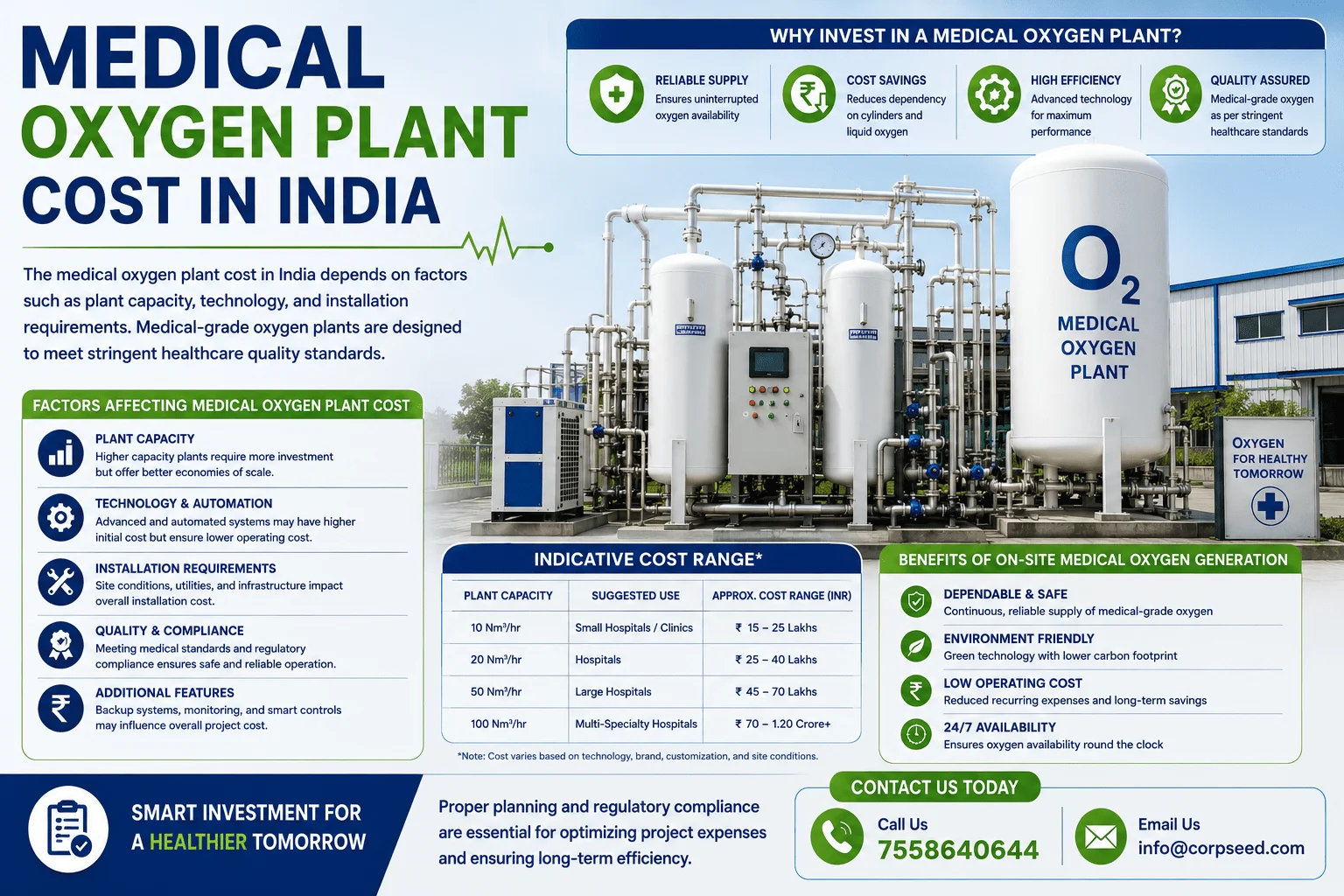
Numbers here move around a lot depending on capacity, automation level, and region, but as a rough planning guide:
Two things trip up first-time planners on cost. First, the machinery quote is never the whole story — land or shed preparation, three-phase power connections, air compressors, storage tanks, cylinder-filling stations, and safety systems (fire suppression, gas leak detection) all add up separately. Second, medical-grade certification adds cost that a purely industrial plant doesn't carry — extra testing equipment, tighter quality control, and validation runs before you can legally sell to a hospital.
Get quotes from at least three manufacturers, and weight after-sales support and spare-parts availability as heavily as the sticker price. A cheaper plant that sits idle for two weeks waiting on a part from another state costs you more than it saved.
The Licensing Maze — and Why It's the Real Bottleneck
This is where most delays happen, and it's worth understanding why the process is so layered: oxygen sits at the intersection of drug regulation, factory safety law, environmental law, and explosives/pressure-vessel safety law, so you're dealing with several regulators who don't necessarily talk to each other.
- Drug License (State Drug Control Department) — mandatory the moment you intend to sell medical-grade oxygen, because oxygen for human use is legally a drug.
- Factory License (state Directorate of Factories) — standard for any manufacturing unit above a certain size.
- Consent to Establish / Consent to Operate (State Pollution Control Board) — required even though oxygen production is relatively clean, because it's still a regulated industrial process.
- PESO license (Petroleum and Explosives Safety Organisation) — covers the storage and handling of compressed gas cylinders. This applies regardless of plant size; a small hospital-scale unit still needs it.
- Fire NOC — compressed oxygen is a serious fire-intensification risk, so local fire authorities inspect and sign off separately.
- GST registration, and Udyam/MSME registration if you want access to government schemes or collateral-free MSME loans.
Realistically, budget a few weeks to a few months for this stack, and expect it to run in parallel with plant construction rather than after it — start the applications as soon as your site and technology are locked in, not after the equipment arrives.
Many operators bring in a compliance consultant specifically for the drug license and pollution board approvals, since these two tend to have the most state-by-state variation in documentation requirements.
A Realistic Setup Sequence
- Study your local demand honestly. Talk to hospital procurement heads and industrial buyers before committing capital — don't assume demand from national statistics alone.
- Lock technology and capacity together. Undersizing means you're back to buying supplemental oxygen during demand spikes; oversizing ties up capital in idle capacity.
- Scout locations for infrastructure, not just land price. Reliable power and water access matter more than a cheap plot far from both.
- Line up financing early, including MSME-specific schemes if you qualify — approval timelines for these can be as long as the plant construction itself.
- File every license application in parallel, not sequentially.
- Commission with your manufacturer present, and don't skip the testing/calibration phase even if you're eager to start selling.
- Validate medical-grade output against pharmacopoeia purity standards before your first hospital sale — this isn't optional and it isn't fast.
- Build distribution relationships before you're at full output, so you're not sitting on stored oxygen with nowhere to send it.
Mistakes Worth Avoiding
A few patterns show up repeatedly among first-time operators who struggle:
- Treating medical and industrial oxygen as interchangeable. They aren't — medical-grade requires separate certification and often a separate production line or rigorous batch testing, even if the underlying PSA technology is identical.
- Underestimating the PESO timeline. Because it applies at every scale, small operators sometimes assume it's a formality. It isn't — inspections and documentation take real time.
- Choosing a manufacturer purely on upfront price. Spare parts, service response time, and warranty terms matter more over a five-year horizon than a 5–10% difference in initial cost.
- Skipping the local demand study. National growth statistics for oxygen demand don't guarantee that your district has an unmet gap — sometimes it's already well served by an existing supplier.
Is It Actually Profitable?
Directionally, yes — steady institutional demand from healthcare and a growing industrial base support the case, particularly in regions that currently depend on oxygen trucked in from elsewhere. But profitability isn't automatic. It depends on running the plant near capacity, keeping quality consistent enough that hospitals trust you as a regular supplier, and controlling the compliance overhead rather than letting it eat into margins. Plants that treat licensing and quality systems as ongoing operational discipline — not a one-time hurdle to clear at launch — tend to be the ones still running profitably five years in.
This article is for general informational purposes and isn't a substitute for advice from a licensed consultant familiar with your state's specific regulatory requirements.